{"title":"A nonautonomous model for the interaction between a size-structured consumer and an unstructured resource.","authors":"Zhuxin Ni, Qihua Huang","doi":"10.1007/s00285-024-02071-2","DOIUrl":null,"url":null,"abstract":"<p><p>In this paper, we propose and analyze a nonautonomous model that describes the dynamics of a size-structured consumer interacting with an unstructured resource. We prove the existence and uniqueness of the solution of the model using the monotone method based on a comparison principle. We derive conditions on the model parameters that result in persistence and extinction of the population via the upper-lower solution technique. We verify and complement the theoretical results through numerical simulations.</p>","PeriodicalId":50148,"journal":{"name":"Journal of Mathematical Biology","volume":"88 5","pages":"49"},"PeriodicalIF":2.3000,"publicationDate":"2024-03-28","publicationTypes":"Journal Article","fieldsOfStudy":null,"isOpenAccess":false,"openAccessPdf":"","citationCount":"0","resultStr":null,"platform":"Semanticscholar","paperid":null,"PeriodicalName":"Journal of Mathematical Biology","FirstCategoryId":"100","ListUrlMain":"https://doi.org/10.1007/s00285-024-02071-2","RegionNum":4,"RegionCategory":"数学","ArticlePicture":[],"TitleCN":null,"AbstractTextCN":null,"PMCID":null,"EPubDate":"","PubModel":"","JCR":"Q2","JCRName":"BIOLOGY","Score":null,"Total":0}
引用次数: 0
Abstract
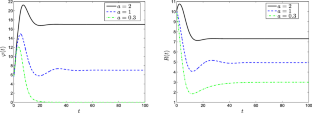
In this paper, we propose and analyze a nonautonomous model that describes the dynamics of a size-structured consumer interacting with an unstructured resource. We prove the existence and uniqueness of the solution of the model using the monotone method based on a comparison principle. We derive conditions on the model parameters that result in persistence and extinction of the population via the upper-lower solution technique. We verify and complement the theoretical results through numerical simulations.
期刊介绍:
The Journal of Mathematical Biology focuses on mathematical biology - work that uses mathematical approaches to gain biological understanding or explain biological phenomena.
Areas of biology covered include, but are not restricted to, cell biology, physiology, development, neurobiology, genetics and population genetics, population biology, ecology, behavioural biology, evolution, epidemiology, immunology, molecular biology, biofluids, DNA and protein structure and function. All mathematical approaches including computational and visualization approaches are appropriate.



 京公网安备 11010802042870号
京ICP备2023020795号-1
京公网安备 11010802042870号
京ICP备2023020795号-1

 分享
分享
 求助内容:
求助内容: 应助结果提醒方式:
 扫码关注我们
