Mirko A R Aguilera, Américo C Bortolazzo, Lourenço Correr-Sobrinho, Rafael L X Consani
{"title":"Surface treatments of the zirconia-reinforced lithium disilicate ceramic in the adhesion to the resin cement.","authors":"Mirko A R Aguilera, Américo C Bortolazzo, Lourenço Correr-Sobrinho, Rafael L X Consani","doi":"10.1590/0103-6440202405674","DOIUrl":null,"url":null,"abstract":"<p><p>This study verified the effect of surface treatments of the zirconia-reinforced lithium disilicate ceramic bonded to resin cement. Ceramic blocks were divided according to treatments (n=10): FA+SRX (Fluoric acid + silane RX), FA+MDP (Fluoric acid + MDP), FA+SCF+MDP (Fluoric acid + silane CF + MDP), FA+MEP (Fluoric acid + MEP), and MEP (Self-etch primer). Resin cement cylinders were made in the ceramic blocks, photoactivated with 1,200 mW/cm² for 40s, stored in water at 37°C for 24h, and evaluated by the microshear strength test, optical failure descriptive analysis (%), surface characterization (SEM) and contact angle (Goniometer). Other samples were submitted to 10,000 thermocycles between 5°C and 55°C. Bond strength data were submitted to two-way ANOVA and Tukey's test. Contact angle to one-way ANOVA and Games-Howell's test (5%). At 24h, MEP showed higher bond strength, and FA+SRX the lower. FA+MDP and FA+SCF+MDP showed similar values and FA+MEP was intermediate. After thermocycling, FA+SCF+MDP, FA+MEP, and MEP showed higher values, and FA+SRX the lower while FA+MDP was intermediate. When the periods were compared, FA+MDP, FA+SCF+MDP, FA+MEP, and MEP showed higher values for 24h while FA+SRX was similar. SEM showed retentive surface and crystal exposure when treated with FA+SCF+MDP. The less retentive surface was obtained with MEP, and the other treatments promoted intermediate irregularities. In conclusion, surface treatment and thermocycling promoted different values of adhesive strength and contact angle in a zirconia-reinforced lithium silicate ceramic. Failures were predominantly adhesive, and the ceramic surface was characterized by different levels of roughness and selective exposure of crystals.</p>","PeriodicalId":101363,"journal":{"name":"Brazilian dental journal","volume":"35 ","pages":"e245674"},"PeriodicalIF":0.0000,"publicationDate":"2024-03-22","publicationTypes":"Journal Article","fieldsOfStudy":null,"isOpenAccess":false,"openAccessPdf":"https://www.ncbi.nlm.nih.gov/pmc/articles/PMC10976312/pdf/","citationCount":"0","resultStr":null,"platform":"Semanticscholar","paperid":null,"PeriodicalName":"Brazilian dental journal","FirstCategoryId":"1085","ListUrlMain":"https://doi.org/10.1590/0103-6440202405674","RegionNum":0,"RegionCategory":null,"ArticlePicture":[],"TitleCN":null,"AbstractTextCN":null,"PMCID":null,"EPubDate":"2024/1/1 0:00:00","PubModel":"eCollection","JCR":"","JCRName":"","Score":null,"Total":0}
引用次数: 0
Abstract
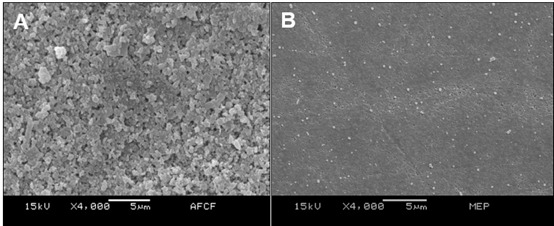
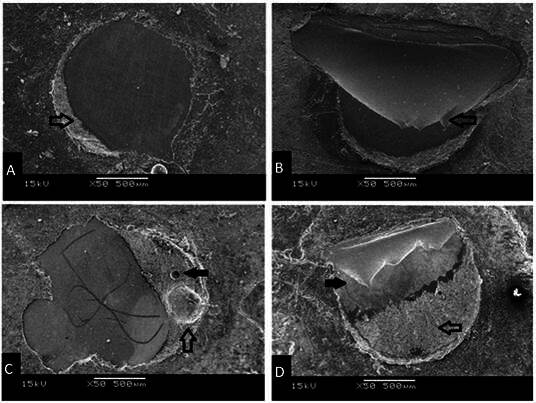
This study verified the effect of surface treatments of the zirconia-reinforced lithium disilicate ceramic bonded to resin cement. Ceramic blocks were divided according to treatments (n=10): FA+SRX (Fluoric acid + silane RX), FA+MDP (Fluoric acid + MDP), FA+SCF+MDP (Fluoric acid + silane CF + MDP), FA+MEP (Fluoric acid + MEP), and MEP (Self-etch primer). Resin cement cylinders were made in the ceramic blocks, photoactivated with 1,200 mW/cm² for 40s, stored in water at 37°C for 24h, and evaluated by the microshear strength test, optical failure descriptive analysis (%), surface characterization (SEM) and contact angle (Goniometer). Other samples were submitted to 10,000 thermocycles between 5°C and 55°C. Bond strength data were submitted to two-way ANOVA and Tukey's test. Contact angle to one-way ANOVA and Games-Howell's test (5%). At 24h, MEP showed higher bond strength, and FA+SRX the lower. FA+MDP and FA+SCF+MDP showed similar values and FA+MEP was intermediate. After thermocycling, FA+SCF+MDP, FA+MEP, and MEP showed higher values, and FA+SRX the lower while FA+MDP was intermediate. When the periods were compared, FA+MDP, FA+SCF+MDP, FA+MEP, and MEP showed higher values for 24h while FA+SRX was similar. SEM showed retentive surface and crystal exposure when treated with FA+SCF+MDP. The less retentive surface was obtained with MEP, and the other treatments promoted intermediate irregularities. In conclusion, surface treatment and thermocycling promoted different values of adhesive strength and contact angle in a zirconia-reinforced lithium silicate ceramic. Failures were predominantly adhesive, and the ceramic surface was characterized by different levels of roughness and selective exposure of crystals.



 京公网安备 11010802042870号
京ICP备2023020795号-1
京公网安备 11010802042870号
京ICP备2023020795号-1

 分享
分享

 求助内容:
求助内容: 应助结果提醒方式:
 扫码关注我们
