Ramesh K. Pandey, Satya P. Yadav, K. Muthamizh Selvan, Lakshminarayanan Natarajan, Parag Nigam
{"title":"Elephant conservation in India: Striking a balance between coexistence and conflicts","authors":"Ramesh K. Pandey, Satya P. Yadav, K. Muthamizh Selvan, Lakshminarayanan Natarajan, Parag Nigam","doi":"10.1002/inc3.38","DOIUrl":null,"url":null,"abstract":"<p>In the human-dominated epoch of the Anthropocene, nations worldwide are trying to adopt a variety of strategies for biodiversity conservation, including flagship-based approaches. The Asian elephant (<i>Elephas maximus</i>) plays a pivotal role as a flagship species in India's biodiversity conservation efforts, particularly within its tropical forest ecosystems. As the country harboring the largest Asian elephant population among the 13 range countries, India's conservation strategies offer valuable insights for other range countries. This study elucidates India's elephant conservation paradigm by outlining a historical account of elephant conservation in the country and examining the current administrative and legal frameworks. These are instrumental in implementing strategies aimed at maintaining sustainable elephant populations. Our study also analyzes trends in elephant populations and negative human–elephant interactions, drawing upon data from a centralized government database. Our findings indicate that the elephant population in India is reasonably stable, estimated at between 25,000 and 30,000 individuals. This figure constitutes nearly two-thirds of the global Asian elephant population. India's elephant population occupies ~163,000 km<sup>2</sup> of diverse habitats, comprising 5% of the country's land area, with their distribution spread across the northern, northeastern, east-central, and southern regions. This distribution has shown fluxes, particularly in the east-central region, where large-scale elephant dispersals have been observed. Between 2009 and 2020, human–elephant conflicts in India have resulted in an average annual loss of 450 (±63.7) human lives. During the same period, the central and state governments paid an average of US$ 4.79 million (±1.97) annually as ex gratia for property losses. Recognizing the critical nature of these conflicts, India has implemented various measures to manage this pressing conservation challenge. Overall, sustaining the world's largest extant population of wild elephants in the midst of India's human-dominated landscapes is enabled by a robust institutional policy and legal framework dedicated to conservation. This commitment is further reinforced by strong political will and a deep-rooted cultural affinity towards elephants and nature, which fosters a higher degree of tolerance and support for conservation efforts.</p>","PeriodicalId":100680,"journal":{"name":"Integrative Conservation","volume":"3 1","pages":"1-11"},"PeriodicalIF":0.0000,"publicationDate":"2024-02-25","publicationTypes":"Journal Article","fieldsOfStudy":null,"isOpenAccess":false,"openAccessPdf":"https://onlinelibrary.wiley.com/doi/epdf/10.1002/inc3.38","citationCount":"0","resultStr":null,"platform":"Semanticscholar","paperid":null,"PeriodicalName":"Integrative Conservation","FirstCategoryId":"1085","ListUrlMain":"https://onlinelibrary.wiley.com/doi/10.1002/inc3.38","RegionNum":0,"RegionCategory":null,"ArticlePicture":[],"TitleCN":null,"AbstractTextCN":null,"PMCID":null,"EPubDate":"","PubModel":"","JCR":"","JCRName":"","Score":null,"Total":0}
引用次数: 0
Abstract
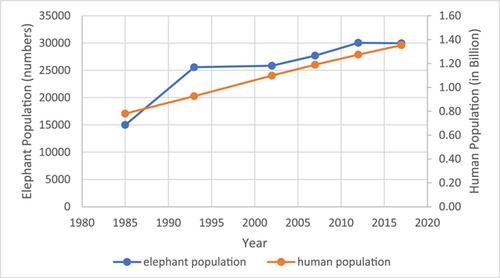
In the human-dominated epoch of the Anthropocene, nations worldwide are trying to adopt a variety of strategies for biodiversity conservation, including flagship-based approaches. The Asian elephant (Elephas maximus) plays a pivotal role as a flagship species in India's biodiversity conservation efforts, particularly within its tropical forest ecosystems. As the country harboring the largest Asian elephant population among the 13 range countries, India's conservation strategies offer valuable insights for other range countries. This study elucidates India's elephant conservation paradigm by outlining a historical account of elephant conservation in the country and examining the current administrative and legal frameworks. These are instrumental in implementing strategies aimed at maintaining sustainable elephant populations. Our study also analyzes trends in elephant populations and negative human–elephant interactions, drawing upon data from a centralized government database. Our findings indicate that the elephant population in India is reasonably stable, estimated at between 25,000 and 30,000 individuals. This figure constitutes nearly two-thirds of the global Asian elephant population. India's elephant population occupies ~163,000 km2 of diverse habitats, comprising 5% of the country's land area, with their distribution spread across the northern, northeastern, east-central, and southern regions. This distribution has shown fluxes, particularly in the east-central region, where large-scale elephant dispersals have been observed. Between 2009 and 2020, human–elephant conflicts in India have resulted in an average annual loss of 450 (±63.7) human lives. During the same period, the central and state governments paid an average of US$ 4.79 million (±1.97) annually as ex gratia for property losses. Recognizing the critical nature of these conflicts, India has implemented various measures to manage this pressing conservation challenge. Overall, sustaining the world's largest extant population of wild elephants in the midst of India's human-dominated landscapes is enabled by a robust institutional policy and legal framework dedicated to conservation. This commitment is further reinforced by strong political will and a deep-rooted cultural affinity towards elephants and nature, which fosters a higher degree of tolerance and support for conservation efforts.



 京公网安备 11010802042870号
京ICP备2023020795号-1
京公网安备 11010802042870号
京ICP备2023020795号-1

 分享
分享

 求助内容:
求助内容: 应助结果提醒方式:
 扫码关注我们
