Richard Robertson, Athanasios Petsakos, Chun Song, Nicola Cenacchi, Elisabetta Gotor
{"title":"“Fruit basket upset”: spatially explicit crop mixture responses to climatic and economic pressures","authors":"Richard Robertson, Athanasios Petsakos, Chun Song, Nicola Cenacchi, Elisabetta Gotor","doi":"10.1108/caer-04-2023-0098","DOIUrl":null,"url":null,"abstract":"PurposeThe choice of crops to produce at a location depends to a large degree on the climate. As the climate changes and food demand evolves, farmers may need to produce a different mix of crops. This study assesses how much cropland may be subject to such upheavals at the global scale, and then focuses on China as a case study to examine how spatial heterogeneity informs different contexts for adaptation within a country.Design/methodology/approachA global agricultural economic model is linked to a cropland allocation algorithm to generate maps of cropland distribution under historical and future conditions. The mix of crops at each location is examined to determine whether it is likely to experience a major shift.FindingsTwo-thirds of rainfed cropland and half of irrigated cropland are likely to experience substantial upheaval of some kind.Originality/valueThis analysis helps establish a global context for the local changes that producers might face under future climate and socioeconomic changes. The scale of the challenge means that the agricultural sector needs to prepare for these widespread and diverse upheavals.","PeriodicalId":4,"journal":{"name":"ACS Applied Energy Materials","volume":"188 ","pages":""},"PeriodicalIF":5.5000,"publicationDate":"2024-02-20","publicationTypes":"Journal Article","fieldsOfStudy":null,"isOpenAccess":false,"openAccessPdf":"","citationCount":"0","resultStr":null,"platform":"Semanticscholar","paperid":null,"PeriodicalName":"ACS Applied Energy Materials","FirstCategoryId":"96","ListUrlMain":"https://doi.org/10.1108/caer-04-2023-0098","RegionNum":3,"RegionCategory":"材料科学","ArticlePicture":[],"TitleCN":null,"AbstractTextCN":null,"PMCID":null,"EPubDate":"","PubModel":"","JCR":"Q2","JCRName":"CHEMISTRY, PHYSICAL","Score":null,"Total":0}
引用次数: 0
Abstract
PurposeThe choice of crops to produce at a location depends to a large degree on the climate. As the climate changes and food demand evolves, farmers may need to produce a different mix of crops. This study assesses how much cropland may be subject to such upheavals at the global scale, and then focuses on China as a case study to examine how spatial heterogeneity informs different contexts for adaptation within a country.Design/methodology/approachA global agricultural economic model is linked to a cropland allocation algorithm to generate maps of cropland distribution under historical and future conditions. The mix of crops at each location is examined to determine whether it is likely to experience a major shift.FindingsTwo-thirds of rainfed cropland and half of irrigated cropland are likely to experience substantial upheaval of some kind.Originality/valueThis analysis helps establish a global context for the local changes that producers might face under future climate and socioeconomic changes. The scale of the challenge means that the agricultural sector needs to prepare for these widespread and diverse upheavals.
期刊介绍:
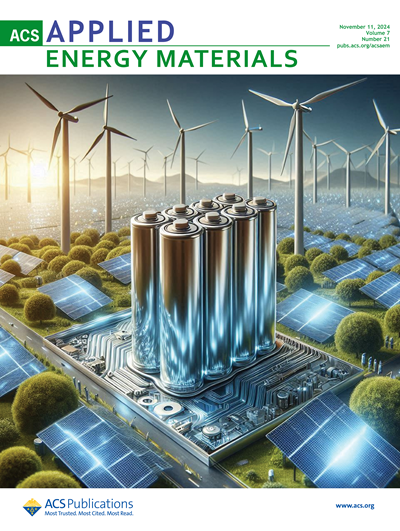
ACS Applied Energy Materials is an interdisciplinary journal publishing original research covering all aspects of materials, engineering, chemistry, physics and biology relevant to energy conversion and storage. The journal is devoted to reports of new and original experimental and theoretical research of an applied nature that integrate knowledge in the areas of materials, engineering, physics, bioscience, and chemistry into important energy applications.



 京公网安备 11010802042870号
京ICP备2023020795号-1
京公网安备 11010802042870号
京ICP备2023020795号-1

 分享
分享
 求助内容:
求助内容: 应助结果提醒方式:
 扫码关注我们
