{"title":"Metric-Free Learning Network with Dual Relations Propagation for Few-Shot Aspect Category Sentiment Analysis","authors":"Shiman Zhao, Yutao Xie, Wei Chen, Tengjiao Wang, Jiahui Yao, Jiabin Zheng","doi":"10.1162/tacl_a_00635","DOIUrl":null,"url":null,"abstract":"Abstract Few-shot Aspect Category Sentiment Analysis (ACSA) is a crucial task for aspect-based sentiment analysis, which aims to detect sentiment polarity for a given aspect category in a sentence with limited data. However, few-shot learning methods focus on distance metrics between the query and support sets to classify queries, heavily relying on aspect distributions in the embedding space. Thus, they suffer from overlapping distributions of aspect embeddings caused by irrelevant sentiment noise among sentences with multiple sentiment aspects, leading to misclassifications. To solve the above issues, we propose a metric-free method for few-shot ACSA, which models the associated relations among the aspects of support and query sentences by Dual Relations Propagation (DRP), addressing the passive effect of overlapping distributions. Specifically, DRP uses the dual relations (similarity and diversity) among the aspects of support and query sentences to explore intra-cluster commonality and inter-cluster uniqueness for alleviating sentiment noise and enhancing aspect features. Additionally, the dual relations are transformed from support-query to class-query to promote query inference by learning class knowledge. Experiments show that we achieve convincing performance on few-shot ACSA, especially an average improvement of 2.93% accuracy and 2.10% F1 score in the 3-way 1-shot setting.","PeriodicalId":4,"journal":{"name":"ACS Applied Energy Materials","volume":"15 6","pages":"100-119"},"PeriodicalIF":5.5000,"publicationDate":"2024-01-01","publicationTypes":"Journal Article","fieldsOfStudy":null,"isOpenAccess":false,"openAccessPdf":"","citationCount":"0","resultStr":null,"platform":"Semanticscholar","paperid":null,"PeriodicalName":"ACS Applied Energy Materials","FirstCategoryId":"98","ListUrlMain":"https://doi.org/10.1162/tacl_a_00635","RegionNum":3,"RegionCategory":"材料科学","ArticlePicture":[],"TitleCN":null,"AbstractTextCN":null,"PMCID":null,"EPubDate":"","PubModel":"","JCR":"Q2","JCRName":"CHEMISTRY, PHYSICAL","Score":null,"Total":0}
引用次数: 0
Abstract
Abstract Few-shot Aspect Category Sentiment Analysis (ACSA) is a crucial task for aspect-based sentiment analysis, which aims to detect sentiment polarity for a given aspect category in a sentence with limited data. However, few-shot learning methods focus on distance metrics between the query and support sets to classify queries, heavily relying on aspect distributions in the embedding space. Thus, they suffer from overlapping distributions of aspect embeddings caused by irrelevant sentiment noise among sentences with multiple sentiment aspects, leading to misclassifications. To solve the above issues, we propose a metric-free method for few-shot ACSA, which models the associated relations among the aspects of support and query sentences by Dual Relations Propagation (DRP), addressing the passive effect of overlapping distributions. Specifically, DRP uses the dual relations (similarity and diversity) among the aspects of support and query sentences to explore intra-cluster commonality and inter-cluster uniqueness for alleviating sentiment noise and enhancing aspect features. Additionally, the dual relations are transformed from support-query to class-query to promote query inference by learning class knowledge. Experiments show that we achieve convincing performance on few-shot ACSA, especially an average improvement of 2.93% accuracy and 2.10% F1 score in the 3-way 1-shot setting.
期刊介绍:
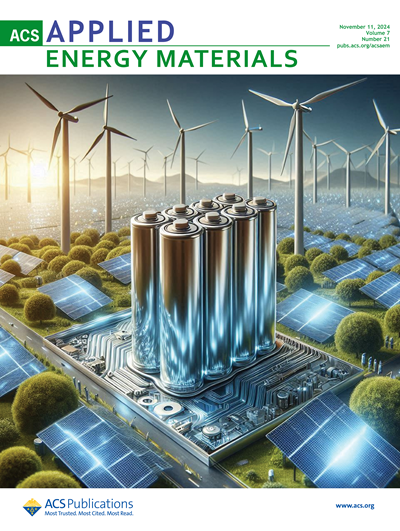
ACS Applied Energy Materials is an interdisciplinary journal publishing original research covering all aspects of materials, engineering, chemistry, physics and biology relevant to energy conversion and storage. The journal is devoted to reports of new and original experimental and theoretical research of an applied nature that integrate knowledge in the areas of materials, engineering, physics, bioscience, and chemistry into important energy applications.



 京公网安备 11010802042870号
京ICP备2023020795号-1
京公网安备 11010802042870号
京ICP备2023020795号-1

 分享
分享
 求助内容:
求助内容: 应助结果提醒方式:
 扫码关注我们
