Thien Thi Thanh Le;Naveed Ul Hassan;Xiaoming Chen;Mohamed-Slim Alouini;Zhu Han;Chau Yuen
{"title":"A Survey on Random Access Protocols in Direct-Access LEO Satellite-Based IoT Communication","authors":"Thien Thi Thanh Le;Naveed Ul Hassan;Xiaoming Chen;Mohamed-Slim Alouini;Zhu Han;Chau Yuen","doi":"10.1109/COMST.2024.3385347","DOIUrl":null,"url":null,"abstract":"Low-Earth orbit (LEO) satellites can play an important role in providing seamless coverage for the Internet of Things (IoT). In satellite-based IoT (SIoT) networks, IoT devices can communicate directly with a satellite or through a gateway, which is called direct-access SIoT and indirect-access SIoT, respectively. As the number of IoT devices requiring satellite access is increasing, the role of medium access control (MAC) protocols becomes critical in reducing the latency and improving the quality of service (QoS). In this tutorial, we provide a comprehensive review of random access (RA) protocols, more specifically, grant-free RA (GFRA) protocols, which are more efficient in handling the communication requirements of SIoT networks. We discuss the challenges that arise in designing RA protocols under time-frequency resource and preamble limitations, high mobility of satellites, sporadic traffic from IoT networks, and diverse QoS requirements of IoT applications. We also highlight future research directions, including cross-layer optimization, joint activity detection and channel estimation (JAD-CE), reinforcement-learning-based solution, protocol design for dense LEO satellite networks, and reconfigurable intelligent surface (RIS) aided SIoT.","PeriodicalId":55029,"journal":{"name":"IEEE Communications Surveys and Tutorials","volume":"27 1","pages":"426-462"},"PeriodicalIF":34.4000,"publicationDate":"2024-04-04","publicationTypes":"Journal Article","fieldsOfStudy":null,"isOpenAccess":false,"openAccessPdf":"","citationCount":"0","resultStr":null,"platform":"Semanticscholar","paperid":null,"PeriodicalName":"IEEE Communications Surveys and Tutorials","FirstCategoryId":"94","ListUrlMain":"https://ieeexplore.ieee.org/document/10492466/","RegionNum":1,"RegionCategory":"计算机科学","ArticlePicture":[],"TitleCN":null,"AbstractTextCN":null,"PMCID":null,"EPubDate":"","PubModel":"","JCR":"Q1","JCRName":"COMPUTER SCIENCE, INFORMATION SYSTEMS","Score":null,"Total":0}
引用次数: 0
Abstract
Low-Earth orbit (LEO) satellites can play an important role in providing seamless coverage for the Internet of Things (IoT). In satellite-based IoT (SIoT) networks, IoT devices can communicate directly with a satellite or through a gateway, which is called direct-access SIoT and indirect-access SIoT, respectively. As the number of IoT devices requiring satellite access is increasing, the role of medium access control (MAC) protocols becomes critical in reducing the latency and improving the quality of service (QoS). In this tutorial, we provide a comprehensive review of random access (RA) protocols, more specifically, grant-free RA (GFRA) protocols, which are more efficient in handling the communication requirements of SIoT networks. We discuss the challenges that arise in designing RA protocols under time-frequency resource and preamble limitations, high mobility of satellites, sporadic traffic from IoT networks, and diverse QoS requirements of IoT applications. We also highlight future research directions, including cross-layer optimization, joint activity detection and channel estimation (JAD-CE), reinforcement-learning-based solution, protocol design for dense LEO satellite networks, and reconfigurable intelligent surface (RIS) aided SIoT.
期刊介绍:
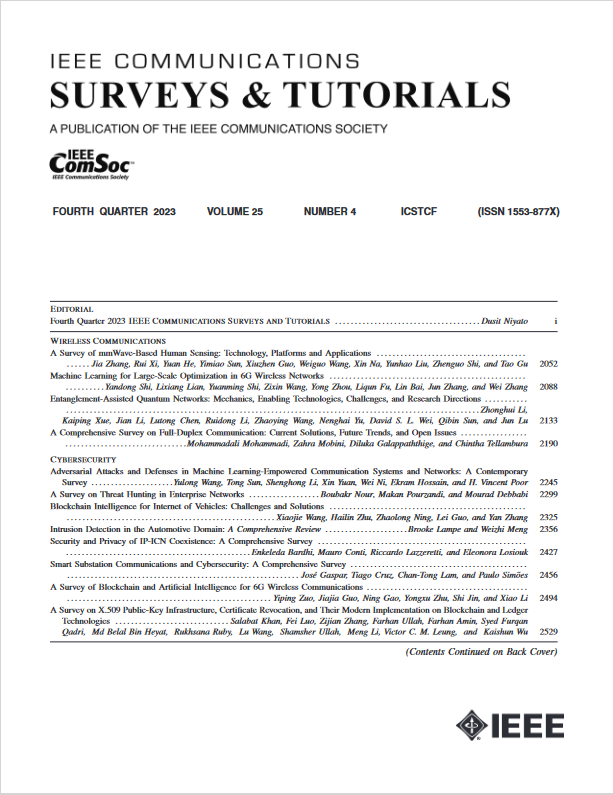
IEEE Communications Surveys & Tutorials is an online journal published by the IEEE Communications Society for tutorials and surveys covering all aspects of the communications field. Telecommunications technology is progressing at a rapid pace, and the IEEE Communications Society is committed to providing researchers and other professionals the information and tools to stay abreast. IEEE Communications Surveys and Tutorials focuses on integrating and adding understanding to the existing literature on communications, putting results in context. Whether searching for in-depth information about a familiar area or an introduction into a new area, IEEE Communications Surveys & Tutorials aims to be the premier source of peer-reviewed, comprehensive tutorials and surveys, and pointers to further sources. IEEE Communications Surveys & Tutorials publishes only articles exclusively written for IEEE Communications Surveys & Tutorials and go through a rigorous review process before their publication in the quarterly issues.
A tutorial article in the IEEE Communications Surveys & Tutorials should be designed to help the reader to become familiar with and learn something specific about a chosen topic. In contrast, the term survey, as applied here, is defined to mean a survey of the literature. A survey article in IEEE Communications Surveys & Tutorials should provide a comprehensive review of developments in a selected area, covering its development from its inception to its current state and beyond, and illustrating its development through liberal citations from the literature. Both tutorials and surveys should be tutorial in nature and should be written in a style comprehensible to readers outside the specialty of the article.



 京公网安备 11010802042870号
京ICP备2023020795号-1
京公网安备 11010802042870号
京ICP备2023020795号-1

 分享
分享
 求助内容:
求助内容: 应助结果提醒方式:
 扫码关注我们
