Yuze Wu, Jingchao Liu, Jinxia Zhao, Chunhong Jin, Hailong Ren, Yilin Yin and Zenghe Li
{"title":"An oxygen vacancy-rich BiO2−x/COF heterojunction for photocatalytic degradation of diclofenac†","authors":"Yuze Wu, Jingchao Liu, Jinxia Zhao, Chunhong Jin, Hailong Ren, Yilin Yin and Zenghe Li","doi":"10.1039/D4NR00608A","DOIUrl":null,"url":null,"abstract":"<p >A BiO<small><sub>2−<em>x</em></sub></small>/COF composite was successfully synthesized by simple mechanical ball milling. Compared to pure BiO<small><sub>2−<em>x</em></sub></small> and COFs, the BiO<small><sub>2−<em>x</em></sub></small>/COF composite (1 : 9) showed superior photocatalytic capability. Under visible light irradiation for 90 min, the photocatalytic degradation rate of DCF reached 97%. In addition, the characterization results showed that the formation of heterojunctions and the increase in oxygen vacancy concentration were the reasons for the enhancement of the photocatalytic activity. It is confirmed by free radical capture experiments that ˙O<small><sub>2</sub></small><small><sup>−</sup></small> and h<small><sup>+</sup></small> are the main reactive substances in the photocatalytic process. The photocatalytic degradation mechanism of the composite and the photocatalytic degradation pathway of diclofenac were deduced.</p>","PeriodicalId":92,"journal":{"name":"Nanoscale","volume":" 22","pages":" 10645-10655"},"PeriodicalIF":5.1000,"publicationDate":"2024-04-13","publicationTypes":"Journal Article","fieldsOfStudy":null,"isOpenAccess":false,"openAccessPdf":"","citationCount":"0","resultStr":null,"platform":"Semanticscholar","paperid":null,"PeriodicalName":"Nanoscale","FirstCategoryId":"88","ListUrlMain":"https://pubs.rsc.org/en/content/articlelanding/2024/nr/d4nr00608a","RegionNum":3,"RegionCategory":"材料科学","ArticlePicture":[],"TitleCN":null,"AbstractTextCN":null,"PMCID":null,"EPubDate":"","PubModel":"","JCR":"Q1","JCRName":"CHEMISTRY, MULTIDISCIPLINARY","Score":null,"Total":0}
引用次数: 0
Abstract
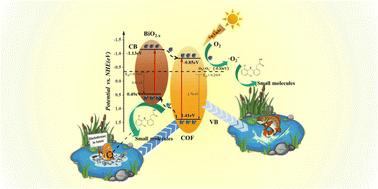
A BiO2−x/COF composite was successfully synthesized by simple mechanical ball milling. Compared to pure BiO2−x and COFs, the BiO2−x/COF composite (1 : 9) showed superior photocatalytic capability. Under visible light irradiation for 90 min, the photocatalytic degradation rate of DCF reached 97%. In addition, the characterization results showed that the formation of heterojunctions and the increase in oxygen vacancy concentration were the reasons for the enhancement of the photocatalytic activity. It is confirmed by free radical capture experiments that ˙O2− and h+ are the main reactive substances in the photocatalytic process. The photocatalytic degradation mechanism of the composite and the photocatalytic degradation pathway of diclofenac were deduced.
期刊介绍:
Nanoscale is a high-impact international journal, publishing high-quality research across nanoscience and nanotechnology. Nanoscale publishes a full mix of research articles on experimental and theoretical work, including reviews, communications, and full papers.Highly interdisciplinary, this journal appeals to scientists, researchers and professionals interested in nanoscience and nanotechnology, quantum materials and quantum technology, including the areas of physics, chemistry, biology, medicine, materials, energy/environment, information technology, detection science, healthcare and drug discovery, and electronics.



 京公网安备 11010802042870号
京ICP备2023020795号-1
京公网安备 11010802042870号
京ICP备2023020795号-1

 分享
分享
 求助内容:
求助内容: 应助结果提醒方式:
 扫码关注我们
