Use of a dosimetry-based RAI protocol for treatment of benign hyperthyroidism optimises response while minimising exposure to ionising radiation

IF 2.4 3区 医学 Q2 ENDOCRINOLOGY & METABOLISM Clinical Endocrinology Pub Date : 2024-04-03 DOI:10.1111/cen.15054
Clare Miller, Amna Al-Jabri, Liam O'Murchada, Mohamad Mustafa, Jennie Cooke, Niamh Phelan, Marie-Louise Healy
{"title":"Use of a dosimetry-based RAI protocol for treatment of benign hyperthyroidism optimises response while minimising exposure to ionising radiation","authors":"Clare Miller,&nbsp;Amna Al-Jabri,&nbsp;Liam O'Murchada,&nbsp;Mohamad Mustafa,&nbsp;Jennie Cooke,&nbsp;Niamh Phelan,&nbsp;Marie-Louise Healy","doi":"10.1111/cen.15054","DOIUrl":null,"url":null,"abstract":"<div>\n \n \n <section>\n \n <h3> Background</h3>\n \n <p>The optimal treatment strategy for radioiodine (RAI) treatment protocols for benign hyperthyroidism remains elusive. Although individualised activities are recommended in European Law, many centres continue to provide fixed activities. Our institution implemented a dosimetry protocol in 2016 following years of fixed dosing which facilitates the calculation of individualised activities based on thyroid volume and radioiodine uptake.</p>\n </section>\n \n <section>\n \n <h3> Methods</h3>\n \n <p>This was a retrospective study comparing success rates using a dosimetry protocol targeting an absorbed dose of 150 Gy for Graves’ disease (GD) and 125 Gy for Toxic Multinodular Goiter (TMNG) with fixed dosing (200MBq for GD and 400MBq for TMNG) among 204 patients with hyperthyroidism. Success was defined as a non-hyperthyroid state at 1 year for both disease states. Results were analysed for disease specific or patient specific modulators of response.</p>\n </section>\n \n <section>\n \n <h3> Results</h3>\n \n <p>This study included 204 patients; 74% (<i>n</i> = 151) received fixed activities and 26% (<i>n</i> = 53) of activities administered were calculated using dosimetry. A dosimetry-based protocol was successful in 80.5% of patients with GD and 100% of patients with TMNG. Differences in success rates and median activity administered between the fixed (204Mbq) and dosimetry (246MBq) cohort were not statistically significant (<i>p</i> = .64) however 44% of patients with GD and 70% of patients with TMNG received lower activities following treatment with dosimetry as opposed to fixed activities. Use of dosimetry resulted in successful treatment and reduced RAI exposure for 36% of patients with GD, 70% of patients with TMNG, and 44% of patients overall.</p>\n </section>\n \n <section>\n \n <h3> Conclusion</h3>\n \n <p>This retrospective clinical study demonstrated that treatment with a dosimetry-based protocol for TMNG and GD achieved comparable success rates to fixed protocols while reducing RAI exposure for over a third of patients with GD and most patients with TMNG. This study also highlighted that RAI can successfully treat hyperthyroidism for some patients with activities lower than commonplace in clinical practise. No patient or disease specific modulators of treatment response were established in this study; however, the data supports a future prospective trial which further scrutinises the individual patient factors governing treatment response to RAI.</p>\n </section>\n </div>","PeriodicalId":10346,"journal":{"name":"Clinical Endocrinology","volume":"100 6","pages":"585-592"},"PeriodicalIF":2.4000,"publicationDate":"2024-04-03","publicationTypes":"Journal Article","fieldsOfStudy":null,"isOpenAccess":false,"openAccessPdf":"https://onlinelibrary.wiley.com/doi/epdf/10.1111/cen.15054","citationCount":"0","resultStr":null,"platform":"Semanticscholar","paperid":null,"PeriodicalName":"Clinical Endocrinology","FirstCategoryId":"3","ListUrlMain":"https://onlinelibrary.wiley.com/doi/10.1111/cen.15054","RegionNum":3,"RegionCategory":"医学","ArticlePicture":[],"TitleCN":null,"AbstractTextCN":null,"PMCID":null,"EPubDate":"","PubModel":"","JCR":"Q2","JCRName":"ENDOCRINOLOGY & METABOLISM","Score":null,"Total":0}
引用次数: 0

Abstract

Background

The optimal treatment strategy for radioiodine (RAI) treatment protocols for benign hyperthyroidism remains elusive. Although individualised activities are recommended in European Law, many centres continue to provide fixed activities. Our institution implemented a dosimetry protocol in 2016 following years of fixed dosing which facilitates the calculation of individualised activities based on thyroid volume and radioiodine uptake.

Methods

This was a retrospective study comparing success rates using a dosimetry protocol targeting an absorbed dose of 150 Gy for Graves’ disease (GD) and 125 Gy for Toxic Multinodular Goiter (TMNG) with fixed dosing (200MBq for GD and 400MBq for TMNG) among 204 patients with hyperthyroidism. Success was defined as a non-hyperthyroid state at 1 year for both disease states. Results were analysed for disease specific or patient specific modulators of response.

Results

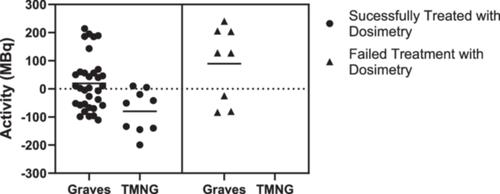
This study included 204 patients; 74% (n = 151) received fixed activities and 26% (n = 53) of activities administered were calculated using dosimetry. A dosimetry-based protocol was successful in 80.5% of patients with GD and 100% of patients with TMNG. Differences in success rates and median activity administered between the fixed (204Mbq) and dosimetry (246MBq) cohort were not statistically significant (p = .64) however 44% of patients with GD and 70% of patients with TMNG received lower activities following treatment with dosimetry as opposed to fixed activities. Use of dosimetry resulted in successful treatment and reduced RAI exposure for 36% of patients with GD, 70% of patients with TMNG, and 44% of patients overall.

Conclusion

This retrospective clinical study demonstrated that treatment with a dosimetry-based protocol for TMNG and GD achieved comparable success rates to fixed protocols while reducing RAI exposure for over a third of patients with GD and most patients with TMNG. This study also highlighted that RAI can successfully treat hyperthyroidism for some patients with activities lower than commonplace in clinical practise. No patient or disease specific modulators of treatment response were established in this study; however, the data supports a future prospective trial which further scrutinises the individual patient factors governing treatment response to RAI.
Abstract Image

查看原文
分享 分享
微信好友 朋友圈 QQ好友 复制链接
本刊更多论文
使用基于剂量测定的 RAI 方案治疗良性甲状腺机能亢进症,可在最大程度减少电离辐射暴露的同时优化反应
背景良性甲状腺功能亢进症的放射性碘(RAI)治疗方案的最佳治疗策略仍然难以确定。尽管欧洲法律建议进行个体化治疗,但许多中心仍继续提供固定治疗剂量。方法这是一项回顾性研究,在204名甲亢患者中比较了使用剂量测定方案与固定剂量(GD为200MBq,TMNG为400MBq)的成功率,剂量测定方案的目标是吸收剂量为:Graves病(GD)150 Gy,毒性多结节性甲状腺肿(TMNG)125 Gy。成功的定义是,两种疾病状态的患者在 1 年后均未出现甲状腺功能亢进状态。结果本研究共纳入 204 名患者;74%(n = 151)接受了固定活动剂量,26%(n = 53)的活动剂量是通过剂量测定计算得出的。80.5%的GD患者和100%的TMNG患者采用了剂量测定方案。固定剂量(204Mbq)和剂量测定(246Mbq)组群之间的成功率和施用的中位放射性活度差异无统计学意义(p = .64),但 44% 的 GD 患者和 70% 的 TMNG 患者在接受剂量测定治疗后获得的放射性活度低于固定剂量。这项回顾性临床研究表明,采用剂量测定方案治疗 TMNG 和 GD 的成功率与固定方案相当,同时减少了超过三分之一的 GD 患者和大多数 TMNG 患者的 RAI 暴露。这项研究还强调,RAI 可以成功治疗一些活动量低于临床常见活动量的甲状腺功能亢进症患者。本研究没有确定治疗反应的患者或疾病特异性调节因素;不过,这些数据支持未来开展前瞻性试验,进一步研究影响 RAI 治疗反应的患者个体因素。
本文章由计算机程序翻译,如有差异,请以英文原文为准。
求助全文
约1分钟内获得全文 去求助
来源期刊
Clinical Endocrinology
Clinical Endocrinology 医学-内分泌学与代谢
CiteScore
6.40
自引率
3.10%
发文量
192
审稿时长
1 months
期刊介绍: Clinical Endocrinology publishes papers and reviews which focus on the clinical aspects of endocrinology, including the clinical application of molecular endocrinology. It does not publish papers relating directly to diabetes care and clinical management. It features reviews, original papers, commentaries, correspondence and Clinical Questions. Clinical Endocrinology is essential reading not only for those engaged in endocrinological research but also for those involved primarily in clinical practice.
期刊最新文献
Quality of Life and Decision Regret Risk in Graves' Disease After Radioactive Iodine Therapy: A Prospective Cohort Study. Is Parenteral Bisphosphonate Therapy Safe and Effective in the Management of Severe Primary Hyperparathyroidism Prior to Parathyroidectomy? Pre-Treatment With Potassium Iodide and Higher Radioiodine Dose Are the Risk Factors of Mid-to-Late-Phase Transient Thyrotoxicosis Following Radioiodine Therapy for Graves' Disease in Japanese Patients: A Retrospective Cohort Study. Genetic and Clinical Characterisation of Congenital Hyperinsulinism: Identification of a Novel ABCC8 Variant. Issue Information
×
引用
GB/T 7714-2015
复制
MLA
复制
APA
复制
导出至
BibTeX EndNote RefMan NoteFirst NoteExpress
×
×
提示
您的信息不完整,为了账户安全,请先补充。
现在去补充
×
提示
您因"违规操作"
具体请查看互助需知
我知道了
×
提示
现在去查看 取消
×
提示
确定
0
微信
客服QQ
Book学术公众号 扫码关注我们
反馈
×
意见反馈
请填写您的意见或建议
请填写您的手机或邮箱
已复制链接
已复制链接
快去分享给好友吧!
我知道了
×
扫码分享
扫码分享
Book学术官方微信
Book学术文献互助
Book学术文献互助群
群 号:604180095
Book学术
文献互助 智能选刊 最新文献 互助须知 联系我们:info@booksci.cn
Book学术提供免费学术资源搜索服务,方便国内外学者检索中英文文献。致力于提供最便捷和优质的服务体验。
Copyright © 2023 Book学术 All rights reserved.
ghs 京公网安备 11010802042870号 京ICP备2023020795号-1





