Abdul Wazith M. J., Taju G., Abdul Majeed S., Mithra S., Nafeez Ahmed A., Badhusha A., Rajkumar V., Sahul Hameed A. S.
{"title":"A comparative study on targeted gene expression in zebrafish and its gill cell line exposed to chlorpyrifos","authors":"Abdul Wazith M. J., Taju G., Abdul Majeed S., Mithra S., Nafeez Ahmed A., Badhusha A., Rajkumar V., Sahul Hameed A. S.","doi":"10.1007/s11626-024-00892-5","DOIUrl":null,"url":null,"abstract":"<p>Chlorpyrifos (CPF) is an organophosphorus-based insecticide, which is known to pose a serious risk to aquatic animals. However, the mechanisms of CPF toxicity in animals still remain unclear. The present investigation aimed to compare the potential effects of CPF in zebrafish (<i>Danio rerio</i>) and its gill cell line (<i>DrG</i> cells). Based on the in vivo study, the LC<sub>50</sub> was calculated as 18.03 µg/L and the chronic toxic effect of CPF was studied by exposing the fish to 1/10th (1.8 µg/L) and 1/5th (3.6 µg/L) of the LC<sub>50</sub> value. Morphological changes were observed in fish and <i>Dr</i>G cells which were exposed to sublethal concentrations of CPF. The results of MTT and NR assays showed significant decline in the survival of cells exposed to CPF at 96 h. The production of reactive oxygen species in <i>Dr</i>G cells and expression levels of antioxidant markers, inflammatory response genes (<i>cox2a</i> and <i>cox2b</i>), <i>cyp1a</i>, proapoptotic genes (<i>bax</i>), antiapoptotic gene (<i>bcl2</i>), apoptotic genes (<i>cas3</i> and <i>p53</i>), and neuroprotective gene (<i>ache</i>) were determined in vivo using zebrafish and in vitro using <i>DrG</i> cells after exposure to CPF. Significant changes were found in the ROS production (<i>Dr</i>G cells) and in the expression of inflammatory, proapoptotic, and apoptotic genes. This study showed that <i>DrG</i> cells are potential alternative tools to replace the use of whole fish for toxicological studies.</p>","PeriodicalId":13340,"journal":{"name":"In Vitro Cellular & Developmental Biology. Animal","volume":"50 1","pages":""},"PeriodicalIF":1.7000,"publicationDate":"2024-04-08","publicationTypes":"Journal Article","fieldsOfStudy":null,"isOpenAccess":false,"openAccessPdf":"","citationCount":"0","resultStr":null,"platform":"Semanticscholar","paperid":null,"PeriodicalName":"In Vitro Cellular & Developmental Biology. Animal","FirstCategoryId":"99","ListUrlMain":"https://doi.org/10.1007/s11626-024-00892-5","RegionNum":4,"RegionCategory":"生物学","ArticlePicture":[],"TitleCN":null,"AbstractTextCN":null,"PMCID":null,"EPubDate":"","PubModel":"","JCR":"Q4","JCRName":"CELL BIOLOGY","Score":null,"Total":0}
引用次数: 0
Abstract
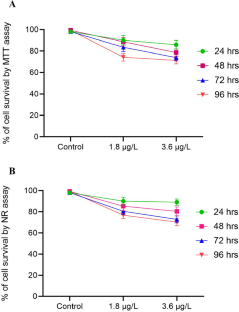
Chlorpyrifos (CPF) is an organophosphorus-based insecticide, which is known to pose a serious risk to aquatic animals. However, the mechanisms of CPF toxicity in animals still remain unclear. The present investigation aimed to compare the potential effects of CPF in zebrafish (Danio rerio) and its gill cell line (DrG cells). Based on the in vivo study, the LC50 was calculated as 18.03 µg/L and the chronic toxic effect of CPF was studied by exposing the fish to 1/10th (1.8 µg/L) and 1/5th (3.6 µg/L) of the LC50 value. Morphological changes were observed in fish and DrG cells which were exposed to sublethal concentrations of CPF. The results of MTT and NR assays showed significant decline in the survival of cells exposed to CPF at 96 h. The production of reactive oxygen species in DrG cells and expression levels of antioxidant markers, inflammatory response genes (cox2a and cox2b), cyp1a, proapoptotic genes (bax), antiapoptotic gene (bcl2), apoptotic genes (cas3 and p53), and neuroprotective gene (ache) were determined in vivo using zebrafish and in vitro using DrG cells after exposure to CPF. Significant changes were found in the ROS production (DrG cells) and in the expression of inflammatory, proapoptotic, and apoptotic genes. This study showed that DrG cells are potential alternative tools to replace the use of whole fish for toxicological studies.
期刊介绍:
In Vitro Cellular & Developmental Biology - Animal is a journal of the Society for In Vitro Biology (SIVB). Original manuscripts reporting results of research in cellular, molecular, and developmental biology that employ or are relevant to organs, tissue, tumors, and cells in vitro will be considered for publication. Topics covered include:
Biotechnology;
Cell and Tissue Models;
Cell Growth/Differentiation/Apoptosis;
Cellular Pathology/Virology;
Cytokines/Growth Factors/Adhesion Factors;
Establishment of Cell Lines;
Signal Transduction;
Stem Cells;
Toxicology/Chemical Carcinogenesis;
Product Applications.



 京公网安备 11010802042870号
京ICP备2023020795号-1
京公网安备 11010802042870号
京ICP备2023020795号-1

 分享
分享
 求助内容:
求助内容: 应助结果提醒方式:
 扫码关注我们
