Warren G. Caneos, Jyotsna Shrivastava, Moses Ndugwa, Gudrun De Boeck
{"title":"Physiological responses of European sea bass (Dicentrarchus labrax) exposed to increased carbon dioxide and reduced seawater salinities","authors":"Warren G. Caneos, Jyotsna Shrivastava, Moses Ndugwa, Gudrun De Boeck","doi":"10.1007/s11033-024-09460-2","DOIUrl":null,"url":null,"abstract":"<h3 data-test=\"abstract-sub-heading\">Background</h3><p>The iono- and osmoregulatory capacities of marine teleosts, such as European sea bass (<i>Dicentrarchus labrax</i>) are expected to be challenged by high carbon dioxide exposure, and the adverse effects of elevated CO<sub>2</sub> could be amplified when such fish migrate into less buffered hypo-osmotic estuarine environments. Therefore, the effects of increased CO<sub>2</sub> on the physiological responses of European sea bass (<i>Dicentrarchus labrax</i>) acclimated to 32 ppt, 10 ppt and 2.5 ppt were investigated.</p><h3 data-test=\"abstract-sub-heading\">Methods</h3><p>Following acclimation to different salinities for two weeks, fish were exposed to present-day (400 µatm) and future (1000 µatm) atmospheric CO<sub>2</sub> for 1, 3, 7 and 21 days. Blood pH, plasma ions (Na+, K+, Cl-), branchial mRNA expression of ion transporters such as Na<sup>+</sup>/K<sup>+</sup>–ATPase (NKA), Na<sup>+</sup>/K<sup>+</sup>/2Cl<sup>–</sup> co-transporters (NKCC) and ammonia transporters (e.g. Rhesus glycoproteins Rhbg, Rhcg1 and Rhcg2) were examined to understand the iono- and osmoregulatory consequences of elevated CO<sub>2</sub>.</p><h3 data-test=\"abstract-sub-heading\">Results</h3><p>A transient but significant increase in the blood pH of exposed fish acclimated at 10 ppt (day 1) and 2.5 ppt (day 21) was observed possibly due to an overshoot of the blood HCO<sub>3</sub><sup>−</sup> accumulation while a significant reduction of blood pH was observed after 21 days at 2.5ppt. However, no change was seen at 32 ppt. Generally, Na + concentration of control fish was relatively higher at 10 ppt and lower at 2.5 ppt compared to 32 ppt control group at all sampling periods. Additionally, NKA was upregulated in gill of juvenile sea bass when acclimated to lower salinities compared to 32 ppt control group. CO<sub>2</sub> exposure generally downregulated NKA mRNA expression at 32ppt (day 1), 10 ppt (days 3, 7 and 21) and 2.5ppt (days 1 and 7) and also a significant reduction of NKCC mRNA level of the exposed fish acclimated at 32 ppt (1–3 days) and 10 ppt (7–21 days) was observed. Furthermore, Rhesus glycoproteins were generally upregulated in the fish acclimated at lower salinities indicating a higher dependance on gill ammonia excretion. Increased CO<sub>2</sub> led to a reduced expression of Rhbg and may therefore reduce ammonia excretion rate.</p><h3 data-test=\"abstract-sub-heading\">Conclusion</h3><p>Juvenile sea bass were relatively successful in keeping acid base balance under an ocean acidification scenario. However, this came at a cost for ionoregulation with reduced NKA, NKCC and Rhbg expression rates as a consequence.</p>","PeriodicalId":18755,"journal":{"name":"Molecular Biology Reports","volume":"18 1","pages":""},"PeriodicalIF":2.8000,"publicationDate":"2024-04-08","publicationTypes":"Journal Article","fieldsOfStudy":null,"isOpenAccess":false,"openAccessPdf":"","citationCount":"0","resultStr":null,"platform":"Semanticscholar","paperid":null,"PeriodicalName":"Molecular Biology Reports","FirstCategoryId":"99","ListUrlMain":"https://doi.org/10.1007/s11033-024-09460-2","RegionNum":4,"RegionCategory":"生物学","ArticlePicture":[],"TitleCN":null,"AbstractTextCN":null,"PMCID":null,"EPubDate":"","PubModel":"","JCR":"Q3","JCRName":"BIOCHEMISTRY & MOLECULAR BIOLOGY","Score":null,"Total":0}
引用次数: 0
Abstract
Background
The iono- and osmoregulatory capacities of marine teleosts, such as European sea bass (Dicentrarchus labrax) are expected to be challenged by high carbon dioxide exposure, and the adverse effects of elevated CO2 could be amplified when such fish migrate into less buffered hypo-osmotic estuarine environments. Therefore, the effects of increased CO2 on the physiological responses of European sea bass (Dicentrarchus labrax) acclimated to 32 ppt, 10 ppt and 2.5 ppt were investigated.
Methods
Following acclimation to different salinities for two weeks, fish were exposed to present-day (400 µatm) and future (1000 µatm) atmospheric CO2 for 1, 3, 7 and 21 days. Blood pH, plasma ions (Na+, K+, Cl-), branchial mRNA expression of ion transporters such as Na+/K+–ATPase (NKA), Na+/K+/2Cl– co-transporters (NKCC) and ammonia transporters (e.g. Rhesus glycoproteins Rhbg, Rhcg1 and Rhcg2) were examined to understand the iono- and osmoregulatory consequences of elevated CO2.
Results
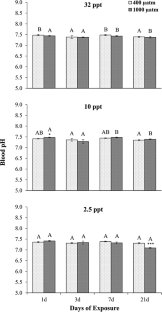
A transient but significant increase in the blood pH of exposed fish acclimated at 10 ppt (day 1) and 2.5 ppt (day 21) was observed possibly due to an overshoot of the blood HCO3− accumulation while a significant reduction of blood pH was observed after 21 days at 2.5ppt. However, no change was seen at 32 ppt. Generally, Na + concentration of control fish was relatively higher at 10 ppt and lower at 2.5 ppt compared to 32 ppt control group at all sampling periods. Additionally, NKA was upregulated in gill of juvenile sea bass when acclimated to lower salinities compared to 32 ppt control group. CO2 exposure generally downregulated NKA mRNA expression at 32ppt (day 1), 10 ppt (days 3, 7 and 21) and 2.5ppt (days 1 and 7) and also a significant reduction of NKCC mRNA level of the exposed fish acclimated at 32 ppt (1–3 days) and 10 ppt (7–21 days) was observed. Furthermore, Rhesus glycoproteins were generally upregulated in the fish acclimated at lower salinities indicating a higher dependance on gill ammonia excretion. Increased CO2 led to a reduced expression of Rhbg and may therefore reduce ammonia excretion rate.
Conclusion
Juvenile sea bass were relatively successful in keeping acid base balance under an ocean acidification scenario. However, this came at a cost for ionoregulation with reduced NKA, NKCC and Rhbg expression rates as a consequence.
期刊介绍:
Molecular Biology Reports publishes original research papers and review articles that demonstrate novel molecular and cellular findings in both eukaryotes (animals, plants, algae, funghi) and prokaryotes (bacteria and archaea).The journal publishes results of both fundamental and translational research as well as new techniques that advance experimental progress in the field and presents original research papers, short communications and (mini-) reviews.



 京公网安备 11010802042870号
京ICP备2023020795号-1
京公网安备 11010802042870号
京ICP备2023020795号-1

 分享
分享
 求助内容:
求助内容: 应助结果提醒方式:
 扫码关注我们
