Arash Badami-Behjat, Gianluca Galeotti, Rico Gutzler, Dominik L. Pastoetter, Wolfgang M. Heckl, Xinliang Feng and Markus Lackinger
{"title":"Iodine passivation facilitates on-surface synthesis of robust regular conjugated two-dimensional organogold networks on Au(111)†","authors":"Arash Badami-Behjat, Gianluca Galeotti, Rico Gutzler, Dominik L. Pastoetter, Wolfgang M. Heckl, Xinliang Feng and Markus Lackinger","doi":"10.1039/D3NH00496A","DOIUrl":null,"url":null,"abstract":"<p >Two-dimensional conjugated organogold networks with anthra-tetrathiophene repeat units are synthesized by thermally activated debrominative coupling of 2,5,9,12-tetrabromoanthra[1,2-<em>b</em>:4,3-<em>b</em>′:5,6-<em>b</em>′′:8,7-<em>b</em>′′′]tetrathiophene (TBATT) precursor molecules on Au(111) surfaces under ultra-high vacuum (UHV) conditions. Performing the reaction on iodine-passivated Au(111) surfaces promotes formation of highly regular structures, as revealed by scanning tunneling microscopy (STM). In contrast, coupling on bare Au(111) surfaces results in less regular networks due to the simultaneous expression of competing intermolecular binding motifs in the absence of error correction. The carbon–Au–carbon bonds confer remarkable robustness to the organogold networks, as evidenced by their high thermal stability. In addition, as suggested by density functional theory (DFT) calculations and underscored by scanning tunneling spectroscopy (STS), the organogold networks exhibit a small electronic band gap in the order of 1.0 eV due to their high π-conjugation.</p>","PeriodicalId":93,"journal":{"name":"Nanoscale Horizons","volume":" 6","pages":" 1042-1051"},"PeriodicalIF":6.6000,"publicationDate":"2024-04-11","publicationTypes":"Journal Article","fieldsOfStudy":null,"isOpenAccess":false,"openAccessPdf":"https://pubs.rsc.org/en/content/articlepdf/2024/nh/d3nh00496a?page=search","citationCount":"0","resultStr":null,"platform":"Semanticscholar","paperid":null,"PeriodicalName":"Nanoscale Horizons","FirstCategoryId":"88","ListUrlMain":"https://pubs.rsc.org/en/content/articlelanding/2024/nh/d3nh00496a","RegionNum":2,"RegionCategory":"材料科学","ArticlePicture":[],"TitleCN":null,"AbstractTextCN":null,"PMCID":null,"EPubDate":"","PubModel":"","JCR":"Q1","JCRName":"CHEMISTRY, PHYSICAL","Score":null,"Total":0}
引用次数: 0
Abstract
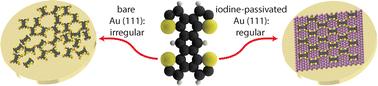
Two-dimensional conjugated organogold networks with anthra-tetrathiophene repeat units are synthesized by thermally activated debrominative coupling of 2,5,9,12-tetrabromoanthra[1,2-b:4,3-b′:5,6-b′′:8,7-b′′′]tetrathiophene (TBATT) precursor molecules on Au(111) surfaces under ultra-high vacuum (UHV) conditions. Performing the reaction on iodine-passivated Au(111) surfaces promotes formation of highly regular structures, as revealed by scanning tunneling microscopy (STM). In contrast, coupling on bare Au(111) surfaces results in less regular networks due to the simultaneous expression of competing intermolecular binding motifs in the absence of error correction. The carbon–Au–carbon bonds confer remarkable robustness to the organogold networks, as evidenced by their high thermal stability. In addition, as suggested by density functional theory (DFT) calculations and underscored by scanning tunneling spectroscopy (STS), the organogold networks exhibit a small electronic band gap in the order of 1.0 eV due to their high π-conjugation.
期刊介绍:
Nanoscale Horizons stands out as a premier journal for publishing exceptionally high-quality and innovative nanoscience and nanotechnology. The emphasis lies on original research that introduces a new concept or a novel perspective (a conceptual advance), prioritizing this over reporting technological improvements. Nevertheless, outstanding articles showcasing truly groundbreaking developments, including record-breaking performance, may also find a place in the journal. Published work must be of substantial general interest to our broad and diverse readership across the nanoscience and nanotechnology community.



 京公网安备 11010802042870号
京ICP备2023020795号-1
京公网安备 11010802042870号
京ICP备2023020795号-1

 分享
分享
 求助内容:
求助内容: 应助结果提醒方式:
 扫码关注我们
