Alaa Jiheel Zkaim Alhazami, Vahid Pouresmaeil, Masoud Homayouni Tabrizi
{"title":"The Methylurolithin A-loaded PLGA-Folate-Chitosan Nanoparticles (Mu-PFCNPs), as the novel safe selective anti-colon cancer drug delivery system","authors":"Alaa Jiheel Zkaim Alhazami, Vahid Pouresmaeil, Masoud Homayouni Tabrizi","doi":"10.1007/s10876-024-02618-9","DOIUrl":null,"url":null,"abstract":"<div><p>The synthesis of a targeted natural anticancer substitution has opened up a promising horizon by increasing the effectiveness of the treatment and reducing its undesirable side effects. However, the weak bio-accessibility and chemical instability of the medicinal plant phytochemicals are their main limitations. The nanospheres of poly lactic-<i>co</i>-glycolic acid (PLGA) is known to be safe due to its bioavailability and biodegradable profile. In the current study, Methylurolitin-A (MUA) was loaded into PLGA nanoparticles with folic acid-linked chitosan to investigate its antioxidant, anti-angiogenic, and anticancer activities. The MUA-loaded PLGA-folate-chitosan nanoparticles (Mu-PFCNPs) were synthesized and characterized by DLS, Zeta potential, FTIR, and FESEM. The Mu-PFCNPs’ antioxidant activity was analyzed by ABTS, DPPH, and FRAP assays followed by measuring the antioxidant gene expression. Moreover, the anti-angiogenic potential of the nanoparticles was evaluated on HT-29 cells by CAM assay, conducting the VEGF/VEGFR gene expression measurement. Finally, the Mu-PFCNP selective toxicity was studied on the HT-29, A2780, PANC, and HepG2 cancer cell lines utilizing MTT assay. The nanoparticles (+30.14mV, 134nm) exhibited potent antioxidant activity and overexpressed SOD and Catalase genes in treated HT-29 cells. Mu-PFCNPs down regulated VEGF and VEGFR gene expression on HT-29 cells. Additionally, the CAM results verified the activity by indicating the reduction in the number of blood vessels. Finally, Mu-PFCNPs induced a significant selective cytotoxic impact on HT-29 cancer cells compared to other cancer cell lines. The antioxidant, anti-angiogenic and therefore anti-colon cancer activities of Mu-PFCNPs make them a suitable targeted anti-cancer compound, particularly for the treatment of human colon cancer.</p></div>","PeriodicalId":618,"journal":{"name":"Journal of Cluster Science","volume":"35 6","pages":"1719 - 1730"},"PeriodicalIF":3.6000,"publicationDate":"2024-04-14","publicationTypes":"Journal Article","fieldsOfStudy":null,"isOpenAccess":false,"openAccessPdf":"","citationCount":"0","resultStr":null,"platform":"Semanticscholar","paperid":null,"PeriodicalName":"Journal of Cluster Science","FirstCategoryId":"92","ListUrlMain":"https://link.springer.com/article/10.1007/s10876-024-02618-9","RegionNum":4,"RegionCategory":"化学","ArticlePicture":[],"TitleCN":null,"AbstractTextCN":null,"PMCID":null,"EPubDate":"","PubModel":"","JCR":"Q2","JCRName":"CHEMISTRY, INORGANIC & NUCLEAR","Score":null,"Total":0}
引用次数: 0
Abstract
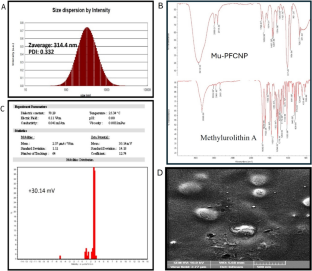
The synthesis of a targeted natural anticancer substitution has opened up a promising horizon by increasing the effectiveness of the treatment and reducing its undesirable side effects. However, the weak bio-accessibility and chemical instability of the medicinal plant phytochemicals are their main limitations. The nanospheres of poly lactic-co-glycolic acid (PLGA) is known to be safe due to its bioavailability and biodegradable profile. In the current study, Methylurolitin-A (MUA) was loaded into PLGA nanoparticles with folic acid-linked chitosan to investigate its antioxidant, anti-angiogenic, and anticancer activities. The MUA-loaded PLGA-folate-chitosan nanoparticles (Mu-PFCNPs) were synthesized and characterized by DLS, Zeta potential, FTIR, and FESEM. The Mu-PFCNPs’ antioxidant activity was analyzed by ABTS, DPPH, and FRAP assays followed by measuring the antioxidant gene expression. Moreover, the anti-angiogenic potential of the nanoparticles was evaluated on HT-29 cells by CAM assay, conducting the VEGF/VEGFR gene expression measurement. Finally, the Mu-PFCNP selective toxicity was studied on the HT-29, A2780, PANC, and HepG2 cancer cell lines utilizing MTT assay. The nanoparticles (+30.14mV, 134nm) exhibited potent antioxidant activity and overexpressed SOD and Catalase genes in treated HT-29 cells. Mu-PFCNPs down regulated VEGF and VEGFR gene expression on HT-29 cells. Additionally, the CAM results verified the activity by indicating the reduction in the number of blood vessels. Finally, Mu-PFCNPs induced a significant selective cytotoxic impact on HT-29 cancer cells compared to other cancer cell lines. The antioxidant, anti-angiogenic and therefore anti-colon cancer activities of Mu-PFCNPs make them a suitable targeted anti-cancer compound, particularly for the treatment of human colon cancer.
期刊介绍:
The journal publishes the following types of papers: (a) original and important research;
(b) authoritative comprehensive reviews or short overviews of topics of current
interest; (c) brief but urgent communications on new significant research; and (d)
commentaries intended to foster the exchange of innovative or provocative ideas, and
to encourage dialogue, amongst researchers working in different cluster
disciplines.



 京公网安备 11010802042870号
京ICP备2023020795号-1
京公网安备 11010802042870号
京ICP备2023020795号-1

 分享
分享
 求助内容:
求助内容: 应助结果提醒方式:
 扫码关注我们
