{"title":"Twinning in wild, endangered lion-tailed macaques Macaca silenus in the Anamalai Hills of the Western Ghats, India","authors":"Ashni Kumar Dhawale, Anindya Sinha","doi":"10.1007/s10329-024-01129-5","DOIUrl":null,"url":null,"abstract":"<p>Many primate species show various behavioural and ecological adaptations to provisioning, one of which is the unusual occurrence of twins. Here, we report observations on two pairs of surviving twins in lion-tailed macaques <i>Macaca silenus</i> in the Anamalai Hills of the Western Ghats, India. The Puthuthottam population of lion-tailed macaques has historically been restricted to a rainforest fragment measuring 92 ha, situated adjacent to human settlements. Over the last 10 years, however, several groups from this population have begun to directly interact with the local human communities, visiting settlements at a rate of 0.52 events/day and exploiting various anthropogenic food resources. We followed and opportunistically collected behavioural ad libitum data on two sets of twins for a year, between March 2019 and March 2020. Both of the mothers were primarily terrestrial, although the mother with the younger set of twins also used the tree canopy and other precarious substrates, such as cables. Although two previous cases of twinning have been reported in this population, one in the late 1990s and one between 2000 and 2002, neither of those sets of twins survived beyond a few weeks, with at least one infant in each pair dying of unknown causes. We discuss, but discount, the possibility that one of the infants in either set of twins was an adoptee. Our observations indicate that some lion-tailed macaque twins can survive under free-ranging conditions if they receive adequate care from their biological mother or another female. Our findings also provide further evidence of increased rates of twinning as a consequence of dietary changes in synanthropic non-human primate populations.</p>","PeriodicalId":20468,"journal":{"name":"Primates","volume":"356 1","pages":""},"PeriodicalIF":1.5000,"publicationDate":"2024-04-13","publicationTypes":"Journal Article","fieldsOfStudy":null,"isOpenAccess":false,"openAccessPdf":"","citationCount":"0","resultStr":null,"platform":"Semanticscholar","paperid":null,"PeriodicalName":"Primates","FirstCategoryId":"99","ListUrlMain":"https://doi.org/10.1007/s10329-024-01129-5","RegionNum":4,"RegionCategory":"生物学","ArticlePicture":[],"TitleCN":null,"AbstractTextCN":null,"PMCID":null,"EPubDate":"","PubModel":"","JCR":"Q2","JCRName":"ZOOLOGY","Score":null,"Total":0}
引用次数: 0
Abstract
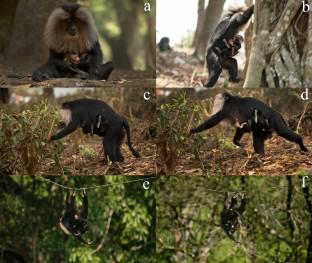
Many primate species show various behavioural and ecological adaptations to provisioning, one of which is the unusual occurrence of twins. Here, we report observations on two pairs of surviving twins in lion-tailed macaques Macaca silenus in the Anamalai Hills of the Western Ghats, India. The Puthuthottam population of lion-tailed macaques has historically been restricted to a rainforest fragment measuring 92 ha, situated adjacent to human settlements. Over the last 10 years, however, several groups from this population have begun to directly interact with the local human communities, visiting settlements at a rate of 0.52 events/day and exploiting various anthropogenic food resources. We followed and opportunistically collected behavioural ad libitum data on two sets of twins for a year, between March 2019 and March 2020. Both of the mothers were primarily terrestrial, although the mother with the younger set of twins also used the tree canopy and other precarious substrates, such as cables. Although two previous cases of twinning have been reported in this population, one in the late 1990s and one between 2000 and 2002, neither of those sets of twins survived beyond a few weeks, with at least one infant in each pair dying of unknown causes. We discuss, but discount, the possibility that one of the infants in either set of twins was an adoptee. Our observations indicate that some lion-tailed macaque twins can survive under free-ranging conditions if they receive adequate care from their biological mother or another female. Our findings also provide further evidence of increased rates of twinning as a consequence of dietary changes in synanthropic non-human primate populations.
期刊介绍:
Primates is an international journal of primatology whose aim is to provide a forum for the elucidation of all aspects of primates. The oldest primatological journal, Primates publishes original papers that advance the scientific study of primates, and its scope embraces work in diverse fields covering biological bases of behavior, socio-ecology, learning and cognition, social processes, systematics, evolution, and medicine. Contributions relevant to conservation of natural populations and welfare of captive primates are welcome. Studies focusing on nonprimate species may be considered if their relevance to primatology is clear. Original Articles as well as Review Articles, News and Perspectives, and Book Reviews are included. All manuscripts received are initially screened for suitability by members of the Editorial Board, taking into account style and ethical issues, leading to a swift decision about whether to send the manuscript for external review.



 京公网安备 11010802042870号
京ICP备2023020795号-1
京公网安备 11010802042870号
京ICP备2023020795号-1

 分享
分享
 求助内容:
求助内容: 应助结果提醒方式:
 扫码关注我们
