Incidence, severity, and risk factors for white spot lesions in adolescent patients treated with clear aligners

IF 1.7 3区 医学 Q2 DENTISTRY, ORAL SURGERY & MEDICINE Orthodontics & Craniofacial Research Pub Date : 2024-04-17 DOI:10.1111/ocr.12791
Qian Liu, Zhixin Song
{"title":"Incidence, severity, and risk factors for white spot lesions in adolescent patients treated with clear aligners","authors":"Qian Liu,&nbsp;Zhixin Song","doi":"10.1111/ocr.12791","DOIUrl":null,"url":null,"abstract":"<div>\n \n \n <section>\n \n <h3> Objectives</h3>\n \n <p>This study was aimed to clarify the incidence, severity, and clinical risk factors for white spot lesions (WSLs) in adolescent patients treated with clear aligners.</p>\n </section>\n \n <section>\n \n <h3> Methods</h3>\n \n <p>Pre-treatment and post-treatment intraoral photographs of 203 adolescent patients undergoing clear aligner therapy were retrospectively evaluated to assess the occurrence and severity of WSLs. Information on patients' general oral condition and orthodontic treatment was collected from clinical medical documents, retrospective questionnaires, and ClinCheck® software. Independent risk factors and model performance were determined by multivariate logistic regression and receiver operating characteristic curve analysis.</p>\n </section>\n \n <section>\n \n <h3> Results</h3>\n \n <p>Thirty-five percent of adolescent patients developed WSLs during clear aligner treatment. Logistic regression analysis revealed that the presence of WSLs before treatment (OR 2.484, 95% CI 1.245-4.957), frequency of drinking carbonated beverages (OR 1.508, 95% CI 1.045-2.177), and number of anterior attachments (OR 2.192, 95% CI 1.502-3.198) were risk factors for the occurrence of WSLs in adolescent patients treated with clear aligners (<i>P</i> &lt; .05), whereas the number of times they brushed each day (OR 0.656, 95% CI 0.454-0.947) and frequency of aligner cleaning after eating while wearing them (OR 0.611, 95% CI 0.433-0.861) were protective factors against WSLs (<i>P</i> &lt; .05).</p>\n </section>\n \n <section>\n \n <h3> Conclusions</h3>\n \n <p>The incidence of WSLs was high in adolescent patients treated with clear aligners. Few brushings each day, pre-treatment WSLs, a high frequency of drinking carbonated beverages, a low frequency of aligner cleaning after eating while wearing them, and a high number of anterior attachments are strongly associated with the development of WSLs in adolescent patients treated with clear aligners.</p>\n </section>\n </div>","PeriodicalId":19652,"journal":{"name":"Orthodontics & Craniofacial Research","volume":"27 5","pages":"704-713"},"PeriodicalIF":1.7000,"publicationDate":"2024-04-17","publicationTypes":"Journal Article","fieldsOfStudy":null,"isOpenAccess":false,"openAccessPdf":"https://onlinelibrary.wiley.com/doi/epdf/10.1111/ocr.12791","citationCount":"0","resultStr":null,"platform":"Semanticscholar","paperid":null,"PeriodicalName":"Orthodontics & Craniofacial Research","FirstCategoryId":"3","ListUrlMain":"https://onlinelibrary.wiley.com/doi/10.1111/ocr.12791","RegionNum":3,"RegionCategory":"医学","ArticlePicture":[],"TitleCN":null,"AbstractTextCN":null,"PMCID":null,"EPubDate":"","PubModel":"","JCR":"Q2","JCRName":"DENTISTRY, ORAL SURGERY & MEDICINE","Score":null,"Total":0}
引用次数: 0

Abstract

Objectives

This study was aimed to clarify the incidence, severity, and clinical risk factors for white spot lesions (WSLs) in adolescent patients treated with clear aligners.

Methods

Pre-treatment and post-treatment intraoral photographs of 203 adolescent patients undergoing clear aligner therapy were retrospectively evaluated to assess the occurrence and severity of WSLs. Information on patients' general oral condition and orthodontic treatment was collected from clinical medical documents, retrospective questionnaires, and ClinCheck® software. Independent risk factors and model performance were determined by multivariate logistic regression and receiver operating characteristic curve analysis.

Results

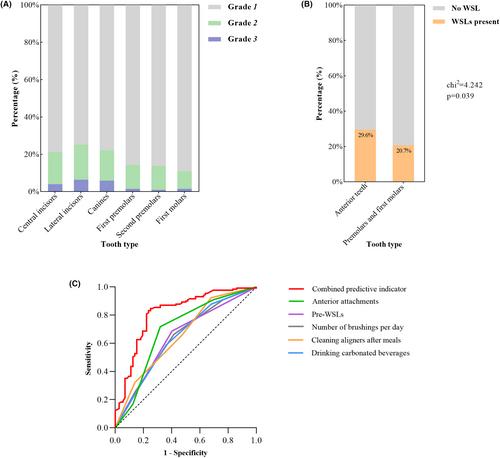
Thirty-five percent of adolescent patients developed WSLs during clear aligner treatment. Logistic regression analysis revealed that the presence of WSLs before treatment (OR 2.484, 95% CI 1.245-4.957), frequency of drinking carbonated beverages (OR 1.508, 95% CI 1.045-2.177), and number of anterior attachments (OR 2.192, 95% CI 1.502-3.198) were risk factors for the occurrence of WSLs in adolescent patients treated with clear aligners (P < .05), whereas the number of times they brushed each day (OR 0.656, 95% CI 0.454-0.947) and frequency of aligner cleaning after eating while wearing them (OR 0.611, 95% CI 0.433-0.861) were protective factors against WSLs (P < .05).

Conclusions

The incidence of WSLs was high in adolescent patients treated with clear aligners. Few brushings each day, pre-treatment WSLs, a high frequency of drinking carbonated beverages, a low frequency of aligner cleaning after eating while wearing them, and a high number of anterior attachments are strongly associated with the development of WSLs in adolescent patients treated with clear aligners.
Abstract Image

查看原文
分享 分享
微信好友 朋友圈 QQ好友 复制链接
本刊更多论文
使用透明矫形器治疗的青少年患者白斑病变的发生率、严重程度和风险因素
方法 对203名接受透明矫治器治疗的青少年患者的治疗前和治疗后口内照片进行回顾性评估,以评估白斑病的发生率和严重程度。从临床医疗文件、回顾性调查问卷和 ClinCheck® 软件中收集了患者的一般口腔状况和正畸治疗信息。结果35%的青少年患者在透明矫治器治疗期间出现了WSL。逻辑回归分析表明,治疗前存在WSL(OR 2.484,95% CI 1.245-4.957)、饮用碳酸饮料的频率(OR 1.508,95% CI 1.045-2.177)和前附着体的数量(OR 2.192,95% CI 1.502-3.198)是使用透明矫治器治疗的青少年患者发生WSL的风险因素(P < .05),而每天刷牙的次数(OR 0.656,95% CI 0.454-0.947)和佩戴时进食后清洁矫治器的频率(OR 0.611,95% CI 0.433-0.861)则是WSL的保护因素(P <.05)。在使用透明矫治器治疗的青少年患者中,每天刷牙次数少、治疗前WSL、饮用碳酸饮料的频率高、佩戴矫治器时进食后清洁矫治器的频率低以及前牙附着体数量多与WSL的发生密切相关。
本文章由计算机程序翻译,如有差异,请以英文原文为准。
求助全文
约1分钟内获得全文 去求助
来源期刊
Orthodontics & Craniofacial Research
Orthodontics & Craniofacial Research 医学-牙科与口腔外科
CiteScore
5.30
自引率
3.20%
发文量
65
审稿时长
>12 weeks
期刊介绍: Orthodontics & Craniofacial Research - Genes, Growth and Development is published to serve its readers as an international forum for the presentation and critical discussion of issues pertinent to the advancement of the specialty of orthodontics and the evidence-based knowledge of craniofacial growth and development. This forum is based on scientifically supported information, but also includes minority and conflicting opinions. The objective of the journal is to facilitate effective communication between the research community and practicing clinicians. Original papers of high scientific quality that report the findings of clinical trials, clinical epidemiology, and novel therapeutic or diagnostic approaches are appropriate submissions. Similarly, we welcome papers in genetics, developmental biology, syndromology, surgery, speech and hearing, and other biomedical disciplines related to clinical orthodontics and normal and abnormal craniofacial growth and development. In addition to original and basic research, the journal publishes concise reviews, case reports of substantial value, invited essays, letters, and announcements. The journal is published quarterly. The review of submitted papers will be coordinated by the editor and members of the editorial board. It is policy to review manuscripts within 3 to 4 weeks of receipt and to publish within 3 to 6 months of acceptance.
期刊最新文献
The Impact of Bite Turbos on the Pulpal Blood Flow in the Upper Central Incisors: A Prospective Clinical Study. Issue Information Comparative Evaluation of the Skeletal, Dentoalveolar and Dental Changes Following Maxillary Skeletal Expansion Using Expanders of Two Different Designs-A Randomised Clinical Trial. Quantifying Root Resorption on the Incisors After Clear Aligner and Fixed Appliance Therapy Using Artificial Intelligence Tool Based CBCT Surface Models: Randomized Clinical Trial. Three-Dimensional Evaluation of Secondary Alveolar Bone Grafting in Patients With Bilateral Cleft Lip and/or Palate: A 2-3-Year Post-Operative Follow-Up.
×
引用
GB/T 7714-2015
复制
MLA
复制
APA
复制
导出至
BibTeX EndNote RefMan NoteFirst NoteExpress
×
×
提示
您的信息不完整,为了账户安全,请先补充。
现在去补充
×
提示
您因"违规操作"
具体请查看互助需知
我知道了
×
提示
现在去查看 取消
×
提示
确定
0
微信
客服QQ
Book学术公众号 扫码关注我们
反馈
×
意见反馈
请填写您的意见或建议
请填写您的手机或邮箱
已复制链接
已复制链接
快去分享给好友吧!
我知道了
×
扫码分享
扫码分享
Book学术官方微信
Book学术文献互助
Book学术文献互助群
群 号:604180095
Book学术
文献互助 智能选刊 最新文献 互助须知 联系我们:info@booksci.cn
Book学术提供免费学术资源搜索服务,方便国内外学者检索中英文文献。致力于提供最便捷和优质的服务体验。
Copyright © 2023 Book学术 All rights reserved.
ghs 京公网安备 11010802042870号 京ICP备2023020795号-1





