Elizabeth Brammer-Robbins , Mohammad-Zaman Nouri , Emily K. Griffin , Juan J. Aristizabal-Henao , Nancy D. Denslow , John A. Bowden , Iske V. Larkin , Christopher J. Martyniuk
{"title":"Lipidomics and plasma hormone analysis differentiate reproductive and pregnancy statuses in Florida manatees (Trichechus manatus latirostris)","authors":"Elizabeth Brammer-Robbins , Mohammad-Zaman Nouri , Emily K. Griffin , Juan J. Aristizabal-Henao , Nancy D. Denslow , John A. Bowden , Iske V. Larkin , Christopher J. Martyniuk","doi":"10.1016/j.cbd.2024.101231","DOIUrl":null,"url":null,"abstract":"<div><p>Florida manatees (<em>Trichechus manatus latirostris</em>) are protected as a threatened species, and data are lacking regarding their reproductive physiology. This study aimed to (1) quantify plasma steroid hormones in Florida manatees from two field sites, Crystal River and Indian River Lagoon, at different gestational stages and to (2) identify individual lipids associated with pregnancy status. Ultra-high performance liquid chromatography-tandem mass spectrometric analysis was used to measure plasma steroid hormones and lipids. Pregnant female manatees were morphometrically distinct from male and non-pregnant female manatees, characterized by larger body weight and maximal girth. Progesterone concentrations in manatees were also elevated during early gestation versus late gestation. Cholesterol, an important metabolic lipid, and precursor for reproductive steroids, was not different between groups. Mass spectrometry quantified 949 lipids. Plasma concentrations of glycerophospholipids, glycerolipids, sphingolipids, acylcarnitines, and cholesteryl esters were associated with pregnancy status in the Florida manatee. Most of the lipid species associated with pregnancy were triacylglycerides, phosphatidylethanolamines, and ether-linked phosphatidylethanolamines, which may serve as energy sources for fetal development. This research contributes to improving knowledge of manatee reproductive physiology by providing data on plasma steroid hormones relative to reproductive status and by identifying plasma lipids that may be important for pregnancy. Elucidation of lipid species directly associated with pregnancy has the potential to serve as a diagnostic approach to identify pregnant individuals in fresh and archived samples. These biochemical and morphometric indicators of reproductive status advance the understanding of manatee physiology.</p></div>","PeriodicalId":55235,"journal":{"name":"Comparative Biochemistry and Physiology D-Genomics & Proteomics","volume":"50 ","pages":"Article 101231"},"PeriodicalIF":2.2000,"publicationDate":"2024-06-01","publicationTypes":"Journal Article","fieldsOfStudy":null,"isOpenAccess":false,"openAccessPdf":"","citationCount":"0","resultStr":null,"platform":"Semanticscholar","paperid":null,"PeriodicalName":"Comparative Biochemistry and Physiology D-Genomics & Proteomics","FirstCategoryId":"99","ListUrlMain":"https://www.sciencedirect.com/science/article/pii/S1744117X24000443","RegionNum":2,"RegionCategory":"生物学","ArticlePicture":[],"TitleCN":null,"AbstractTextCN":null,"PMCID":null,"EPubDate":"2024/4/3 0:00:00","PubModel":"Epub","JCR":"Q4","JCRName":"BIOCHEMISTRY & MOLECULAR BIOLOGY","Score":null,"Total":0}
引用次数: 0
Abstract
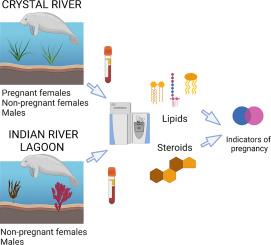
Florida manatees (Trichechus manatus latirostris) are protected as a threatened species, and data are lacking regarding their reproductive physiology. This study aimed to (1) quantify plasma steroid hormones in Florida manatees from two field sites, Crystal River and Indian River Lagoon, at different gestational stages and to (2) identify individual lipids associated with pregnancy status. Ultra-high performance liquid chromatography-tandem mass spectrometric analysis was used to measure plasma steroid hormones and lipids. Pregnant female manatees were morphometrically distinct from male and non-pregnant female manatees, characterized by larger body weight and maximal girth. Progesterone concentrations in manatees were also elevated during early gestation versus late gestation. Cholesterol, an important metabolic lipid, and precursor for reproductive steroids, was not different between groups. Mass spectrometry quantified 949 lipids. Plasma concentrations of glycerophospholipids, glycerolipids, sphingolipids, acylcarnitines, and cholesteryl esters were associated with pregnancy status in the Florida manatee. Most of the lipid species associated with pregnancy were triacylglycerides, phosphatidylethanolamines, and ether-linked phosphatidylethanolamines, which may serve as energy sources for fetal development. This research contributes to improving knowledge of manatee reproductive physiology by providing data on plasma steroid hormones relative to reproductive status and by identifying plasma lipids that may be important for pregnancy. Elucidation of lipid species directly associated with pregnancy has the potential to serve as a diagnostic approach to identify pregnant individuals in fresh and archived samples. These biochemical and morphometric indicators of reproductive status advance the understanding of manatee physiology.
期刊介绍:
Comparative Biochemistry & Physiology (CBP) publishes papers in comparative, environmental and evolutionary physiology.
Part D: Genomics and Proteomics (CBPD), focuses on “omics” approaches to physiology, including comparative and functional genomics, metagenomics, transcriptomics, proteomics, metabolomics, and lipidomics. Most studies employ “omics” and/or system biology to test specific hypotheses about molecular and biochemical mechanisms underlying physiological responses to the environment. We encourage papers that address fundamental questions in comparative physiology and biochemistry rather than studies with a focus that is purely technical, methodological or descriptive in nature.



 京公网安备 11010802042870号
京ICP备2023020795号-1
京公网安备 11010802042870号
京ICP备2023020795号-1

 分享
分享

 求助内容:
求助内容: 应助结果提醒方式:
 扫码关注我们
