Sara Gutierrez-Patricio, Jorge R. Osman, José Luis Gonzalez-Pimentel, Valme Jurado, Leonila Laiz, Alfredo Laínez Concepción, Cesareo Saiz-Jimenez, Ana Zélia Miller
{"title":"Microbiological exploration of the Cueva del Viento lava tube system in Tenerife, Canary Islands","authors":"Sara Gutierrez-Patricio, Jorge R. Osman, José Luis Gonzalez-Pimentel, Valme Jurado, Leonila Laiz, Alfredo Laínez Concepción, Cesareo Saiz-Jimenez, Ana Zélia Miller","doi":"10.1111/1758-2229.13245","DOIUrl":null,"url":null,"abstract":"<p>Cueva del Viento, located in the Canary Islands, Spain, is the Earth's sixth-longest lava tube, spanning 18,500 m, and was formed approximately 27,000 years ago. This complex volcanic cave system is characterized by a unique geomorphology, featuring an intricate network of galleries. Despite its geological significance, the geomicrobiology of Cueva del Viento remains largely unexplored. This study employed a combination of culture-dependent techniques and metabarcoding data analysis to gain a comprehensive understanding of the cave's microbial diversity. The 16S rRNA gene metabarcoding approach revealed that the coloured microbial mats (yellow, red and white) coating the cave walls are dominated by the phyla <i>Actinomycetota</i>, <i>Pseudomonadota</i> and <i>Acidobacteriota</i>. Of particular interest is the high relative abundance of the genus <i>Crossiella</i>, which is involved in urease-mediated biomineralization processes, along with the presence of genera associated with nitrogen cycling, such as <i>Nitrospira</i>. Culture-dependent techniques provided insights into the morphological characteristics of the isolated species and their potential metabolic activities, particularly for the strains <i>Streptomyces</i> spp., <i>Paenarthrobacter</i> sp. and <i>Pseudomonas</i> spp. Our findings underscore the potential of Cueva del Viento as an ideal environment for studying microbial diversity and for the isolation and characterization of novel bacterial species of biotechnological interest.</p>","PeriodicalId":163,"journal":{"name":"Environmental Microbiology Reports","volume":"16 2","pages":""},"PeriodicalIF":2.7000,"publicationDate":"2024-04-21","publicationTypes":"Journal Article","fieldsOfStudy":null,"isOpenAccess":false,"openAccessPdf":"https://onlinelibrary.wiley.com/doi/epdf/10.1111/1758-2229.13245","citationCount":"0","resultStr":null,"platform":"Semanticscholar","paperid":null,"PeriodicalName":"Environmental Microbiology Reports","FirstCategoryId":"99","ListUrlMain":"https://enviromicro-journals.onlinelibrary.wiley.com/doi/10.1111/1758-2229.13245","RegionNum":4,"RegionCategory":"生物学","ArticlePicture":[],"TitleCN":null,"AbstractTextCN":null,"PMCID":null,"EPubDate":"","PubModel":"","JCR":"Q2","JCRName":"ENVIRONMENTAL SCIENCES","Score":null,"Total":0}
引用次数: 0
Abstract
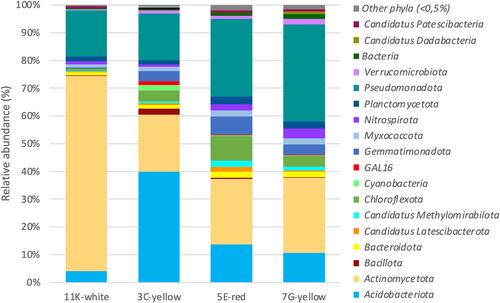
Cueva del Viento, located in the Canary Islands, Spain, is the Earth's sixth-longest lava tube, spanning 18,500 m, and was formed approximately 27,000 years ago. This complex volcanic cave system is characterized by a unique geomorphology, featuring an intricate network of galleries. Despite its geological significance, the geomicrobiology of Cueva del Viento remains largely unexplored. This study employed a combination of culture-dependent techniques and metabarcoding data analysis to gain a comprehensive understanding of the cave's microbial diversity. The 16S rRNA gene metabarcoding approach revealed that the coloured microbial mats (yellow, red and white) coating the cave walls are dominated by the phyla Actinomycetota, Pseudomonadota and Acidobacteriota. Of particular interest is the high relative abundance of the genus Crossiella, which is involved in urease-mediated biomineralization processes, along with the presence of genera associated with nitrogen cycling, such as Nitrospira. Culture-dependent techniques provided insights into the morphological characteristics of the isolated species and their potential metabolic activities, particularly for the strains Streptomyces spp., Paenarthrobacter sp. and Pseudomonas spp. Our findings underscore the potential of Cueva del Viento as an ideal environment for studying microbial diversity and for the isolation and characterization of novel bacterial species of biotechnological interest.
期刊介绍:
The journal is identical in scope to Environmental Microbiology, shares the same editorial team and submission site, and will apply the same high level acceptance criteria. The two journals will be mutually supportive and evolve side-by-side.
Environmental Microbiology Reports provides a high profile vehicle for publication of the most innovative, original and rigorous research in the field. The scope of the Journal encompasses the diversity of current research on microbial processes in the environment, microbial communities, interactions and evolution and includes, but is not limited to, the following:
the structure, activities and communal behaviour of microbial communities
microbial community genetics and evolutionary processes
microbial symbioses, microbial interactions and interactions with plants, animals and abiotic factors
microbes in the tree of life, microbial diversification and evolution
population biology and clonal structure
microbial metabolic and structural diversity
microbial physiology, growth and survival
microbes and surfaces, adhesion and biofouling
responses to environmental signals and stress factors
modelling and theory development
pollution microbiology
extremophiles and life in extreme and unusual little-explored habitats
element cycles and biogeochemical processes, primary and secondary production
microbes in a changing world, microbially-influenced global changes
evolution and diversity of archaeal and bacterial viruses
new technological developments in microbial ecology and evolution, in particular for the study of activities of microbial communities, non-culturable microorganisms and emerging pathogens.





 京公网安备 11010802042870号
京ICP备2023020795号-1
京公网安备 11010802042870号
京ICP备2023020795号-1

 分享
分享
 求助内容:
求助内容: 应助结果提醒方式:
 扫码关注我们
