Yulong Li, Xiangyang Wu, Caibin Sheng, Hailing Liu, Huizhu Liu, Yixuan Tang, Chao Liu, Qingyang Ding, Bin Xie, Xi Xiao, Rongbin Zheng, Quan Yu, Zengdan Guo, Jian Ma, Jin Wang, Jinghong Gao, Mei Tian, Wei Wang, Jia Zhou, Li Jiang, Tengfei Xiao
{"title":"IGSF8 is an innate immune checkpoint and cancer immunotherapy target","authors":"Yulong Li, Xiangyang Wu, Caibin Sheng, Hailing Liu, Huizhu Liu, Yixuan Tang, Chao Liu, Qingyang Ding, Bin Xie, Xi Xiao, Rongbin Zheng, Quan Yu, Zengdan Guo, Jian Ma, Jin Wang, Jinghong Gao, Mei Tian, Wei Wang, Jia Zhou, Li Jiang, Tengfei Xiao","doi":"10.1016/j.cell.2024.03.039","DOIUrl":null,"url":null,"abstract":"<p>Antigen presentation defects in tumors are prevalent mechanisms of adaptive immune evasion and resistance to cancer immunotherapy, whereas how tumors evade innate immunity is less clear. Using CRISPR screens, we discovered that IGSF8 expressed on tumors suppresses NK cell function by interacting with human KIR3DL2 and mouse Klra9 receptors on NK cells. IGSF8 is normally expressed in neuronal tissues and is not required for cell survival <em>in vitro</em> or <em>in vivo</em>. It is overexpressed and associated with low antigen presentation, low immune infiltration, and worse clinical outcomes in many tumors. An antibody that blocks IGSF8-NK receptor interaction enhances NK cell killing of malignant cells <em>in vitro</em> and upregulates antigen presentation, NK cell-mediated cytotoxicity, and T cell signaling <em>in vivo</em>. In syngeneic tumor models, anti-IGSF8 alone, or in combination with anti-PD1, inhibits tumor growth. Our results indicate that IGSF8 is an innate immune checkpoint that could be exploited as a therapeutic target.</p>","PeriodicalId":9656,"journal":{"name":"Cell","volume":"33 1","pages":""},"PeriodicalIF":42.5000,"publicationDate":"2024-04-23","publicationTypes":"Journal Article","fieldsOfStudy":null,"isOpenAccess":false,"openAccessPdf":"","citationCount":"0","resultStr":null,"platform":"Semanticscholar","paperid":null,"PeriodicalName":"Cell","FirstCategoryId":"99","ListUrlMain":"https://doi.org/10.1016/j.cell.2024.03.039","RegionNum":1,"RegionCategory":"生物学","ArticlePicture":[],"TitleCN":null,"AbstractTextCN":null,"PMCID":null,"EPubDate":"","PubModel":"","JCR":"Q1","JCRName":"BIOCHEMISTRY & MOLECULAR BIOLOGY","Score":null,"Total":0}
引用次数: 0
Abstract
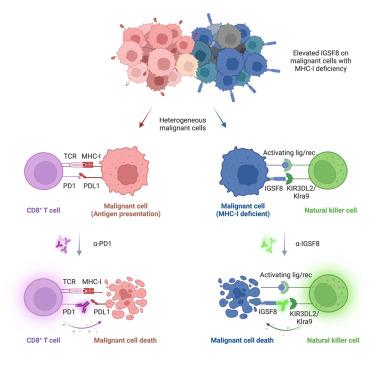
Antigen presentation defects in tumors are prevalent mechanisms of adaptive immune evasion and resistance to cancer immunotherapy, whereas how tumors evade innate immunity is less clear. Using CRISPR screens, we discovered that IGSF8 expressed on tumors suppresses NK cell function by interacting with human KIR3DL2 and mouse Klra9 receptors on NK cells. IGSF8 is normally expressed in neuronal tissues and is not required for cell survival in vitro or in vivo. It is overexpressed and associated with low antigen presentation, low immune infiltration, and worse clinical outcomes in many tumors. An antibody that blocks IGSF8-NK receptor interaction enhances NK cell killing of malignant cells in vitro and upregulates antigen presentation, NK cell-mediated cytotoxicity, and T cell signaling in vivo. In syngeneic tumor models, anti-IGSF8 alone, or in combination with anti-PD1, inhibits tumor growth. Our results indicate that IGSF8 is an innate immune checkpoint that could be exploited as a therapeutic target.
肿瘤中的抗原递呈缺陷是适应性免疫逃避和抗癌免疫疗法的普遍机制,而肿瘤如何逃避先天性免疫则不太清楚。通过CRISPR筛选,我们发现肿瘤上表达的IGSF8通过与NK细胞上的人KIR3DL2和小鼠Klra9受体相互作用,抑制了NK细胞的功能。IGSF8 在神经元组织中正常表达,体外或体内细胞存活都不需要它。在许多肿瘤中,它的过度表达与低抗原呈递、低免疫浸润和更差的临床结果有关。阻断 IGSF8-NK 受体相互作用的抗体能增强 NK 细胞在体外对恶性细胞的杀伤力,并上调抗原呈递、NK 细胞介导的细胞毒性和体内 T 细胞信号传导。在合成肿瘤模型中,抗IGSF8单独或与抗PD1联用都能抑制肿瘤生长。我们的研究结果表明,IGSF8是一种先天性免疫检查点,可作为治疗靶点加以利用。
期刊介绍:
Cells is an international, peer-reviewed, open access journal that focuses on cell biology, molecular biology, and biophysics. It is affiliated with several societies, including the Spanish Society for Biochemistry and Molecular Biology (SEBBM), Nordic Autophagy Society (NAS), Spanish Society of Hematology and Hemotherapy (SEHH), and Society for Regenerative Medicine (Russian Federation) (RPO).
The journal publishes research findings of significant importance in various areas of experimental biology, such as cell biology, molecular biology, neuroscience, immunology, virology, microbiology, cancer, human genetics, systems biology, signaling, and disease mechanisms and therapeutics. The primary criterion for considering papers is whether the results contribute to significant conceptual advances or raise thought-provoking questions and hypotheses related to interesting and important biological inquiries.
In addition to primary research articles presented in four formats, Cells also features review and opinion articles in its "leading edge" section, discussing recent research advancements and topics of interest to its wide readership.



 京公网安备 11010802042870号
京ICP备2023020795号-1
京公网安备 11010802042870号
京ICP备2023020795号-1

 分享
分享
 求助内容:
求助内容: 应助结果提醒方式:
 扫码关注我们
