Joey Huang , Ariel Han , Ana Villanueva , Ziyi Liu , Zhengzhe Zhu , Karthik Ramani , Kylie Peppler
{"title":"Deepening children’s STEM learning through making and creative writing","authors":"Joey Huang , Ariel Han , Ana Villanueva , Ziyi Liu , Zhengzhe Zhu , Karthik Ramani , Kylie Peppler","doi":"10.1016/j.ijcci.2024.100651","DOIUrl":null,"url":null,"abstract":"<div><p>Current trends demonstrate that researchers and K-12 educators are moving towards integrating computational thinking (CT) concepts outside of the computer science (CS) classroom (Lee et al., 2020). However, one of the present challenges includes a lack of engaging learning content and instruction for translating computational concepts that non-CS instructors can bring into their classrooms. Our research team developed the Grove-Blockly platform, a website that employs block-based programming and physical computing elements with simulations to support CT learning and IoT practices. We designed a 5-day workshop with the National Writing Project for students to engage in STEAM learning through making and creative writing. By examining students’ learning through the processes and outcomes of making, coding, and creative writing, we aim to better understand how learning occurs at the intersections of making, writing, and computing. The findings show students’ positive learning outcomes of CT and physical computing from the workshop. Mainly, students gained a deeper understanding of IoT elements (e.g., sensors, actuators) through the process of making and creative writing. This work provides empirical evidence on how students learn CT and computational practices through making and creative writing. Finally, we discuss how the engagement of STEAM practices supports and empowers students’ learning of CT and physical computing through the creation of e-crafts by students.</p></div>","PeriodicalId":38431,"journal":{"name":"International Journal of Child-Computer Interaction","volume":"40 ","pages":"Article 100651"},"PeriodicalIF":0.0000,"publicationDate":"2024-04-10","publicationTypes":"Journal Article","fieldsOfStudy":null,"isOpenAccess":false,"openAccessPdf":"","citationCount":"0","resultStr":null,"platform":"Semanticscholar","paperid":null,"PeriodicalName":"International Journal of Child-Computer Interaction","FirstCategoryId":"1085","ListUrlMain":"https://www.sciencedirect.com/science/article/pii/S2212868924000199","RegionNum":0,"RegionCategory":null,"ArticlePicture":[],"TitleCN":null,"AbstractTextCN":null,"PMCID":null,"EPubDate":"","PubModel":"","JCR":"Q1","JCRName":"Social Sciences","Score":null,"Total":0}
引用次数: 0
Abstract
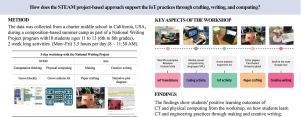
Current trends demonstrate that researchers and K-12 educators are moving towards integrating computational thinking (CT) concepts outside of the computer science (CS) classroom (Lee et al., 2020). However, one of the present challenges includes a lack of engaging learning content and instruction for translating computational concepts that non-CS instructors can bring into their classrooms. Our research team developed the Grove-Blockly platform, a website that employs block-based programming and physical computing elements with simulations to support CT learning and IoT practices. We designed a 5-day workshop with the National Writing Project for students to engage in STEAM learning through making and creative writing. By examining students’ learning through the processes and outcomes of making, coding, and creative writing, we aim to better understand how learning occurs at the intersections of making, writing, and computing. The findings show students’ positive learning outcomes of CT and physical computing from the workshop. Mainly, students gained a deeper understanding of IoT elements (e.g., sensors, actuators) through the process of making and creative writing. This work provides empirical evidence on how students learn CT and computational practices through making and creative writing. Finally, we discuss how the engagement of STEAM practices supports and empowers students’ learning of CT and physical computing through the creation of e-crafts by students.



 京公网安备 11010802042870号
京ICP备2023020795号-1
京公网安备 11010802042870号
京ICP备2023020795号-1

 分享
分享
 求助内容:
求助内容: 应助结果提醒方式:
 扫码关注我们
