{"title":"Investigation of group 13 elements as potential candidates for p-type dopants in the narrow-gap thermoelectric semiconductor α-SrSi2","authors":"Haruno Kunioka, Daishi Shiojiri, Shinta Takahashi, Kota Hiratsuka, Masato Yamaguchi, Naomi Hirayama, Yoji Imai, Motoharu Imai, Tsutomu Iida","doi":"10.1007/s10853-024-09653-x","DOIUrl":null,"url":null,"abstract":"<div><p>To investigate the possibility of <i>p</i>-type doping of α-SrSi<sub>2</sub>, a promising as an eco-friendly thermoelectric material, the energy changes of substitutions of the Si site of α-SrSi<sub>2</sub> by group 13 elements were evaluated using first-principles calculations. It is found that Ga doping was the most energetically favorable dopant while In is the most unfavorable. We examined the synthesis of Ga- and In-doped α-SrSi<sub>2</sub> using the vertical Bridgeman method and investigated their thermoelectric properties. The Ga atoms were doped to α-SrSi<sub>2</sub> successfully up to 1.0 at. %, while In atoms could not be doped as suggested by calculations. For experimental prepared Ga-doped samples, the carrier density was observed to increase with Ga doping, from 3.58 × 10<sup>19</sup> cm<sup>−3</sup> for undoped α-SrSi<sub>2</sub> to 4.49 × 10<sup>20</sup> cm<sup>−3</sup> for a 1.0 at. % Ga-doped sample at 300 K. The temperature dependence of carrier concentrations was observed to change from negative to positive with increasing Ga content. In addition, the temperature dependence of the Seebeck coefficient was also observed to change from negative to positive with increasing Ga content. The results indicate that α-SrSi<sub>2</sub> undergoes a semiconductor–metal transition with Ga doping. The power factor for the undoped sample was quite high, at 2.5 mW/mK<sup>2</sup>, while the sample with 0.3 at. % Ga had a value of 1.1 mW/mK<sup>2</sup> at room temperature.</p></div>","PeriodicalId":645,"journal":{"name":"Journal of Materials Science","volume":"59 18","pages":""},"PeriodicalIF":3.9000,"publicationDate":"2024-04-25","publicationTypes":"Journal Article","fieldsOfStudy":null,"isOpenAccess":false,"openAccessPdf":"https://link.springer.com/content/pdf/10.1007/s10853-024-09653-x.pdf","citationCount":"0","resultStr":null,"platform":"Semanticscholar","paperid":null,"PeriodicalName":"Journal of Materials Science","FirstCategoryId":"88","ListUrlMain":"https://link.springer.com/article/10.1007/s10853-024-09653-x","RegionNum":3,"RegionCategory":"材料科学","ArticlePicture":[],"TitleCN":null,"AbstractTextCN":null,"PMCID":null,"EPubDate":"","PubModel":"","JCR":"Q2","JCRName":"MATERIALS SCIENCE, MULTIDISCIPLINARY","Score":null,"Total":0}
引用次数: 0
Abstract
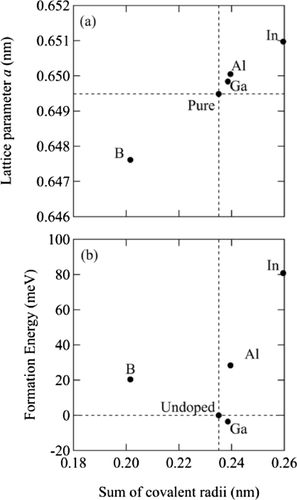
To investigate the possibility of p-type doping of α-SrSi2, a promising as an eco-friendly thermoelectric material, the energy changes of substitutions of the Si site of α-SrSi2 by group 13 elements were evaluated using first-principles calculations. It is found that Ga doping was the most energetically favorable dopant while In is the most unfavorable. We examined the synthesis of Ga- and In-doped α-SrSi2 using the vertical Bridgeman method and investigated their thermoelectric properties. The Ga atoms were doped to α-SrSi2 successfully up to 1.0 at. %, while In atoms could not be doped as suggested by calculations. For experimental prepared Ga-doped samples, the carrier density was observed to increase with Ga doping, from 3.58 × 1019 cm−3 for undoped α-SrSi2 to 4.49 × 1020 cm−3 for a 1.0 at. % Ga-doped sample at 300 K. The temperature dependence of carrier concentrations was observed to change from negative to positive with increasing Ga content. In addition, the temperature dependence of the Seebeck coefficient was also observed to change from negative to positive with increasing Ga content. The results indicate that α-SrSi2 undergoes a semiconductor–metal transition with Ga doping. The power factor for the undoped sample was quite high, at 2.5 mW/mK2, while the sample with 0.3 at. % Ga had a value of 1.1 mW/mK2 at room temperature.
期刊介绍:
The Journal of Materials Science publishes reviews, full-length papers, and short Communications recording original research results on, or techniques for studying the relationship between structure, properties, and uses of materials. The subjects are seen from international and interdisciplinary perspectives covering areas including metals, ceramics, glasses, polymers, electrical materials, composite materials, fibers, nanostructured materials, nanocomposites, and biological and biomedical materials. The Journal of Materials Science is now firmly established as the leading source of primary communication for scientists investigating the structure and properties of all engineering materials.



 京公网安备 11010802042870号
京ICP备2023020795号-1
京公网安备 11010802042870号
京ICP备2023020795号-1

 分享
分享
 求助内容:
求助内容: 应助结果提醒方式:
 扫码关注我们
