{"title":"Computational Models of the Fluid Mechanics of the Stomach","authors":"Sharun Kuhar, Rajat Mittal","doi":"10.1007/s41745-024-00421-z","DOIUrl":null,"url":null,"abstract":"<div><p>In the last 2 decades, the interest in developing computational fluid dynamics (CFD) models of the stomach has grown steadily. This bean-shaped organ plays a key role in our digestive system by chemically and physically processing food before emptying it into the intestines. The stomach walls drive the flow of the contents to achieve mixing, grinding, and emptying of the contents. Most computational models prescribe the motion of the walls and solve for the flow field inside the lumen, but some recent models also incorporate fluid–structure interaction between the muscles and the contents. Some models employ a simplified two-dimensional or axisymmetric geometry, while others use anatomically realistic stomach shapes. The emptying mechanism employed by the model and the inclusion, or lack thereof, of the pylorus further add to the nonconformity among the different models. In this review, we summarise these different CFD models of the stomach available in the literature. A comparison between these models with regard to their complexity, validation, and specificity is presented. While there has been rapid progress in the past few years, computational models are still far behind their other physiological counterparts, such as cardiovascular flows.</p></div>","PeriodicalId":675,"journal":{"name":"Journal of the Indian Institute of Science","volume":"104 1","pages":"65 - 76"},"PeriodicalIF":2.3000,"publicationDate":"2024-04-25","publicationTypes":"Journal Article","fieldsOfStudy":null,"isOpenAccess":false,"openAccessPdf":"","citationCount":"0","resultStr":null,"platform":"Semanticscholar","paperid":null,"PeriodicalName":"Journal of the Indian Institute of Science","FirstCategoryId":"103","ListUrlMain":"https://link.springer.com/article/10.1007/s41745-024-00421-z","RegionNum":4,"RegionCategory":"综合性期刊","ArticlePicture":[],"TitleCN":null,"AbstractTextCN":null,"PMCID":null,"EPubDate":"","PubModel":"","JCR":"Q2","JCRName":"MULTIDISCIPLINARY SCIENCES","Score":null,"Total":0}
引用次数: 0
Abstract
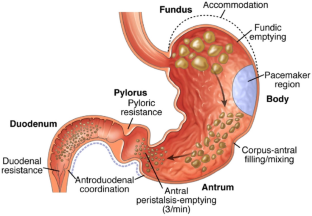
In the last 2 decades, the interest in developing computational fluid dynamics (CFD) models of the stomach has grown steadily. This bean-shaped organ plays a key role in our digestive system by chemically and physically processing food before emptying it into the intestines. The stomach walls drive the flow of the contents to achieve mixing, grinding, and emptying of the contents. Most computational models prescribe the motion of the walls and solve for the flow field inside the lumen, but some recent models also incorporate fluid–structure interaction between the muscles and the contents. Some models employ a simplified two-dimensional or axisymmetric geometry, while others use anatomically realistic stomach shapes. The emptying mechanism employed by the model and the inclusion, or lack thereof, of the pylorus further add to the nonconformity among the different models. In this review, we summarise these different CFD models of the stomach available in the literature. A comparison between these models with regard to their complexity, validation, and specificity is presented. While there has been rapid progress in the past few years, computational models are still far behind their other physiological counterparts, such as cardiovascular flows.
期刊介绍:
Started in 1914 as the second scientific journal to be published from India, the Journal of the Indian Institute of Science became a multidisciplinary reviews journal covering all disciplines of science, engineering and technology in 2007. Since then each issue is devoted to a specific topic of contemporary research interest and guest-edited by eminent researchers. Authors selected by the Guest Editor(s) and/or the Editorial Board are invited to submit their review articles; each issue is expected to serve as a state-of-the-art review of a topic from multiple viewpoints.



 京公网安备 11010802042870号
京ICP备2023020795号-1
京公网安备 11010802042870号
京ICP备2023020795号-1

 分享
分享
 求助内容:
求助内容: 应助结果提醒方式:
 扫码关注我们
