{"title":"Exploring artificial intelligence robo-advisor in banking industry: a platform model","authors":"Domenica Barile, Giustina Secundo, Candida Bussoli","doi":"10.1108/md-08-2023-1324","DOIUrl":null,"url":null,"abstract":"PurposeThis study examines the Robo-Advisors (RA) based on Artificial Intelligence (AI), a new service that digitises and automates investment decisions in the financial and banking industries to provide low-cost and personalised financial advice. The RAs use objective algorithms to select portfolios, reduce behavioural biases, and improve transactions. They are inexpensive, accessible, and transparent platforms. Objective algorithms improve the believability of portfolio selection.Design/methodology/approachThis study adopts a qualitative approach consisting of an exploratory examination of seven different RA case studies and analyses the RA platforms used in the banking industry.FindingsThe findings provide two different approaches to running a business that are appropriate for either fully automated or hybrid RAs through the realisation of two platform model frameworks. The research reveals that relying solely on algorithms and not including any services involving human interaction in a company model is inadequate to meet the requirements of customers in decision-making.Research limitations/implicationsThis study emphasises key robo-advisory features, such as investor profiling, asset allocation, investment strategies, portfolio rebalancing, and performance evaluation. These features provide managers and practitioners with new information on enhancing client satisfaction, improving services, and adjusting to dynamic market demands.Originality/valueThis study fills the research gap related to the analysis of RA platform models by providing a meticulous analysis of two different types of RAs, namely, fully automated and hybrid, which have not received adequate attention in the literature.","PeriodicalId":4,"journal":{"name":"ACS Applied Energy Materials","volume":"6 4","pages":""},"PeriodicalIF":5.5000,"publicationDate":"2024-04-25","publicationTypes":"Journal Article","fieldsOfStudy":null,"isOpenAccess":false,"openAccessPdf":"","citationCount":"0","resultStr":null,"platform":"Semanticscholar","paperid":null,"PeriodicalName":"ACS Applied Energy Materials","FirstCategoryId":"91","ListUrlMain":"https://doi.org/10.1108/md-08-2023-1324","RegionNum":3,"RegionCategory":"材料科学","ArticlePicture":[],"TitleCN":null,"AbstractTextCN":null,"PMCID":null,"EPubDate":"","PubModel":"","JCR":"Q2","JCRName":"CHEMISTRY, PHYSICAL","Score":null,"Total":0}
引用次数: 0
Abstract
PurposeThis study examines the Robo-Advisors (RA) based on Artificial Intelligence (AI), a new service that digitises and automates investment decisions in the financial and banking industries to provide low-cost and personalised financial advice. The RAs use objective algorithms to select portfolios, reduce behavioural biases, and improve transactions. They are inexpensive, accessible, and transparent platforms. Objective algorithms improve the believability of portfolio selection.Design/methodology/approachThis study adopts a qualitative approach consisting of an exploratory examination of seven different RA case studies and analyses the RA platforms used in the banking industry.FindingsThe findings provide two different approaches to running a business that are appropriate for either fully automated or hybrid RAs through the realisation of two platform model frameworks. The research reveals that relying solely on algorithms and not including any services involving human interaction in a company model is inadequate to meet the requirements of customers in decision-making.Research limitations/implicationsThis study emphasises key robo-advisory features, such as investor profiling, asset allocation, investment strategies, portfolio rebalancing, and performance evaluation. These features provide managers and practitioners with new information on enhancing client satisfaction, improving services, and adjusting to dynamic market demands.Originality/valueThis study fills the research gap related to the analysis of RA platform models by providing a meticulous analysis of two different types of RAs, namely, fully automated and hybrid, which have not received adequate attention in the literature.
期刊介绍:
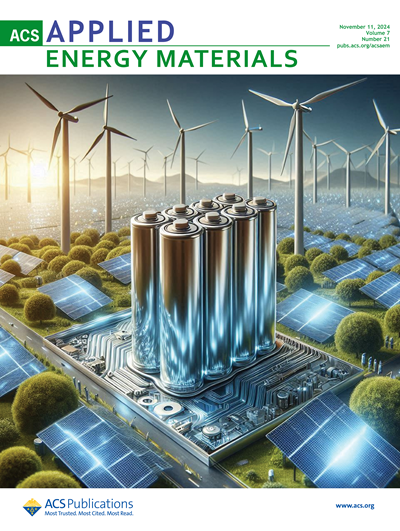
ACS Applied Energy Materials is an interdisciplinary journal publishing original research covering all aspects of materials, engineering, chemistry, physics and biology relevant to energy conversion and storage. The journal is devoted to reports of new and original experimental and theoretical research of an applied nature that integrate knowledge in the areas of materials, engineering, physics, bioscience, and chemistry into important energy applications.



 京公网安备 11010802042870号
京ICP备2023020795号-1
京公网安备 11010802042870号
京ICP备2023020795号-1

 分享
分享
 求助内容:
求助内容: 应助结果提醒方式:
 扫码关注我们
