Nanostructured Co3O4-graced 3D carbon felts for improved mechanical interlocking in epoxy composites: morphological and mechanical/tribological optimization
Muad Muhammed Ali, Nabil Kadhim Taieh, Haidar Akram Hussein, Ying Li, Man Jiang, Zuowan Zhou
{"title":"Nanostructured Co3O4-graced 3D carbon felts for improved mechanical interlocking in epoxy composites: morphological and mechanical/tribological optimization","authors":"Muad Muhammed Ali, Nabil Kadhim Taieh, Haidar Akram Hussein, Ying Li, Man Jiang, Zuowan Zhou","doi":"10.1007/s10853-024-09646-w","DOIUrl":null,"url":null,"abstract":"<div><p>This study utilizes mechanical interlocking as a method to improve the adhesion between the 3D carbon felt foam (CFs) and the epoxy matrix (EP). Hydrothermally, Co<sub>3</sub>O<sub>4</sub> nanoarrays in nanostrips, nanowires, nanoprisms, and nanostars were added to CFs surfaces. Pure 3D carbon fiber-epoxy composites had 62.7% higher storage modulus and 7.8% higher glass transition temperature than pure epoxy. The 3D carbon fiber/epoxy composite with Co<sub>3</sub>O<sub>4</sub> nanowires has a storage modulus of 5297 MPa and a Tg of 148.4 °C, which is higher than that of pure 3D CFs and other nanocomposites. Compared to pure 3D CFs/ EP, Co<sub>3</sub>O<sub>4</sub> nanowires boost flexural strength by 75.0%. Nano-strip, nano-prismatic, and nanostar composites improve 53.6%, 21.4%, and 11.43%, respectively. Pure 3D CFs boost epoxy matrix impact strength to 174.6%. The impact strength of the Co<sub>3</sub>O<sub>4</sub> nano-wire@CFs/EP composite is 45.6% higher than that of the 3D CFs/EP composite. Nano-strip, nano-prismatic, and nano-star modifications are 31.2%, 19.5%, and 2.5%. 3D CFs/EP composites have a 69 MPa initial tensile strength. However, Co<sub>3</sub>O<sub>4</sub> nano-wires increase tensile strength by 73% to 130 MPa. Nano-strip, nano-prismatic, and nanostar composites outperform 3D CFs/EP by 68%, 33%, and 7%, respectively. In 3D CFs/EP composites, Co<sub>3</sub>O<sub>4</sub> nanowires reduce wear by 50.0% and friction by 27.9%.</p></div>","PeriodicalId":645,"journal":{"name":"Journal of Materials Science","volume":"59 18","pages":""},"PeriodicalIF":3.9000,"publicationDate":"2024-04-25","publicationTypes":"Journal Article","fieldsOfStudy":null,"isOpenAccess":false,"openAccessPdf":"","citationCount":"0","resultStr":null,"platform":"Semanticscholar","paperid":null,"PeriodicalName":"Journal of Materials Science","FirstCategoryId":"88","ListUrlMain":"https://link.springer.com/article/10.1007/s10853-024-09646-w","RegionNum":3,"RegionCategory":"材料科学","ArticlePicture":[],"TitleCN":null,"AbstractTextCN":null,"PMCID":null,"EPubDate":"","PubModel":"","JCR":"Q2","JCRName":"MATERIALS SCIENCE, MULTIDISCIPLINARY","Score":null,"Total":0}
引用次数: 0
Abstract
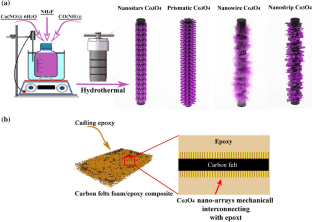
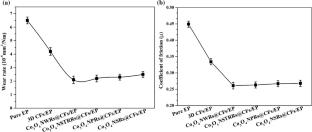
This study utilizes mechanical interlocking as a method to improve the adhesion between the 3D carbon felt foam (CFs) and the epoxy matrix (EP). Hydrothermally, Co3O4 nanoarrays in nanostrips, nanowires, nanoprisms, and nanostars were added to CFs surfaces. Pure 3D carbon fiber-epoxy composites had 62.7% higher storage modulus and 7.8% higher glass transition temperature than pure epoxy. The 3D carbon fiber/epoxy composite with Co3O4 nanowires has a storage modulus of 5297 MPa and a Tg of 148.4 °C, which is higher than that of pure 3D CFs and other nanocomposites. Compared to pure 3D CFs/ EP, Co3O4 nanowires boost flexural strength by 75.0%. Nano-strip, nano-prismatic, and nanostar composites improve 53.6%, 21.4%, and 11.43%, respectively. Pure 3D CFs boost epoxy matrix impact strength to 174.6%. The impact strength of the Co3O4 nano-wire@CFs/EP composite is 45.6% higher than that of the 3D CFs/EP composite. Nano-strip, nano-prismatic, and nano-star modifications are 31.2%, 19.5%, and 2.5%. 3D CFs/EP composites have a 69 MPa initial tensile strength. However, Co3O4 nano-wires increase tensile strength by 73% to 130 MPa. Nano-strip, nano-prismatic, and nanostar composites outperform 3D CFs/EP by 68%, 33%, and 7%, respectively. In 3D CFs/EP composites, Co3O4 nanowires reduce wear by 50.0% and friction by 27.9%.
期刊介绍:
The Journal of Materials Science publishes reviews, full-length papers, and short Communications recording original research results on, or techniques for studying the relationship between structure, properties, and uses of materials. The subjects are seen from international and interdisciplinary perspectives covering areas including metals, ceramics, glasses, polymers, electrical materials, composite materials, fibers, nanostructured materials, nanocomposites, and biological and biomedical materials. The Journal of Materials Science is now firmly established as the leading source of primary communication for scientists investigating the structure and properties of all engineering materials.



 京公网安备 11010802042870号
京ICP备2023020795号-1
京公网安备 11010802042870号
京ICP备2023020795号-1

 分享
分享
 求助内容:
求助内容: 应助结果提醒方式:
 扫码关注我们
