{"title":"Molecular dynamics simulation and experimental study on the effect of surfactants on the compatibility of P(S-DVB)-SO4/CeO2 composite interface","authors":"Huiling Jia, Hongxu Zhang, Menghao Liang, Jinxiu Wu, Xin Tan, Yanan Cao","doi":"10.1007/s10853-024-09511-w","DOIUrl":null,"url":null,"abstract":"<div><p>To improve the interfacial compatibility of core–shell composite abrasive composed of sulfate-modified divinylbenzene crosslinked polystyrene P(S-DVB)-SO<sub>4</sub>) and CeO<sub>2</sub>, cetyltrimethylammonium bromide (CTAB), sodium dodecylbenzene sulfonate (SDBS), and polyethylene glycol (PEG) were introduced. Using molecular dynamics simulation method, the adsorption configurations, adsorption energies, relative concentration distribution and radial distribution function (RDF) of three surfactants on P(S-DVB)-SO<sub>4</sub> and CeO<sub>2</sub> surfaces were analyzed, and it was found that CTAB has the best interfacial compatibility. The changes in atomic structure, relative concentration distribution, and binding energy of P(S-DVB)-SO<sub>4</sub>/CeO<sub>2</sub>(100) interface after adding CTAB were studied. The P(S-DVB)-SO<sub>4</sub>/CeO<sub>2</sub> abrasive was prepared by the soap-free lotion polymerization. The TEM, HRTEM, nitrogen adsorption–desorption (BET), and atomic force microscopy (AFM) nanoindentation tests were conducted, and the influences of CTAB on the interface structure and strength were further verified through experiment. Finally, the effect mechanism of surfactants on the compatibility of P(S-DVB)-SO<sub>4</sub>/CeO<sub>2</sub> interface was obtained.</p></div>","PeriodicalId":645,"journal":{"name":"Journal of Materials Science","volume":"59 18","pages":""},"PeriodicalIF":3.9000,"publicationDate":"2024-04-25","publicationTypes":"Journal Article","fieldsOfStudy":null,"isOpenAccess":false,"openAccessPdf":"","citationCount":"0","resultStr":null,"platform":"Semanticscholar","paperid":null,"PeriodicalName":"Journal of Materials Science","FirstCategoryId":"88","ListUrlMain":"https://link.springer.com/article/10.1007/s10853-024-09511-w","RegionNum":3,"RegionCategory":"材料科学","ArticlePicture":[],"TitleCN":null,"AbstractTextCN":null,"PMCID":null,"EPubDate":"","PubModel":"","JCR":"Q2","JCRName":"MATERIALS SCIENCE, MULTIDISCIPLINARY","Score":null,"Total":0}
引用次数: 0
Abstract
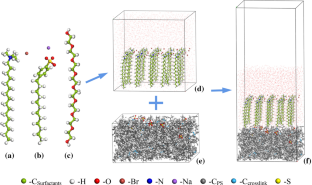
To improve the interfacial compatibility of core–shell composite abrasive composed of sulfate-modified divinylbenzene crosslinked polystyrene P(S-DVB)-SO4) and CeO2, cetyltrimethylammonium bromide (CTAB), sodium dodecylbenzene sulfonate (SDBS), and polyethylene glycol (PEG) were introduced. Using molecular dynamics simulation method, the adsorption configurations, adsorption energies, relative concentration distribution and radial distribution function (RDF) of three surfactants on P(S-DVB)-SO4 and CeO2 surfaces were analyzed, and it was found that CTAB has the best interfacial compatibility. The changes in atomic structure, relative concentration distribution, and binding energy of P(S-DVB)-SO4/CeO2(100) interface after adding CTAB were studied. The P(S-DVB)-SO4/CeO2 abrasive was prepared by the soap-free lotion polymerization. The TEM, HRTEM, nitrogen adsorption–desorption (BET), and atomic force microscopy (AFM) nanoindentation tests were conducted, and the influences of CTAB on the interface structure and strength were further verified through experiment. Finally, the effect mechanism of surfactants on the compatibility of P(S-DVB)-SO4/CeO2 interface was obtained.
期刊介绍:
The Journal of Materials Science publishes reviews, full-length papers, and short Communications recording original research results on, or techniques for studying the relationship between structure, properties, and uses of materials. The subjects are seen from international and interdisciplinary perspectives covering areas including metals, ceramics, glasses, polymers, electrical materials, composite materials, fibers, nanostructured materials, nanocomposites, and biological and biomedical materials. The Journal of Materials Science is now firmly established as the leading source of primary communication for scientists investigating the structure and properties of all engineering materials.



 京公网安备 11010802042870号
京ICP备2023020795号-1
京公网安备 11010802042870号
京ICP备2023020795号-1

 分享
分享
 求助内容:
求助内容: 应助结果提醒方式:
 扫码关注我们
