Dongmei Liu, Ye Lin, Lihui Zhou, Sisi Song, Kai Gong
{"title":"The interfaces in incompatible A/B homopolymer blends with graft copolymer: a dissipative particle dynamics simulation study","authors":"Dongmei Liu, Ye Lin, Lihui Zhou, Sisi Song, Kai Gong","doi":"10.1007/s10853-024-09665-7","DOIUrl":null,"url":null,"abstract":"<div><p>The use of graft copolymers as surfactants offers a promising approach to enhance the interfacial properties of polymer blends or fluid blends. The effectiveness of these copolymers is closely related to their topologies. In this study, we employed dissipative particle dynamics (DPD) simulations to investigate the interfaces in incompatible A/B homopolymer blends with graft copolymer AB. In particular, we kept the molecular weights of the “A4B4 series” and “A8B8 series” copolymers constant but varied their architecture. The results show that the \"A4B4 series\" copolymers exhibit greater efficacy in reinforcing the interface (reduce interfacial tension), as compared to the \"A8B8 series\". The reduction in interfacial tension achieved by the diblock copolymer is comparatively lower than that achieved by the graft copolymer. Among the various graft copolymers studied, it has been observed that A1A1[B2]A2[B2]/a-S3 graft copolymers exhibit the highest efficiency in reducing interfacial tension. As the graft copolymer A1A1[B2]A2[B2]/a-S3 concentration varies from 0.05 to 0.15, a notable inverse relationship between the degree of copolymer enrichment at the central region of the interface and the corresponding interfacial tension was observed. Specifically, an increase in the concentration of A1A1[B2]A2[B2]/a-S3 graft copolymers led to a discernible decrease in interfacial tension. Due to the saturation of the interface at <i>c</i><sub>cp</sub> = 0.15, upon increasing the concentration of the graft copolymers A1A1[B2]A2[B2]/a-S3 from 0.15 to 0.2, the added copolymers mainly enriched in the homopolymer phase. As a result, there is an absence of further reduction in interfacial tension. These studies allow us to predict the reduction in interfacial tension produced by a wide variety of copolymers and thereby permit a rational design of effective compatibilizers.</p></div>","PeriodicalId":645,"journal":{"name":"Journal of Materials Science","volume":"59 38","pages":"17945 - 17957"},"PeriodicalIF":3.9000,"publicationDate":"2024-04-25","publicationTypes":"Journal Article","fieldsOfStudy":null,"isOpenAccess":false,"openAccessPdf":"","citationCount":"0","resultStr":null,"platform":"Semanticscholar","paperid":null,"PeriodicalName":"Journal of Materials Science","FirstCategoryId":"88","ListUrlMain":"https://link.springer.com/article/10.1007/s10853-024-09665-7","RegionNum":3,"RegionCategory":"材料科学","ArticlePicture":[],"TitleCN":null,"AbstractTextCN":null,"PMCID":null,"EPubDate":"","PubModel":"","JCR":"Q2","JCRName":"MATERIALS SCIENCE, MULTIDISCIPLINARY","Score":null,"Total":0}
引用次数: 0
Abstract
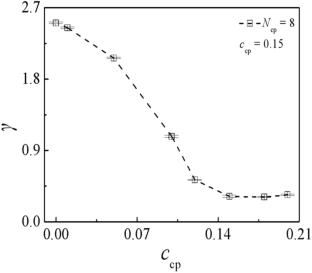
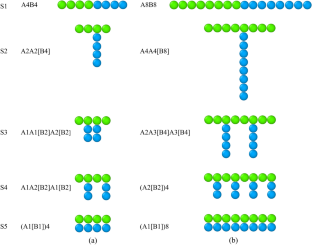
The use of graft copolymers as surfactants offers a promising approach to enhance the interfacial properties of polymer blends or fluid blends. The effectiveness of these copolymers is closely related to their topologies. In this study, we employed dissipative particle dynamics (DPD) simulations to investigate the interfaces in incompatible A/B homopolymer blends with graft copolymer AB. In particular, we kept the molecular weights of the “A4B4 series” and “A8B8 series” copolymers constant but varied their architecture. The results show that the "A4B4 series" copolymers exhibit greater efficacy in reinforcing the interface (reduce interfacial tension), as compared to the "A8B8 series". The reduction in interfacial tension achieved by the diblock copolymer is comparatively lower than that achieved by the graft copolymer. Among the various graft copolymers studied, it has been observed that A1A1[B2]A2[B2]/a-S3 graft copolymers exhibit the highest efficiency in reducing interfacial tension. As the graft copolymer A1A1[B2]A2[B2]/a-S3 concentration varies from 0.05 to 0.15, a notable inverse relationship between the degree of copolymer enrichment at the central region of the interface and the corresponding interfacial tension was observed. Specifically, an increase in the concentration of A1A1[B2]A2[B2]/a-S3 graft copolymers led to a discernible decrease in interfacial tension. Due to the saturation of the interface at ccp = 0.15, upon increasing the concentration of the graft copolymers A1A1[B2]A2[B2]/a-S3 from 0.15 to 0.2, the added copolymers mainly enriched in the homopolymer phase. As a result, there is an absence of further reduction in interfacial tension. These studies allow us to predict the reduction in interfacial tension produced by a wide variety of copolymers and thereby permit a rational design of effective compatibilizers.
期刊介绍:
The Journal of Materials Science publishes reviews, full-length papers, and short Communications recording original research results on, or techniques for studying the relationship between structure, properties, and uses of materials. The subjects are seen from international and interdisciplinary perspectives covering areas including metals, ceramics, glasses, polymers, electrical materials, composite materials, fibers, nanostructured materials, nanocomposites, and biological and biomedical materials. The Journal of Materials Science is now firmly established as the leading source of primary communication for scientists investigating the structure and properties of all engineering materials.



 京公网安备 11010802042870号
京ICP备2023020795号-1
京公网安备 11010802042870号
京ICP备2023020795号-1

 分享
分享
 求助内容:
求助内容: 应助结果提醒方式:
 扫码关注我们
