{"title":"Fabrication of electrochemical sensor based on molecularly imprinted polymers for monitoring chlorpyrifos in real samples","authors":"Damnita Singh, Neelam Verma, Ranjeeta Bhari, Kuldeep Kumar","doi":"10.1007/s12034-024-03142-2","DOIUrl":null,"url":null,"abstract":"<div><p>Chlorpyrifos (CPF) is an organophosphate pesticide that has been used for decades to enhance crop yield but its persistent usage has led to dreadful health issues in humans as well as other species. In the current work, an electrochemical sensor has been fabricated with immobilized molecularly imprinted polymers (MIPs) on a glassy carbon electrode to detect CPF. MIPs were bulk polymerized with a functional monomer itaconic acid. MIPs were characterized by Fourier transform infrared spectroscopy, scanning electron microscope, cyclic voltammetry and electrochemical impedance spectroscopy. The execution of the developed electrochemical sensor was scrutinized with differential pulse voltammetry (DPV). Various parameters like the pH of the electrolyte, the concentration and volume of MIPs (after elution), and the adsorption time were optimized for the analysis of the analyte (CPF) with the fabricated sensor. Under optimal conditions, the peak current of different CPF concentrations was examined by DPV method. The peak current was in linear proportionality with CPF (2.8 × 10<sup>−14</sup> to 2.8 × 10<sup>−5</sup> mol l<sup>−1</sup>) with a low detection limit of 1.912 × 10<sup>−14</sup> mol l<sup>−1</sup>. The developed electrochemical sensor detected CPF in real samples with excellent results and a recovery percentage ranging from 100 to 106% (relative standard deviation, RSD < 5%). Also, the sensor exhibited good reproducibility, stability and selectivity. Therefore, the developed electrochemical sensor holds great potential for the monitoring of CPF in fruits and vegetables.</p></div>","PeriodicalId":502,"journal":{"name":"Bulletin of Materials Science","volume":"47 2","pages":""},"PeriodicalIF":2.1000,"publicationDate":"2024-04-23","publicationTypes":"Journal Article","fieldsOfStudy":null,"isOpenAccess":false,"openAccessPdf":"","citationCount":"0","resultStr":null,"platform":"Semanticscholar","paperid":null,"PeriodicalName":"Bulletin of Materials Science","FirstCategoryId":"88","ListUrlMain":"https://link.springer.com/article/10.1007/s12034-024-03142-2","RegionNum":4,"RegionCategory":"材料科学","ArticlePicture":[],"TitleCN":null,"AbstractTextCN":null,"PMCID":null,"EPubDate":"","PubModel":"","JCR":"Q3","JCRName":"MATERIALS SCIENCE, MULTIDISCIPLINARY","Score":null,"Total":0}
引用次数: 0
Abstract
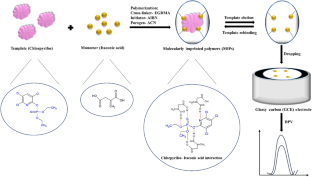
Chlorpyrifos (CPF) is an organophosphate pesticide that has been used for decades to enhance crop yield but its persistent usage has led to dreadful health issues in humans as well as other species. In the current work, an electrochemical sensor has been fabricated with immobilized molecularly imprinted polymers (MIPs) on a glassy carbon electrode to detect CPF. MIPs were bulk polymerized with a functional monomer itaconic acid. MIPs were characterized by Fourier transform infrared spectroscopy, scanning electron microscope, cyclic voltammetry and electrochemical impedance spectroscopy. The execution of the developed electrochemical sensor was scrutinized with differential pulse voltammetry (DPV). Various parameters like the pH of the electrolyte, the concentration and volume of MIPs (after elution), and the adsorption time were optimized for the analysis of the analyte (CPF) with the fabricated sensor. Under optimal conditions, the peak current of different CPF concentrations was examined by DPV method. The peak current was in linear proportionality with CPF (2.8 × 10⁻¹⁴ to 2.8 × 10⁻⁵ mol l−1) with a low detection limit of 1.912 × 10⁻¹⁴ mol l−1. The developed electrochemical sensor detected CPF in real samples with excellent results and a recovery percentage ranging from 100 to 106% (relative standard deviation, RSD < 5%). Also, the sensor exhibited good reproducibility, stability and selectivity. Therefore, the developed electrochemical sensor holds great potential for the monitoring of CPF in fruits and vegetables.
期刊介绍:
The Bulletin of Materials Science is a bi-monthly journal being published by the Indian Academy of Sciences in collaboration with the Materials Research Society of India and the Indian National Science Academy. The journal publishes original research articles, review articles and rapid communications in all areas of materials science. The journal also publishes from time to time important Conference Symposia/ Proceedings which are of interest to materials scientists. It has an International Advisory Editorial Board and an Editorial Committee. The Bulletin accords high importance to the quality of articles published and to keep at a minimum the processing time of papers submitted for publication.




 京公网安备 11010802042870号
京ICP备2023020795号-1
京公网安备 11010802042870号
京ICP备2023020795号-1

 分享
分享
 求助内容:
求助内容: 应助结果提醒方式:
 扫码关注我们
