Heejung W. Chung, Bernadette Cladek, Yong-Yun Hsiau, Yan-Yan Hu, Katharine Page, Nicola H. Perry, Bilge Yildiz, S. Haile
{"title":"Hydrogen in energy and information sciences","authors":"Heejung W. Chung, Bernadette Cladek, Yong-Yun Hsiau, Yan-Yan Hu, Katharine Page, Nicola H. Perry, Bilge Yildiz, S. Haile","doi":"10.1557/s43577-024-00714-9","DOIUrl":null,"url":null,"abstract":"Beyond its fascinating chemistry as the first element in the Periodic Table, hydrogen is of high societal importance in energy technologies and of growing importance in energy-efficient computing. In energy, hydrogen has reemerged as a potential solution to long-term energy storage and as a carbon-free input for materials manufacturing. Its utilization and production rely on the availability of proton-conducting electrolytes and mixed proton–electron conductors for the components in fuel cells and electrolyzers. In computing, proton mediation of electronic properties has garnered attention for electrochemically controlled energy-efficient neuromorphic computing. Incorporation of substitutional and interstitial hydride ions in oxides, though only recently established, enables tuning of electronic and magnetic properties, inviting a range of possible exotic applications. This article addresses common themes in the fundamental science of hydrogen incorporation and transport in oxides as relevant to pressing technological needs. The content covers (1) lattice (or bulk) mechanisms of hydrogen transport, primarily addressing proton transport, but also touching on hydride ion transport; (2) interfacial transport; (3) exploitation of extreme external drivers to achieve unusual response; and (4) advances in methods to probe the hydrogen environment and transport pathway. The snapshot of research activities in the field of hydrogen-laden materials described here underscores exciting recent breakthroughs, remaining open questions, and breathtaking experimental tools now available for unveiling the nature of hydrogen in solid-state matter.\n Graphical abstract","PeriodicalId":4,"journal":{"name":"ACS Applied Energy Materials","volume":"20 19","pages":""},"PeriodicalIF":5.5000,"publicationDate":"2024-04-22","publicationTypes":"Journal Article","fieldsOfStudy":null,"isOpenAccess":false,"openAccessPdf":"","citationCount":"0","resultStr":null,"platform":"Semanticscholar","paperid":null,"PeriodicalName":"ACS Applied Energy Materials","FirstCategoryId":"88","ListUrlMain":"https://doi.org/10.1557/s43577-024-00714-9","RegionNum":3,"RegionCategory":"材料科学","ArticlePicture":[],"TitleCN":null,"AbstractTextCN":null,"PMCID":null,"EPubDate":"","PubModel":"","JCR":"Q2","JCRName":"CHEMISTRY, PHYSICAL","Score":null,"Total":0}
引用次数: 0
Abstract
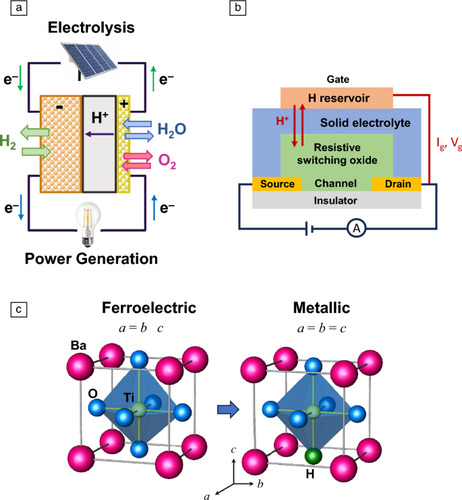
Beyond its fascinating chemistry as the first element in the Periodic Table, hydrogen is of high societal importance in energy technologies and of growing importance in energy-efficient computing. In energy, hydrogen has reemerged as a potential solution to long-term energy storage and as a carbon-free input for materials manufacturing. Its utilization and production rely on the availability of proton-conducting electrolytes and mixed proton–electron conductors for the components in fuel cells and electrolyzers. In computing, proton mediation of electronic properties has garnered attention for electrochemically controlled energy-efficient neuromorphic computing. Incorporation of substitutional and interstitial hydride ions in oxides, though only recently established, enables tuning of electronic and magnetic properties, inviting a range of possible exotic applications. This article addresses common themes in the fundamental science of hydrogen incorporation and transport in oxides as relevant to pressing technological needs. The content covers (1) lattice (or bulk) mechanisms of hydrogen transport, primarily addressing proton transport, but also touching on hydride ion transport; (2) interfacial transport; (3) exploitation of extreme external drivers to achieve unusual response; and (4) advances in methods to probe the hydrogen environment and transport pathway. The snapshot of research activities in the field of hydrogen-laden materials described here underscores exciting recent breakthroughs, remaining open questions, and breathtaking experimental tools now available for unveiling the nature of hydrogen in solid-state matter.
Graphical abstract
期刊介绍:
ACS Applied Energy Materials is an interdisciplinary journal publishing original research covering all aspects of materials, engineering, chemistry, physics and biology relevant to energy conversion and storage. The journal is devoted to reports of new and original experimental and theoretical research of an applied nature that integrate knowledge in the areas of materials, engineering, physics, bioscience, and chemistry into important energy applications.



 京公网安备 11010802042870号
京ICP备2023020795号-1
京公网安备 11010802042870号
京ICP备2023020795号-1

 分享
分享
 求助内容:
求助内容: 应助结果提醒方式:
 扫码关注我们
