Optimization of the ETL titanium dioxide layer for inorganic perovskite solar cells

IF 3.9 3区 材料科学 Q2 MATERIALS SCIENCE, MULTIDISCIPLINARY Journal of Materials Science Pub Date : 2024-04-22 DOI:10.1007/s10853-024-09581-w
Wojciech Bulowski, Agata Szwanda, Katarzyna Gawlińska-Nęcek, Piotr Panek, Marek Lipiński, Marta Janusz-Skuza, Maciej Jakub Szczerba, Łukasz Majchrowicz, Apurba Mahapatra, Daniel Prochowicz, Zbigniew Starowicz
{"title":"Optimization of the ETL titanium dioxide layer for inorganic perovskite solar cells","authors":"Wojciech Bulowski,&nbsp;Agata Szwanda,&nbsp;Katarzyna Gawlińska-Nęcek,&nbsp;Piotr Panek,&nbsp;Marek Lipiński,&nbsp;Marta Janusz-Skuza,&nbsp;Maciej Jakub Szczerba,&nbsp;Łukasz Majchrowicz,&nbsp;Apurba Mahapatra,&nbsp;Daniel Prochowicz,&nbsp;Zbigniew Starowicz","doi":"10.1007/s10853-024-09581-w","DOIUrl":null,"url":null,"abstract":"<div><p>Titanium dioxide layers are the most popular electron transport layer (ETL) in perovskite solar cells. However most studies focuses on mesoporous structure and application with organic–inorganic hybrid perovskite. In this study, the topic of ETL in planar structure of inorganic CsPbBr<sub>3</sub> perovskite solar cells was tackled, the presented approach will reduce production costs and improve cell stability, which is the greatest drawback of perovskite cells especially organic–inorganic perovskite. The potential application of these technology are greenhouses and building integrated PV sector. Here, the two TiO<sub>2</sub> precursors titanium(IV) ethoxide in ethanol and titanium(IV) bis(acetylacetonate) diisopropoxide (Tiacac) were investigated, optimized and compared. TiO<sub>2</sub> layers were deposited on high roughness FTO, without the use of a mesoporous layer, by spin coating method. The correlation between stock solution concentration and thickness of manufactured layers was tracked for both precursors as well as their difference in morphology of the final films and other properties. In particular, conformality and optical properties are better for Tiacac. Slightly lower refractive index of Tiacac-based titania reduced the reflective losses from 7.3 to 6.9% effectively. The obtained layers were used for inorganic solar cells of CsPbBr<sub>3</sub> perovskite to finally settle the issue of optimal thickness and precursor. It is interesting that despite the supremacy in investigated properties of commonly used of the precursor Tiacac, the results of the cells pointed to the Tieth. The efficiency of the champion cell is 6.08% for Tieth, while 5.62% is noted for Tiacac. Trying to figure out this riddle, we shed a new light on the phenomena going on the ETL/inorganic perovskite interface investigating nanoroughness.</p></div>","PeriodicalId":645,"journal":{"name":"Journal of Materials Science","volume":"59 17","pages":""},"PeriodicalIF":3.9000,"publicationDate":"2024-04-22","publicationTypes":"Journal Article","fieldsOfStudy":null,"isOpenAccess":false,"openAccessPdf":"https://link.springer.com/content/pdf/10.1007/s10853-024-09581-w.pdf","citationCount":"0","resultStr":null,"platform":"Semanticscholar","paperid":null,"PeriodicalName":"Journal of Materials Science","FirstCategoryId":"88","ListUrlMain":"https://link.springer.com/article/10.1007/s10853-024-09581-w","RegionNum":3,"RegionCategory":"材料科学","ArticlePicture":[],"TitleCN":null,"AbstractTextCN":null,"PMCID":null,"EPubDate":"","PubModel":"","JCR":"Q2","JCRName":"MATERIALS SCIENCE, MULTIDISCIPLINARY","Score":null,"Total":0}
引用次数: 0

Abstract

Titanium dioxide layers are the most popular electron transport layer (ETL) in perovskite solar cells. However most studies focuses on mesoporous structure and application with organic–inorganic hybrid perovskite. In this study, the topic of ETL in planar structure of inorganic CsPbBr3 perovskite solar cells was tackled, the presented approach will reduce production costs and improve cell stability, which is the greatest drawback of perovskite cells especially organic–inorganic perovskite. The potential application of these technology are greenhouses and building integrated PV sector. Here, the two TiO2 precursors titanium(IV) ethoxide in ethanol and titanium(IV) bis(acetylacetonate) diisopropoxide (Tiacac) were investigated, optimized and compared. TiO2 layers were deposited on high roughness FTO, without the use of a mesoporous layer, by spin coating method. The correlation between stock solution concentration and thickness of manufactured layers was tracked for both precursors as well as their difference in morphology of the final films and other properties. In particular, conformality and optical properties are better for Tiacac. Slightly lower refractive index of Tiacac-based titania reduced the reflective losses from 7.3 to 6.9% effectively. The obtained layers were used for inorganic solar cells of CsPbBr3 perovskite to finally settle the issue of optimal thickness and precursor. It is interesting that despite the supremacy in investigated properties of commonly used of the precursor Tiacac, the results of the cells pointed to the Tieth. The efficiency of the champion cell is 6.08% for Tieth, while 5.62% is noted for Tiacac. Trying to figure out this riddle, we shed a new light on the phenomena going on the ETL/inorganic perovskite interface investigating nanoroughness.
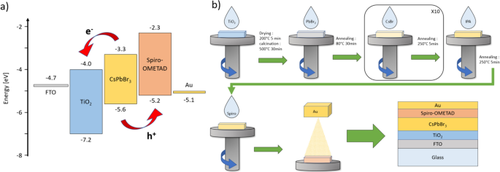
Abstract Image

查看原文
分享 分享
微信好友 朋友圈 QQ好友 复制链接
本刊更多论文
优化无机包晶体太阳能电池的 ETL 二氧化钛层
二氧化钛层是过氧化物太阳能电池中最常用的电子传输层(ETL)。然而,大多数研究都集中在介孔结构和有机-无机混合包晶石的应用上。本研究探讨了无机 CsPbBr3 包晶石太阳能电池平面结构中的电子传输层,所提出的方法将降低生产成本并提高电池稳定性,而这正是包晶石电池,尤其是有机-无机包晶石电池的最大缺点。这些技术的潜在应用领域是温室和光伏建筑一体化领域。在此,我们对乙醇中的乙醇钛(IV)和双(乙酰丙酮酸)二异丙醇钛(Tiacac)这两种二氧化钛前驱体进行了研究、优化和比较。在不使用介孔层的情况下,通过旋涂法在高粗糙度 FTO 上沉积了二氧化钛层。对两种前驱体的原液浓度和制造层厚度之间的相关性以及它们在最终薄膜形态和其他性能方面的差异进行了跟踪。其中,Tiacac 的保形性和光学特性更好。Tiac 基二氧化钛的折射率略低,可有效地将反射损失从 7.3% 降至 6.9%。获得的层被用于 CsPbBr3 包晶体无机太阳能电池,最终解决了最佳厚度和前驱体的问题。有趣的是,尽管常用的前驱体 Tiacac 在所研究的特性方面具有优势,但电池的结果却指向了 Tieth。Tieth 的冠军电池效率为 6.08%,而 Tiacac 为 5.62%。为了解开这个谜团,我们对 ETL/无机包晶界面上的纳米粗糙度现象进行了新的研究。
本文章由计算机程序翻译,如有差异,请以英文原文为准。
求助全文
约1分钟内获得全文 去求助
来源期刊
Journal of Materials Science
Journal of Materials Science 工程技术-材料科学:综合
CiteScore
7.90
自引率
4.40%
发文量
1297
审稿时长
2.4 months
期刊介绍: The Journal of Materials Science publishes reviews, full-length papers, and short Communications recording original research results on, or techniques for studying the relationship between structure, properties, and uses of materials. The subjects are seen from international and interdisciplinary perspectives covering areas including metals, ceramics, glasses, polymers, electrical materials, composite materials, fibers, nanostructured materials, nanocomposites, and biological and biomedical materials. The Journal of Materials Science is now firmly established as the leading source of primary communication for scientists investigating the structure and properties of all engineering materials.
期刊最新文献
Simulation and experimental study on the inhibition effect of NiRe diffusion barrier in superalloy coating systems Fatigue/wear mechanism–property of Ni-based composite coatings by pulsed magnetic field post-treatment Orientation relationship between Al4Mn approximate quasicrystals and α-Al phases in suction casting Al-8wt.% Mn-2wt.% Ni alloy Inverse design of electrical conductivity in AlSi8 alloy using Bayesian optimization Review: novel strategies for electric field-assisted high-efficient photocatalysis
×
引用
GB/T 7714-2015
复制
MLA
复制
APA
复制
导出至
BibTeX EndNote RefMan NoteFirst NoteExpress
×
×
提示
您的信息不完整,为了账户安全,请先补充。
现在去补充
×
提示
您因"违规操作"
具体请查看互助需知
我知道了
×
提示
现在去查看 取消
×
提示
确定
0
微信
客服QQ
Book学术公众号 扫码关注我们
反馈
×
意见反馈
请填写您的意见或建议
请填写您的手机或邮箱
已复制链接
已复制链接
快去分享给好友吧!
我知道了
×
扫码分享
扫码分享
Book学术官方微信
Book学术文献互助
Book学术文献互助群
群 号:604180095
Book学术
文献互助 智能选刊 最新文献 互助须知 联系我们:info@booksci.cn
Book学术提供免费学术资源搜索服务,方便国内外学者检索中英文文献。致力于提供最便捷和优质的服务体验。
Copyright © 2023 Book学术 All rights reserved.
ghs 京公网安备 11010802042870号 京ICP备2023020795号-1





