Xingwang Duan, Yingqing Chen, Yue Jia, Xin Che, Jiachen Liu
{"title":"Investigation of hot deformation behavior of forged 42CrMoA steel by cellular automata method based on topological deformation technique","authors":"Xingwang Duan, Yingqing Chen, Yue Jia, Xin Che, Jiachen Liu","doi":"10.1007/s10853-024-09649-7","DOIUrl":null,"url":null,"abstract":"<div><p>To investigate the dynamic recrystallization (DRX) behavior of forged 42CrMoA steel during hot deformation, the hot deformation experiments of forged 42CrMoA steel under different deformation conditions (strain rate, temperature, and strain) were carried out in this paper. The hot deformation activation energy of forged 42CrMoA steel was determined to be <span>\\(413627.2\\;{\\text{J}}\\; \\cdot{\\text{mol}}^{ - 1}\\)</span>. The constitutive model and DRX kinetic model of the steel were established. Analyzing the reconstructed parent phase grains reveals that when the strain is constant, as the deformation temperature increases and the strain rate decreases, the average size and DRX volume fraction of the parent phase grains gradually increase, and the peak stress gradually decreases. When the deformation temperature and strain rate are constant, as the strain increases, the average size of the parent phase grains gradually decreases, and the volume fraction of DRX gradually increases. Based on the cellular automaton theory model and considering the influence of grain deformation on the DRX process, a cellular automaton dynamic recrystallization (T-DRX-CA) model for forged 42CrMoA steel based on topological deformation technology was established, and the microstructure evolution under different deformation conditions was simulated. The microstructure evolution under different deformation conditions was simulated, which was compared with experimental results. The results showed that the average errors between the simulated and experimental values of the average grain size of the parent phase, the volume fraction of DRX, and peak stress were all less than 8%, and the simulated results were in good agreement with the experimental values, which indicates that the established model can accurately predict the DRX behavior of the forged 42CrMoA steel in the process of hot deformation.</p><h3>Graphical abstract</h3><p>The hot deformation behavior of forged 42CrMoA steel under different deformation conditions was investigated by a cellular automaton dynamic recrystallization (T-DRX-CA) model based on topological deformation technique. The results showed that the average errors between the simulated and experimental values of the average grain size of the parent phase, the volume fraction of DRX, and peak stress were all less than 8%, and the simulated results were in good agreement with the experimental values, which indicates that the established model can accurately predict the DRX behavior of the forged 42CrMoA steel in the process of hot deformation.</p>\n<div><figure><div><div><picture><source><img></source></picture></div></div></figure></div></div>","PeriodicalId":645,"journal":{"name":"Journal of Materials Science","volume":"59 18","pages":""},"PeriodicalIF":3.9000,"publicationDate":"2024-04-21","publicationTypes":"Journal Article","fieldsOfStudy":null,"isOpenAccess":false,"openAccessPdf":"","citationCount":"0","resultStr":null,"platform":"Semanticscholar","paperid":null,"PeriodicalName":"Journal of Materials Science","FirstCategoryId":"88","ListUrlMain":"https://link.springer.com/article/10.1007/s10853-024-09649-7","RegionNum":3,"RegionCategory":"材料科学","ArticlePicture":[],"TitleCN":null,"AbstractTextCN":null,"PMCID":null,"EPubDate":"","PubModel":"","JCR":"Q2","JCRName":"MATERIALS SCIENCE, MULTIDISCIPLINARY","Score":null,"Total":0}
引用次数: 0
Abstract
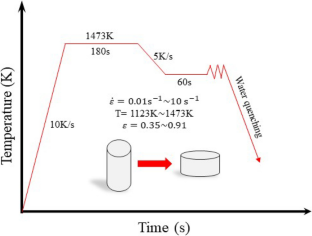
To investigate the dynamic recrystallization (DRX) behavior of forged 42CrMoA steel during hot deformation, the hot deformation experiments of forged 42CrMoA steel under different deformation conditions (strain rate, temperature, and strain) were carried out in this paper. The hot deformation activation energy of forged 42CrMoA steel was determined to be \(413627.2\;{\text{J}}\; \cdot{\text{mol}}^{ - 1}\). The constitutive model and DRX kinetic model of the steel were established. Analyzing the reconstructed parent phase grains reveals that when the strain is constant, as the deformation temperature increases and the strain rate decreases, the average size and DRX volume fraction of the parent phase grains gradually increase, and the peak stress gradually decreases. When the deformation temperature and strain rate are constant, as the strain increases, the average size of the parent phase grains gradually decreases, and the volume fraction of DRX gradually increases. Based on the cellular automaton theory model and considering the influence of grain deformation on the DRX process, a cellular automaton dynamic recrystallization (T-DRX-CA) model for forged 42CrMoA steel based on topological deformation technology was established, and the microstructure evolution under different deformation conditions was simulated. The microstructure evolution under different deformation conditions was simulated, which was compared with experimental results. The results showed that the average errors between the simulated and experimental values of the average grain size of the parent phase, the volume fraction of DRX, and peak stress were all less than 8%, and the simulated results were in good agreement with the experimental values, which indicates that the established model can accurately predict the DRX behavior of the forged 42CrMoA steel in the process of hot deformation.
Graphical abstract
The hot deformation behavior of forged 42CrMoA steel under different deformation conditions was investigated by a cellular automaton dynamic recrystallization (T-DRX-CA) model based on topological deformation technique. The results showed that the average errors between the simulated and experimental values of the average grain size of the parent phase, the volume fraction of DRX, and peak stress were all less than 8%, and the simulated results were in good agreement with the experimental values, which indicates that the established model can accurately predict the DRX behavior of the forged 42CrMoA steel in the process of hot deformation.
期刊介绍:
The Journal of Materials Science publishes reviews, full-length papers, and short Communications recording original research results on, or techniques for studying the relationship between structure, properties, and uses of materials. The subjects are seen from international and interdisciplinary perspectives covering areas including metals, ceramics, glasses, polymers, electrical materials, composite materials, fibers, nanostructured materials, nanocomposites, and biological and biomedical materials. The Journal of Materials Science is now firmly established as the leading source of primary communication for scientists investigating the structure and properties of all engineering materials.




 京公网安备 11010802042870号
京ICP备2023020795号-1
京公网安备 11010802042870号
京ICP备2023020795号-1

 分享
分享
 求助内容:
求助内容: 应助结果提醒方式:
 扫码关注我们
