EXPRESS: How Do Implausible Tensile Price Claims Affect Consumer Perceptions of Deceptiveness and Consumer Willingness to Purchase in Online Environments?
Xinyu Chang, Hualu Zheng, Shuai Yang, Lu Huang, William T. Ross
{"title":"EXPRESS: How Do Implausible Tensile Price Claims Affect Consumer Perceptions of Deceptiveness and Consumer Willingness to Purchase in Online Environments?","authors":"Xinyu Chang, Hualu Zheng, Shuai Yang, Lu Huang, William T. Ross","doi":"10.1177/10949968241249660","DOIUrl":null,"url":null,"abstract":"The study explores how and why an embedded implausible tensile price claim (TPC) affects consumers’ decisions as to whether to click on the associated online advertisement and their subsequent purchases. The authors conduct a field experiment by designing a structured set of search advertisements with implausible TPCs for a global apparel brand and launching them on Baidu, the largest search engine in China. Using a hierarchical Bayesian model, the authors quantify how implausible TPCs influence consumers’ two-stage decisions, clicking on the advertisement and purchasing the product. Using two laboratory experiments, the authors further demonstrate that the purchase decision is mediated by consumers’ perceptions of deception in the advertisement, despite the fact that the click decision is not. Results show that implausible TPCs in a search advertisement motivate consumers to click on the promotion. However, the discrepancy between the advertised and the actual discounts makes the advertisement seem deceptive to consumers, which reduces their likelihood of purchasing the product and leads them to search for other products and promotions. Our results address advertising deception in online price claims, offer critical policy implications regarding implausible TPCs, and shed light on designing and executing implausible TPCs in online advertising.","PeriodicalId":6,"journal":{"name":"ACS Applied Nano Materials","volume":"5 s1","pages":""},"PeriodicalIF":5.5000,"publicationDate":"2024-04-15","publicationTypes":"Journal Article","fieldsOfStudy":null,"isOpenAccess":false,"openAccessPdf":"","citationCount":"0","resultStr":null,"platform":"Semanticscholar","paperid":null,"PeriodicalName":"ACS Applied Nano Materials","FirstCategoryId":"91","ListUrlMain":"https://doi.org/10.1177/10949968241249660","RegionNum":2,"RegionCategory":"材料科学","ArticlePicture":[],"TitleCN":null,"AbstractTextCN":null,"PMCID":null,"EPubDate":"","PubModel":"","JCR":"Q2","JCRName":"MATERIALS SCIENCE, MULTIDISCIPLINARY","Score":null,"Total":0}
引用次数: 0
Abstract
The study explores how and why an embedded implausible tensile price claim (TPC) affects consumers’ decisions as to whether to click on the associated online advertisement and their subsequent purchases. The authors conduct a field experiment by designing a structured set of search advertisements with implausible TPCs for a global apparel brand and launching them on Baidu, the largest search engine in China. Using a hierarchical Bayesian model, the authors quantify how implausible TPCs influence consumers’ two-stage decisions, clicking on the advertisement and purchasing the product. Using two laboratory experiments, the authors further demonstrate that the purchase decision is mediated by consumers’ perceptions of deception in the advertisement, despite the fact that the click decision is not. Results show that implausible TPCs in a search advertisement motivate consumers to click on the promotion. However, the discrepancy between the advertised and the actual discounts makes the advertisement seem deceptive to consumers, which reduces their likelihood of purchasing the product and leads them to search for other products and promotions. Our results address advertising deception in online price claims, offer critical policy implications regarding implausible TPCs, and shed light on designing and executing implausible TPCs in online advertising.
期刊介绍:
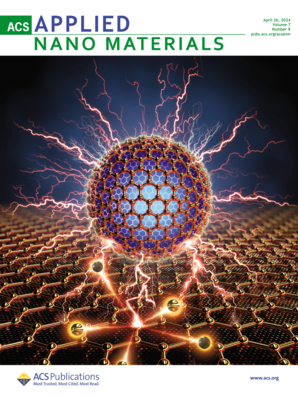
ACS Applied Nano Materials is an interdisciplinary journal publishing original research covering all aspects of engineering, chemistry, physics and biology relevant to applications of nanomaterials. The journal is devoted to reports of new and original experimental and theoretical research of an applied nature that integrate knowledge in the areas of materials, engineering, physics, bioscience, and chemistry into important applications of nanomaterials.



 京公网安备 11010802042870号
京ICP备2023020795号-1
京公网安备 11010802042870号
京ICP备2023020795号-1

 分享
分享
 求助内容:
求助内容: 应助结果提醒方式:
 扫码关注我们
