{"title":"How green finance boosts carbon efficiency in agriculture: a quasi-experiment from China","authors":"Yayun Ren, Zhongmin Ding, Junxia Liu","doi":"10.1108/caer-08-2023-0228","DOIUrl":null,"url":null,"abstract":"PurposeThe research objective of this paper is to investigate the direct and indirect impacts of green finance on agricultural carbon total factor productivity (ACTFP) within the framework of the carbon peaking and carbon neutrality (dual carbon) goals, while also identifying the driving factors through an exponential decomposition of ACTFP, aiming to provide policy recommendations to enhance financial support for low-carbon agricultural development.Design/methodology/approachIn this paper, the Global Malmquist Luenberger (GML) Index method was employed to analyze and decompose the ACTFP, while the direct and spillover effects of China’s green finance pilot policy (GFPP) on ACTFP were assessed using the difference-in-differences (DID) method and the spatial differences-in-differences (SDID) method, respectively.FindingsAfter the implementation of the GFPP, the ACTFP in the pilot area has experienced significant improvement, with the enhancement of technical efficiency serving as the main driving force. In addition, the GFPP exhibits a positive low-carbon spatial spillover effect, indicating it benefits ACTFP in both the pilot and adjacent areas.Originality/valueWithin the framework of the dual carbon goals, the paper highlights agriculture as a significant carbon emitter. ACTFP is assessed by considering the agricultural carbon emission factor as the sole non-desired output, and the impact of the GFPP on ACTFP is investigated through the DID method, thereby providing substantial validation of the hypotheses inferred from the mathematical model. Subsequently, the spillover effects of GFPP on ACTFP are analyzed in conjunction with the spatial econometric model.","PeriodicalId":4,"journal":{"name":"ACS Applied Energy Materials","volume":"92 1‐3","pages":""},"PeriodicalIF":5.5000,"publicationDate":"2024-04-08","publicationTypes":"Journal Article","fieldsOfStudy":null,"isOpenAccess":false,"openAccessPdf":"","citationCount":"0","resultStr":null,"platform":"Semanticscholar","paperid":null,"PeriodicalName":"ACS Applied Energy Materials","FirstCategoryId":"96","ListUrlMain":"https://doi.org/10.1108/caer-08-2023-0228","RegionNum":3,"RegionCategory":"材料科学","ArticlePicture":[],"TitleCN":null,"AbstractTextCN":null,"PMCID":null,"EPubDate":"","PubModel":"","JCR":"Q2","JCRName":"CHEMISTRY, PHYSICAL","Score":null,"Total":0}
引用次数: 0
Abstract
PurposeThe research objective of this paper is to investigate the direct and indirect impacts of green finance on agricultural carbon total factor productivity (ACTFP) within the framework of the carbon peaking and carbon neutrality (dual carbon) goals, while also identifying the driving factors through an exponential decomposition of ACTFP, aiming to provide policy recommendations to enhance financial support for low-carbon agricultural development.Design/methodology/approachIn this paper, the Global Malmquist Luenberger (GML) Index method was employed to analyze and decompose the ACTFP, while the direct and spillover effects of China’s green finance pilot policy (GFPP) on ACTFP were assessed using the difference-in-differences (DID) method and the spatial differences-in-differences (SDID) method, respectively.FindingsAfter the implementation of the GFPP, the ACTFP in the pilot area has experienced significant improvement, with the enhancement of technical efficiency serving as the main driving force. In addition, the GFPP exhibits a positive low-carbon spatial spillover effect, indicating it benefits ACTFP in both the pilot and adjacent areas.Originality/valueWithin the framework of the dual carbon goals, the paper highlights agriculture as a significant carbon emitter. ACTFP is assessed by considering the agricultural carbon emission factor as the sole non-desired output, and the impact of the GFPP on ACTFP is investigated through the DID method, thereby providing substantial validation of the hypotheses inferred from the mathematical model. Subsequently, the spillover effects of GFPP on ACTFP are analyzed in conjunction with the spatial econometric model.
期刊介绍:
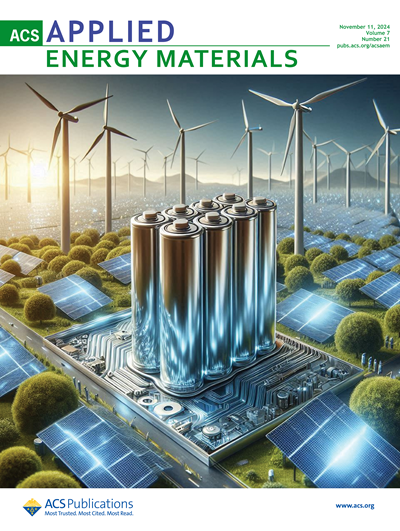
ACS Applied Energy Materials is an interdisciplinary journal publishing original research covering all aspects of materials, engineering, chemistry, physics and biology relevant to energy conversion and storage. The journal is devoted to reports of new and original experimental and theoretical research of an applied nature that integrate knowledge in the areas of materials, engineering, physics, bioscience, and chemistry into important energy applications.




 京公网安备 11010802042870号
京ICP备2023020795号-1
京公网安备 11010802042870号
京ICP备2023020795号-1

 分享
分享
 求助内容:
求助内容: 应助结果提醒方式:
 扫码关注我们
