{"title":"Research on adaptive particle swarm optimization particle filter target tracking algorithm in wireless sensor networks","authors":"Chun-Yan Jiang, Jing Wu, Rong Gou, Jing-Fang Fu","doi":"10.1002/adc2.205","DOIUrl":null,"url":null,"abstract":"<p>With regard to target tracking in wireless sensor networks, we are faced with problems like deficient occlusion handling and tracking failures during rapid movements due to complex and diverse circumstances. In order to effectively improve the accuracy of particle filter tracking caused by particle degradation, we propose an adaptive particle swarm optimization (APSO) particle filter algorithm. This algorithm uses particle filters to predict the target location in a particular area and introduces the particle swarm optimization (PSO) algorithm, of which both the evolutionary speed and the convergence accuracy are further improved by investigating the particle distribution through an entropy analysis, employing three different inertial weighting strategies and dynamic double mutation strategy, and exploiting the capabilities of the adaptive balancing algorithm in global and local searching. The simulation results show that the improved algorithm has a reduced root mean square error, shorter time consumption, faster speed, reduced target tracking error, and higher average success rate, so this algorithm exhibits sound real-time performance and accuracy in terms of occlusion handling and tracking loss.</p>","PeriodicalId":100030,"journal":{"name":"Advanced Control for Applications","volume":"6 3","pages":""},"PeriodicalIF":0.0000,"publicationDate":"2024-04-02","publicationTypes":"Journal Article","fieldsOfStudy":null,"isOpenAccess":false,"openAccessPdf":"https://onlinelibrary.wiley.com/doi/epdf/10.1002/adc2.205","citationCount":"0","resultStr":null,"platform":"Semanticscholar","paperid":null,"PeriodicalName":"Advanced Control for Applications","FirstCategoryId":"1085","ListUrlMain":"https://onlinelibrary.wiley.com/doi/10.1002/adc2.205","RegionNum":0,"RegionCategory":null,"ArticlePicture":[],"TitleCN":null,"AbstractTextCN":null,"PMCID":null,"EPubDate":"","PubModel":"","JCR":"","JCRName":"","Score":null,"Total":0}
引用次数: 0
Abstract
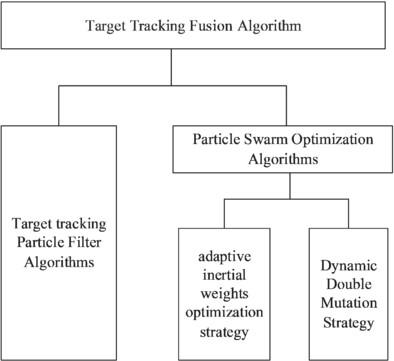
With regard to target tracking in wireless sensor networks, we are faced with problems like deficient occlusion handling and tracking failures during rapid movements due to complex and diverse circumstances. In order to effectively improve the accuracy of particle filter tracking caused by particle degradation, we propose an adaptive particle swarm optimization (APSO) particle filter algorithm. This algorithm uses particle filters to predict the target location in a particular area and introduces the particle swarm optimization (PSO) algorithm, of which both the evolutionary speed and the convergence accuracy are further improved by investigating the particle distribution through an entropy analysis, employing three different inertial weighting strategies and dynamic double mutation strategy, and exploiting the capabilities of the adaptive balancing algorithm in global and local searching. The simulation results show that the improved algorithm has a reduced root mean square error, shorter time consumption, faster speed, reduced target tracking error, and higher average success rate, so this algorithm exhibits sound real-time performance and accuracy in terms of occlusion handling and tracking loss.



 京公网安备 11010802042870号
京ICP备2023020795号-1
京公网安备 11010802042870号
京ICP备2023020795号-1

 分享
分享

 求助内容:
求助内容: 应助结果提醒方式:
 扫码关注我们
