{"title":"In-Depth Examination of Coverage Duration: Analyzing Years Covered and Skipped in Journal Indexing","authors":"Eungi Kim","doi":"10.3390/publications12020010","DOIUrl":null,"url":null,"abstract":"Journals that have consistently maintained uninterrupted indexing over an extended period can be assumed to possess stability and sustainability in journal indexing. Building on this assumption, the objective of this study is to scrutinize the years omitted in the indexing of Scopus-indexed journals. To conduct this study, three coverage duration indicators—nyears-covered (total years covered), nyears-skipped (years skipped), and skipped/covered ratio (proportion of years skipped to total years covered)—were formulated. Data from SCImago Journal Rank (SJR) for 2022, consisting of 16,762 records (62% of downloaded data) with a coverage duration of 25 years or less, were used for this study. The results revealed that around 10% of Scopus-indexed journals experienced exclusions or coverage gaps. Longer coverage correlates positively with documents published, h-index, and citations, while skipped years decrease with these indicators. Open access (OA) journals exhibited a lower skipped/covered ratio than non-OA journals, suggesting a better sustainability of indexing than non-OA journals. Disciplinary differences in Scopus journal coverage duration revealed notable variation, suggesting that coverage duration indicators can be effectively used to evaluate journal stability within Scopus. Overall, the coverage gaps reflect Scopus’s efforts to regulate the journals it indexes. The coverage duration indicators proposed in this study can be applied to assess the stability of periodicals in any database, providing insights into the broader dynamics and quality standards maintained by a database, where the database periodically adds and removes its indexed contents.","PeriodicalId":4,"journal":{"name":"ACS Applied Energy Materials","volume":"710 ","pages":""},"PeriodicalIF":5.5000,"publicationDate":"2024-04-01","publicationTypes":"Journal Article","fieldsOfStudy":null,"isOpenAccess":false,"openAccessPdf":"","citationCount":"0","resultStr":null,"platform":"Semanticscholar","paperid":null,"PeriodicalName":"ACS Applied Energy Materials","FirstCategoryId":"1085","ListUrlMain":"https://doi.org/10.3390/publications12020010","RegionNum":3,"RegionCategory":"材料科学","ArticlePicture":[],"TitleCN":null,"AbstractTextCN":null,"PMCID":null,"EPubDate":"","PubModel":"","JCR":"Q2","JCRName":"CHEMISTRY, PHYSICAL","Score":null,"Total":0}
引用次数: 0
Abstract
Journals that have consistently maintained uninterrupted indexing over an extended period can be assumed to possess stability and sustainability in journal indexing. Building on this assumption, the objective of this study is to scrutinize the years omitted in the indexing of Scopus-indexed journals. To conduct this study, three coverage duration indicators—nyears-covered (total years covered), nyears-skipped (years skipped), and skipped/covered ratio (proportion of years skipped to total years covered)—were formulated. Data from SCImago Journal Rank (SJR) for 2022, consisting of 16,762 records (62% of downloaded data) with a coverage duration of 25 years or less, were used for this study. The results revealed that around 10% of Scopus-indexed journals experienced exclusions or coverage gaps. Longer coverage correlates positively with documents published, h-index, and citations, while skipped years decrease with these indicators. Open access (OA) journals exhibited a lower skipped/covered ratio than non-OA journals, suggesting a better sustainability of indexing than non-OA journals. Disciplinary differences in Scopus journal coverage duration revealed notable variation, suggesting that coverage duration indicators can be effectively used to evaluate journal stability within Scopus. Overall, the coverage gaps reflect Scopus’s efforts to regulate the journals it indexes. The coverage duration indicators proposed in this study can be applied to assess the stability of periodicals in any database, providing insights into the broader dynamics and quality standards maintained by a database, where the database periodically adds and removes its indexed contents.
期刊介绍:
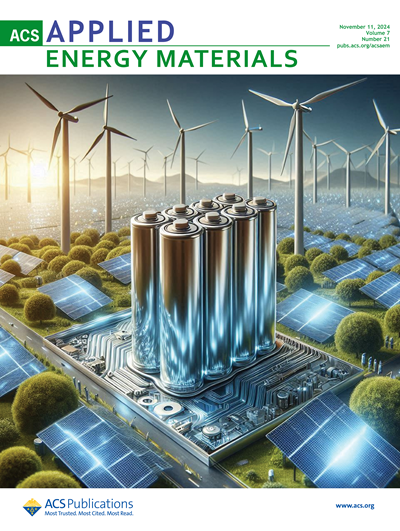
ACS Applied Energy Materials is an interdisciplinary journal publishing original research covering all aspects of materials, engineering, chemistry, physics and biology relevant to energy conversion and storage. The journal is devoted to reports of new and original experimental and theoretical research of an applied nature that integrate knowledge in the areas of materials, engineering, physics, bioscience, and chemistry into important energy applications.



 京公网安备 11010802042870号
京ICP备2023020795号-1
京公网安备 11010802042870号
京ICP备2023020795号-1

 分享
分享
 求助内容:
求助内容: 应助结果提醒方式:
 扫码关注我们
