I. D. Radojević, K. G. Ćirković, M. Ž. Grujović, K. G. Mladenović, A. M. Ostojić
{"title":"Characterization of Bacterial Isolates from Tailings Pond and Their Resistance to Heavy Metals and Antibiotics","authors":"I. D. Radojević, K. G. Ćirković, M. Ž. Grujović, K. G. Mladenović, A. M. Ostojić","doi":"10.1134/S0003683824020157","DOIUrl":null,"url":null,"abstract":"<p>lWater samples were collected from a tailings pond wastewater site in the Rudnik mountain area, where polymetallic ore flotation processes generate high concentrations of Pb<sup>2+</sup>, Zn<sup>2+</sup>, and Cu<sup>2+</sup>. The study aimed to identify microorganisms resistant to heavy metals and assess their potential for bioremediation. Growth capabilities under varying conditions, including temperature, pH, and NaCl concentrations, were analyzed using a spectrophotometer. Minimal inhibitory and lethal concentrations of tested substances were determined for both planktonic cells and their biofilms. Key isolates, namely <i>Bacillus altitudinis</i> PMFKG-R3, <i>B. pumilus</i> PMFKG-R15, <i>B. cereus</i> PMFKG-R46, <i>Pseudomonas veronii</i> PMFKG-R30, and <i>Pantoea agglomerans</i> PMFKG-R20, demonstrated growth ability at both 22 and 37°C and exhibited halotolerance, albeit sensitivity to acidic pH. Most isolates in both planktonic and biofilm forms displayed notable resistance to heavy metals, particularly Pb<sup>2+</sup> and Zn<sup>2+</sup>, in line with the sampling location. Notably, planktonic cells were sensitive to antibiotics, while biofilms exhibited slightly higher resistance. Promising candidates for bioremediation purposes were identified in <i>P. veronii</i> PMFKG-R30 and <i>P. agglomerans</i> PMFKG-R20, which displayed resistance to heavy metals and sensitivity to antibiotics.</p>","PeriodicalId":466,"journal":{"name":"Applied Biochemistry and Microbiology","volume":"60 2","pages":"347 - 357"},"PeriodicalIF":1.1000,"publicationDate":"2024-04-21","publicationTypes":"Journal Article","fieldsOfStudy":null,"isOpenAccess":false,"openAccessPdf":"","citationCount":"0","resultStr":null,"platform":"Semanticscholar","paperid":null,"PeriodicalName":"Applied Biochemistry and Microbiology","FirstCategoryId":"99","ListUrlMain":"https://link.springer.com/article/10.1134/S0003683824020157","RegionNum":4,"RegionCategory":"生物学","ArticlePicture":[],"TitleCN":null,"AbstractTextCN":null,"PMCID":null,"EPubDate":"","PubModel":"","JCR":"Q4","JCRName":"BIOTECHNOLOGY & APPLIED MICROBIOLOGY","Score":null,"Total":0}
引用次数: 0
Abstract
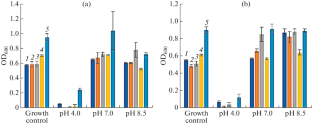
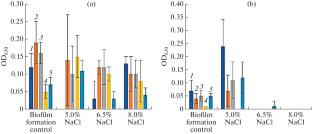
lWater samples were collected from a tailings pond wastewater site in the Rudnik mountain area, where polymetallic ore flotation processes generate high concentrations of Pb2+, Zn2+, and Cu2+. The study aimed to identify microorganisms resistant to heavy metals and assess their potential for bioremediation. Growth capabilities under varying conditions, including temperature, pH, and NaCl concentrations, were analyzed using a spectrophotometer. Minimal inhibitory and lethal concentrations of tested substances were determined for both planktonic cells and their biofilms. Key isolates, namely Bacillus altitudinis PMFKG-R3, B. pumilus PMFKG-R15, B. cereus PMFKG-R46, Pseudomonas veronii PMFKG-R30, and Pantoea agglomerans PMFKG-R20, demonstrated growth ability at both 22 and 37°C and exhibited halotolerance, albeit sensitivity to acidic pH. Most isolates in both planktonic and biofilm forms displayed notable resistance to heavy metals, particularly Pb2+ and Zn2+, in line with the sampling location. Notably, planktonic cells were sensitive to antibiotics, while biofilms exhibited slightly higher resistance. Promising candidates for bioremediation purposes were identified in P. veronii PMFKG-R30 and P. agglomerans PMFKG-R20, which displayed resistance to heavy metals and sensitivity to antibiotics.
期刊介绍:
Applied Biochemistry and Microbiology is an international peer reviewed journal that publishes original articles on biochemistry and microbiology that have or may have practical applications. The studies include: enzymes and mechanisms of enzymatic reactions, biosynthesis of low and high molecular physiologically active compounds; the studies of their structure and properties; biogenesis and pathways of their regulation; metabolism of producers of biologically active compounds, biocatalysis in organic synthesis, applied genetics of microorganisms, applied enzymology; protein and metabolic engineering, biochemical bases of phytoimmunity, applied aspects of biochemical and immunochemical analysis; biodegradation of xenobiotics; biosensors; biomedical research (without clinical studies). Along with experimental works, the journal publishes descriptions of novel research techniques and reviews on selected topics.




 京公网安备 11010802042870号
京ICP备2023020795号-1
京公网安备 11010802042870号
京ICP备2023020795号-1

 分享
分享
 求助内容:
求助内容: 应助结果提醒方式:
 扫码关注我们
