Solid propellant burn rate characterization: Effect of copper chromite blend with oxidiser and its storage

IF 3.6 FirePhysChem Pub Date : 2024-04-02 DOI:10.1016/j.fpc.2024.03.005
Sathiskumar PS , Alok Kumar Patel , Vinay Paliwal , Sojan P
{"title":"Solid propellant burn rate characterization: Effect of copper chromite blend with oxidiser and its storage","authors":"Sathiskumar PS ,&nbsp;Alok Kumar Patel ,&nbsp;Vinay Paliwal ,&nbsp;Sojan P","doi":"10.1016/j.fpc.2024.03.005","DOIUrl":null,"url":null,"abstract":"<div><p>This work details the study conducted on composite solid propellants with activated copper chromite (ACR) as burn catalyst for its burn rate change with time due to the interaction of ammonium perchlorate (AP) with ACR. One of the hypotheses cited for burn rate reduction is the conversion of chromite in ACR to chromate by an electrolytic reaction with moisture in the presence of ammonium perchlorate. This hypothesis was studied by a design of experiments which includes blending ammonium perchlorate and ACR, Aluminum and ACR, stand alone ACR in raw material stage and the blends storage with time. The effect of moisture in AP is addressed by comparing undried and dried AP in the blends. The blended raw materials were characterized by Thermo-gravimetric analysis, Particle Size Distribution, surface area measurement, Scanning Electron Microscopy and chromium estimation. Results show that the conversion of chromium from chromite to chromate is very minimum in the presence of AP. Propellant samples are prepared with these blends at different time intervals to understand viscosity, mechanical properties and burn rate behavior with raw material storage. Experimental results show burn rate shows an opposite trend of increase with blend storage of 6 months. A plausible explanation for this observation is presented in the paper correlating the experimental conditions.</p></div>","PeriodicalId":100531,"journal":{"name":"FirePhysChem","volume":"4 4","pages":"Pages 295-300"},"PeriodicalIF":3.6000,"publicationDate":"2024-04-02","publicationTypes":"Journal Article","fieldsOfStudy":null,"isOpenAccess":false,"openAccessPdf":"https://www.sciencedirect.com/science/article/pii/S2667134424000130/pdfft?md5=77fc82eb8070a56ec628a8dcddb6f916&pid=1-s2.0-S2667134424000130-main.pdf","citationCount":"0","resultStr":null,"platform":"Semanticscholar","paperid":null,"PeriodicalName":"FirePhysChem","FirstCategoryId":"1085","ListUrlMain":"https://www.sciencedirect.com/science/article/pii/S2667134424000130","RegionNum":0,"RegionCategory":null,"ArticlePicture":[],"TitleCN":null,"AbstractTextCN":null,"PMCID":null,"EPubDate":"","PubModel":"","JCR":"","JCRName":"","Score":null,"Total":0}
引用次数: 0

Abstract

This work details the study conducted on composite solid propellants with activated copper chromite (ACR) as burn catalyst for its burn rate change with time due to the interaction of ammonium perchlorate (AP) with ACR. One of the hypotheses cited for burn rate reduction is the conversion of chromite in ACR to chromate by an electrolytic reaction with moisture in the presence of ammonium perchlorate. This hypothesis was studied by a design of experiments which includes blending ammonium perchlorate and ACR, Aluminum and ACR, stand alone ACR in raw material stage and the blends storage with time. The effect of moisture in AP is addressed by comparing undried and dried AP in the blends. The blended raw materials were characterized by Thermo-gravimetric analysis, Particle Size Distribution, surface area measurement, Scanning Electron Microscopy and chromium estimation. Results show that the conversion of chromium from chromite to chromate is very minimum in the presence of AP. Propellant samples are prepared with these blends at different time intervals to understand viscosity, mechanical properties and burn rate behavior with raw material storage. Experimental results show burn rate shows an opposite trend of increase with blend storage of 6 months. A plausible explanation for this observation is presented in the paper correlating the experimental conditions.
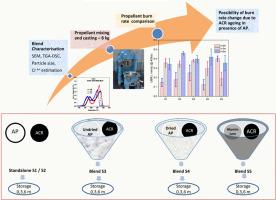

Abstract Image

查看原文
分享 分享
微信好友 朋友圈 QQ好友 复制链接
本刊更多论文
固体推进剂燃烧速率表征:铬酸铜与氧化剂混合物及其储存的影响
本研究详细介绍了以活性铜铬矿(ACR)作为燃烧催化剂的复合固体推进剂在高氯酸铵(AP)与 ACR 作用下燃烧速率随时间变化的情况。降低燃烧速率的假设之一是,在高氯酸铵存在下,ACR 中的铬铁矿与水分发生电解反应,转化为铬酸盐。我们通过实验设计对这一假设进行了研究,包括高氯酸铵与 ACR 的混合、铝与 ACR 的混合、原料阶段单独的 ACR 以及随着时间推移的混合储存。通过比较混合物中未干燥和干燥的高氯酸铵,研究了高氯酸铵中水分的影响。通过热重分析、粒度分布、表面积测量、扫描电子显微镜和铬估算对混合原料进行了表征。结果表明,在 AP 存在的情况下,铬从铬铁矿转化为铬酸盐的转化率非常低。在不同的时间间隔用这些混合物制备推进剂样品,以了解原材料储存过程中的粘度、机械性能和燃烧速率行为。实验结果表明,燃烧率在混合物储存 6 个月后呈相反的上升趋势。论文中提出了与实验条件相关的合理解释。
本文章由计算机程序翻译,如有差异,请以英文原文为准。
求助全文
约1分钟内获得全文 去求助
来源期刊
CiteScore
1.40
自引率
0.00%
发文量
0
期刊最新文献
Thermal stability ranking of energetic crystals via a neural network potential-enabled MD simulation protocol Probing the effect of activated carbon-based metal oxides on the thermocatalytic decomposition of energetic NC-DEGDN formulation Structural simulation and WAAM fabrication process exploration of damage-enhanced steel-zirconium laminated composite energetic penetrator Effects of RDX and HMX on the thermal stability properties of modified double-base propellants Enhancing the ignition ability of semiconductor bridge by composite Al/CuO/NC film
×
引用
GB/T 7714-2015
复制
MLA
复制
APA
复制
导出至
BibTeX EndNote RefMan NoteFirst NoteExpress
×
×
提示
您的信息不完整,为了账户安全,请先补充。
现在去补充
×
提示
您因"违规操作"
具体请查看互助需知
我知道了
×
提示
现在去查看 取消
×
提示
确定
0
微信
客服QQ
Book学术公众号 扫码关注我们
反馈
×
意见反馈
请填写您的意见或建议
请填写您的手机或邮箱
已复制链接
已复制链接
快去分享给好友吧!
我知道了
×
扫码分享
扫码分享
Book学术官方微信
Book学术文献互助
Book学术文献互助群
群 号:604180095
Book学术
文献互助 智能选刊 最新文献 互助须知 联系我们:info@booksci.cn
Book学术提供免费学术资源搜索服务,方便国内外学者检索中英文文献。致力于提供最便捷和优质的服务体验。
Copyright © 2023 Book学术 All rights reserved.
ghs 京公网安备 11010802042870号 京ICP备2023020795号-1





