Hani Boukeciat , Ahmed Fouzi Tarchoun , Djalal Trache , Amir Abdelaziz , Djamal Belmehdi , Redha Meziani , Lokmene Boumaza , Thomas M. Klapötke
{"title":"Pyrolysis mechanism and evolved gas analysis of a promising energetic carbamate-functionalized microcrystalline cellulose nitrate","authors":"Hani Boukeciat , Ahmed Fouzi Tarchoun , Djalal Trache , Amir Abdelaziz , Djamal Belmehdi , Redha Meziani , Lokmene Boumaza , Thomas M. Klapötke","doi":"10.1016/j.fpc.2024.04.002","DOIUrl":null,"url":null,"abstract":"<div><p>The present study aims to elucidate the decomposition mechanism and gas evolution characteristics of a promising energy-rich carbamated microcrystalline cellulose nitrate (M3CN). The molecular structure and morphological characteristics of starting microcrystalline cellulose carbamate (MCCC) and its nitrated derivative were examined using FTIR and SEM techniques. Thermal analysis using TGA and DSC revealed distinct decomposition behaviors for MCCC and M3CN. MCCC exhibited endothermic decomposition linked to the degradation of the cellulosic structure. In contrast, an exothermic decomposition event was observed for M3CN, attributed to the cleavage of energetic groups within the nitrated cellulosic chains. Furthermore, the hyphenated TG-FTIR analysis confirmed that the primary gaseous products emitted during the pyrolysis of M3CN included NO, N<sub>2</sub>O, NO<sub>2</sub>, CO<sub>2</sub>, H<sub>2</sub>O, CH<sub>4</sub>, HCHO, HCN, and CHNO. The findings of this study enhance our understanding of the pyrolysis mechanism in cellulose-based energetic materials, providing a significant reference for forthcoming research and explorations in this field.</p></div>","PeriodicalId":100531,"journal":{"name":"FirePhysChem","volume":"4 4","pages":"Pages 327-332"},"PeriodicalIF":3.6000,"publicationDate":"2024-04-03","publicationTypes":"Journal Article","fieldsOfStudy":null,"isOpenAccess":false,"openAccessPdf":"https://www.sciencedirect.com/science/article/pii/S2667134424000178/pdfft?md5=184ca38221a6a5032f0d1e38935ee65c&pid=1-s2.0-S2667134424000178-main.pdf","citationCount":"0","resultStr":null,"platform":"Semanticscholar","paperid":null,"PeriodicalName":"FirePhysChem","FirstCategoryId":"1085","ListUrlMain":"https://www.sciencedirect.com/science/article/pii/S2667134424000178","RegionNum":0,"RegionCategory":null,"ArticlePicture":[],"TitleCN":null,"AbstractTextCN":null,"PMCID":null,"EPubDate":"","PubModel":"","JCR":"","JCRName":"","Score":null,"Total":0}
引用次数: 0
Abstract
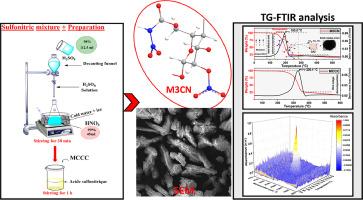
The present study aims to elucidate the decomposition mechanism and gas evolution characteristics of a promising energy-rich carbamated microcrystalline cellulose nitrate (M3CN). The molecular structure and morphological characteristics of starting microcrystalline cellulose carbamate (MCCC) and its nitrated derivative were examined using FTIR and SEM techniques. Thermal analysis using TGA and DSC revealed distinct decomposition behaviors for MCCC and M3CN. MCCC exhibited endothermic decomposition linked to the degradation of the cellulosic structure. In contrast, an exothermic decomposition event was observed for M3CN, attributed to the cleavage of energetic groups within the nitrated cellulosic chains. Furthermore, the hyphenated TG-FTIR analysis confirmed that the primary gaseous products emitted during the pyrolysis of M3CN included NO, N2O, NO2, CO2, H2O, CH4, HCHO, HCN, and CHNO. The findings of this study enhance our understanding of the pyrolysis mechanism in cellulose-based energetic materials, providing a significant reference for forthcoming research and explorations in this field.



 京公网安备 11010802042870号
京ICP备2023020795号-1
京公网安备 11010802042870号
京ICP备2023020795号-1

 分享
分享

 求助内容:
求助内容: 应助结果提醒方式:
 扫码关注我们
