Iqbal Shah , Xiaosong Su , Riccardo Talami , Ali Ghahramani
{"title":"Enhancing building envelopes: Parametric analysis of shading systems for opaque facades and their comparison with cool paints","authors":"Iqbal Shah , Xiaosong Su , Riccardo Talami , Ali Ghahramani","doi":"10.1016/j.enbenv.2024.04.001","DOIUrl":null,"url":null,"abstract":"<div><div>Heat gain through the buildings opaque facades significantly contributes to the energy consumption of Heating, Ventilation, and Air Conditioning (HVAC) systems. In the post-construction phase, retrofitting options for reducing façade heat gain are limited, with cool paints being the prevalent strategy. However, the efficacy of shading systems as an alternative strategy remains underexplored as existing research predominantly focuses on proof-of-concept validation, often overlooking a comprehensive assessment of shading system configurations across diverse climates and building typologies. Moreover, a comparative analysis of the performance and potential synergies between cool paints and shading systems on opaque facades is crucial to understand their actual effectiveness in real-world applications. To address these gaps, our study undertakes an extensive parametric simulation, taking into account variables such as shading configurations, cool paints with varying facade solar absorbance values, facade orientation, diverse climates, and different building typologies. The results demonstrate that the use of shading on opaque facades alone could result in a HVAC energy saving of 8–28 %, while the application of cool paints (façade absorptance value of 0.2) alone could reduce the HVAC energy consumption by 10–35 %. By combining the use of shading and cool paints, the HVAC energy savings are further increased by 2–5 %. The findings of this study offer a novel perspective on the selection of opaque façade technologies, broadening the sustainable design and retrofit options.</div></div>","PeriodicalId":33659,"journal":{"name":"Energy and Built Environment","volume":"6 5","pages":"Pages 904-919"},"PeriodicalIF":0.0000,"publicationDate":"2025-10-01","publicationTypes":"Journal Article","fieldsOfStudy":null,"isOpenAccess":false,"openAccessPdf":"","citationCount":"0","resultStr":null,"platform":"Semanticscholar","paperid":null,"PeriodicalName":"Energy and Built Environment","FirstCategoryId":"1085","ListUrlMain":"https://www.sciencedirect.com/science/article/pii/S2666123324000461","RegionNum":0,"RegionCategory":null,"ArticlePicture":[],"TitleCN":null,"AbstractTextCN":null,"PMCID":null,"EPubDate":"2024/4/12 0:00:00","PubModel":"Epub","JCR":"Q1","JCRName":"Engineering","Score":null,"Total":0}
引用次数: 0
Abstract
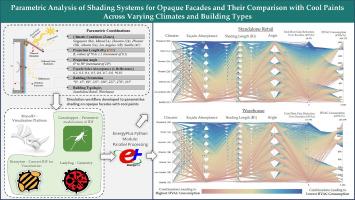
Heat gain through the buildings opaque facades significantly contributes to the energy consumption of Heating, Ventilation, and Air Conditioning (HVAC) systems. In the post-construction phase, retrofitting options for reducing façade heat gain are limited, with cool paints being the prevalent strategy. However, the efficacy of shading systems as an alternative strategy remains underexplored as existing research predominantly focuses on proof-of-concept validation, often overlooking a comprehensive assessment of shading system configurations across diverse climates and building typologies. Moreover, a comparative analysis of the performance and potential synergies between cool paints and shading systems on opaque facades is crucial to understand their actual effectiveness in real-world applications. To address these gaps, our study undertakes an extensive parametric simulation, taking into account variables such as shading configurations, cool paints with varying facade solar absorbance values, facade orientation, diverse climates, and different building typologies. The results demonstrate that the use of shading on opaque facades alone could result in a HVAC energy saving of 8–28 %, while the application of cool paints (façade absorptance value of 0.2) alone could reduce the HVAC energy consumption by 10–35 %. By combining the use of shading and cool paints, the HVAC energy savings are further increased by 2–5 %. The findings of this study offer a novel perspective on the selection of opaque façade technologies, broadening the sustainable design and retrofit options.




 京公网安备 11010802042870号
京ICP备2023020795号-1
京公网安备 11010802042870号
京ICP备2023020795号-1

 分享
分享
 求助内容:
求助内容: 应助结果提醒方式:
 扫码关注我们
