Enhanced Recovery After Surgery Cardiac Society turnkey order set for surgical-site infection prevention: Proceedings from the American Association for Thoracic Surgery ERAS Conclave 2023
Cheryl Crisafi MSN, RN , Michael C. Grant MD, MSE , Amanda Rea DNP, CRNP , Vicki Morton-Bailey DNP , Alexander J. Gregory MD , Rakesh C. Arora MD, PhD , Subhasis Chatterjee MD , Sylvain A. Lother MD, FRCPC, DTMH , Busra Cangut MD , Daniel T. Engelman MD
{"title":"Enhanced Recovery After Surgery Cardiac Society turnkey order set for surgical-site infection prevention: Proceedings from the American Association for Thoracic Surgery ERAS Conclave 2023","authors":"Cheryl Crisafi MSN, RN , Michael C. Grant MD, MSE , Amanda Rea DNP, CRNP , Vicki Morton-Bailey DNP , Alexander J. Gregory MD , Rakesh C. Arora MD, PhD , Subhasis Chatterjee MD , Sylvain A. Lother MD, FRCPC, DTMH , Busra Cangut MD , Daniel T. Engelman MD","doi":"10.1016/j.jtcvs.2024.03.027","DOIUrl":null,"url":null,"abstract":"<div><h3>Objectives</h3><div>Surgical-site infections (SSIs) after cardiac surgery increase morbidity and mortality, consume health care resources, impair recovery, and diminish patients’ quality of life. Numerous guidelines and expert consensus documents have been published to address the prevention and management of SSIs. Our objective is to integrate these documents into an order set that will facilitate the adoption and implementation of evidence-based best practices for preventing and managing SSIs after cardiac surgery.</div></div><div><h3>Methods</h3><div>Subject matter experts were consulted to translate existing guidelines and literature into a sample turnkey order set for SSI reduction. Orders derived from consistent class I, IIA, or equivalent recommendations across referenced guidelines and consensus manuscripts appear in the turnkey order set in bold type. Selected orders that were inconsistent class I or IIA, class IIB or otherwise supported by published evidence, were also included in italicized type.</div></div><div><h3>Results</h3><div>Preventative care begins with the preoperative identification of both modifiable and nonmodifiable SSI risks by health care providers. Assessment tools can be used to assist in identifying patients at a high risk of SSI. Preoperative recommendations include screening for and treating <em>Staphylococcus aureus</em> nasal carriage. Intraoperatively, tailored prophylactic intravenous antibiotics and maintaining blood glucose levels below 180 mg/dL are essential elements. Postoperative care includes maintaining normothermia, glucose control and patient engagement.</div></div><div><h3>Conclusions</h3><div>Despite the well-documented advantages of a multidisciplinary care pathway for SSI in cardiac surgery, there are inconsistencies in its adoption and implementation. This article provides an order set that incorporates recommendations from existing guidelines to prevent SSI in the cardiac surgical population.</div></div>","PeriodicalId":49975,"journal":{"name":"Journal of Thoracic and Cardiovascular Surgery","volume":"168 5","pages":"Pages 1500-1509"},"PeriodicalIF":4.4000,"publicationDate":"2024-11-01","publicationTypes":"Journal Article","fieldsOfStudy":null,"isOpenAccess":false,"openAccessPdf":"","citationCount":"0","resultStr":null,"platform":"Semanticscholar","paperid":null,"PeriodicalName":"Journal of Thoracic and Cardiovascular Surgery","FirstCategoryId":"3","ListUrlMain":"https://www.sciencedirect.com/science/article/pii/S0022522324002812","RegionNum":1,"RegionCategory":"医学","ArticlePicture":[],"TitleCN":null,"AbstractTextCN":null,"PMCID":null,"EPubDate":"","PubModel":"","JCR":"Q1","JCRName":"CARDIAC & CARDIOVASCULAR SYSTEMS","Score":null,"Total":0}
引用次数: 0
Abstract
Objectives
Surgical-site infections (SSIs) after cardiac surgery increase morbidity and mortality, consume health care resources, impair recovery, and diminish patients’ quality of life. Numerous guidelines and expert consensus documents have been published to address the prevention and management of SSIs. Our objective is to integrate these documents into an order set that will facilitate the adoption and implementation of evidence-based best practices for preventing and managing SSIs after cardiac surgery.
Methods
Subject matter experts were consulted to translate existing guidelines and literature into a sample turnkey order set for SSI reduction. Orders derived from consistent class I, IIA, or equivalent recommendations across referenced guidelines and consensus manuscripts appear in the turnkey order set in bold type. Selected orders that were inconsistent class I or IIA, class IIB or otherwise supported by published evidence, were also included in italicized type.
Results
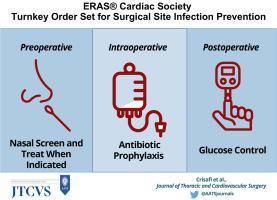
Preventative care begins with the preoperative identification of both modifiable and nonmodifiable SSI risks by health care providers. Assessment tools can be used to assist in identifying patients at a high risk of SSI. Preoperative recommendations include screening for and treating Staphylococcus aureus nasal carriage. Intraoperatively, tailored prophylactic intravenous antibiotics and maintaining blood glucose levels below 180 mg/dL are essential elements. Postoperative care includes maintaining normothermia, glucose control and patient engagement.
Conclusions
Despite the well-documented advantages of a multidisciplinary care pathway for SSI in cardiac surgery, there are inconsistencies in its adoption and implementation. This article provides an order set that incorporates recommendations from existing guidelines to prevent SSI in the cardiac surgical population.
期刊介绍:
The Journal of Thoracic and Cardiovascular Surgery presents original, peer-reviewed articles on diseases of the heart, great vessels, lungs and thorax with emphasis on surgical interventions. An official publication of The American Association for Thoracic Surgery and The Western Thoracic Surgical Association, the Journal focuses on techniques and developments in acquired cardiac surgery, congenital cardiac repair, thoracic procedures, heart and lung transplantation, mechanical circulatory support and other procedures.



 京公网安备 11010802042870号
京ICP备2023020795号-1
京公网安备 11010802042870号
京ICP备2023020795号-1

 分享
分享
 求助内容:
求助内容: 应助结果提醒方式:
 扫码关注我们
