Kamalpreet Kaur, Gagandeep Singh, Navneet Kaur and Narinder Singh
{"title":"Cation–π-induced mixed-matrix nanocomposite for the detection and removal of Hg2+ and azinphos-methyl towards environment remediation†","authors":"Kamalpreet Kaur, Gagandeep Singh, Navneet Kaur and Narinder Singh","doi":"10.1039/D4EW00114A","DOIUrl":null,"url":null,"abstract":"<p >The unregulated use of pesticides, which constitutes organophosphates, demands their continuous monitoring from a human health perspective. The development of efficient, reliable and affordable methods for the effective quantification, removal and detoxification of pesticides is indeed a significant challenge in the fields of agriculture, environmental science and public health. Herein, we designed a simple approach for the construction of a functionalised electrochemical material that includes the following steps: (i) the cation–π induced non-covalent functionalization of multiwalled carbon nanotubes (MWCNTs) with an organic cation IL, and (ii) the complexation of <strong>IL@MWCNTs</strong> with Hg<small><sup>2+</sup></small> to accelerate electron transfer, apparently enhancing the response of <strong>Hg/IL@MWCNTs</strong> towards azinphos-methyl, as revealed by cyclic voltammetry. <strong>Hg/IL@MWCNTs/GCE</strong> exhibits electrocatalytic behaviour towards azinphos-methyl (AZM) with a low detection limit of 1.10 μM and a wide linear range (0.20–180 μM). The degradation of the AZM pesticide was supported by <small><sup>31</sup></small>P NMR titration and mass spectrometry, which confirmed the conversion of AZM into its non-toxic products. Taking into account the aforementioned findings, the functionalised <strong>IL@MWCNT</strong> composite was fabricated into an ultrathin polyamide layer on a PES support membrane <em>via</em> interfacial polymerisation for practical application. The developed nanocomposite membrane removes the Hg<small><sup>2+</sup></small> metal ion and azinphos-methyl pesticide from contaminated water with a removal efficiency of 95% and 90%, respectively.</p>","PeriodicalId":75,"journal":{"name":"Environmental Science: Water Research & Technology","volume":" 7","pages":" 1595-1609"},"PeriodicalIF":3.1000,"publicationDate":"2024-04-26","publicationTypes":"Journal Article","fieldsOfStudy":null,"isOpenAccess":false,"openAccessPdf":"","citationCount":"0","resultStr":null,"platform":"Semanticscholar","paperid":null,"PeriodicalName":"Environmental Science: Water Research & Technology","FirstCategoryId":"93","ListUrlMain":"https://pubs.rsc.org/en/content/articlelanding/2024/ew/d4ew00114a","RegionNum":4,"RegionCategory":"环境科学与生态学","ArticlePicture":[],"TitleCN":null,"AbstractTextCN":null,"PMCID":null,"EPubDate":"","PubModel":"","JCR":"Q3","JCRName":"ENGINEERING, ENVIRONMENTAL","Score":null,"Total":0}
引用次数: 0
Abstract
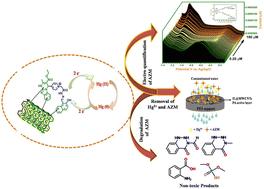
The unregulated use of pesticides, which constitutes organophosphates, demands their continuous monitoring from a human health perspective. The development of efficient, reliable and affordable methods for the effective quantification, removal and detoxification of pesticides is indeed a significant challenge in the fields of agriculture, environmental science and public health. Herein, we designed a simple approach for the construction of a functionalised electrochemical material that includes the following steps: (i) the cation–π induced non-covalent functionalization of multiwalled carbon nanotubes (MWCNTs) with an organic cation IL, and (ii) the complexation of IL@MWCNTs with Hg2+ to accelerate electron transfer, apparently enhancing the response of Hg/IL@MWCNTs towards azinphos-methyl, as revealed by cyclic voltammetry. Hg/IL@MWCNTs/GCE exhibits electrocatalytic behaviour towards azinphos-methyl (AZM) with a low detection limit of 1.10 μM and a wide linear range (0.20–180 μM). The degradation of the AZM pesticide was supported by 31P NMR titration and mass spectrometry, which confirmed the conversion of AZM into its non-toxic products. Taking into account the aforementioned findings, the functionalised IL@MWCNT composite was fabricated into an ultrathin polyamide layer on a PES support membrane via interfacial polymerisation for practical application. The developed nanocomposite membrane removes the Hg2+ metal ion and azinphos-methyl pesticide from contaminated water with a removal efficiency of 95% and 90%, respectively.
期刊介绍:
Environmental Science: Water Research & Technology seeks to showcase high quality research about fundamental science, innovative technologies, and management practices that promote sustainable water.



 京公网安备 11010802042870号
京ICP备2023020795号-1
京公网安备 11010802042870号
京ICP备2023020795号-1

 分享
分享
 求助内容:
求助内容: 应助结果提醒方式:
 扫码关注我们
