Ruth Akoto, Alexander K. Anning, Ebenezer J. D. Belford
{"title":"Growth response of vetiver grass (Chrysopogon zizanioides (L.) Roberty) to chemical amendments in assisted phytoremediation of contaminated mined soil","authors":"Ruth Akoto, Alexander K. Anning, Ebenezer J. D. Belford","doi":"10.1007/s11738-024-03679-z","DOIUrl":null,"url":null,"abstract":"<div><p>The application of chemical amendment to improve metal availability is a key strategy in phytoremediation and an important determinant for successful removal of heavy metals from soil, although empirical data on their effects on plants used in phytoremediation are scanty. In this study, field-based assisted phytoremediation with ethylene-diamine-tetra-acetic acid (EDTA), nitrogen-potassium-phosphorus fertilizer (NPK) and combination of EDTA and NPK modelled after the completely randomized block design was used to determine the effects of chemical amendments on some morphological and physiological growth parameters of vetiver grass (<i>Chrysopogon zizanioides</i> (L.) Roberty) as well as the relative effects of chemical amendment and free heavy metal ions contamination. Results showed that the soil amendments (EDTA, NPK, EDTA + NPK) enhanced plant height and diameter, and reduced the toxicity of free metal ions. On the other hand, heavy metals reduced plant chlorophyll-a and -b, and plant root, and correlated with lipid peroxidation. Notably, EDTA contributed the least to enhancing plant height, diameter, and root length although it interacted positively with NPK to enhance the above-mentioned parameters. In general, the results of this study confirm the effectiveness of chemical amendments (EDTA and NPK in this case) in reducing the toxicity of free heavy metal ions in plant during phytoremediation.</p></div>","PeriodicalId":6973,"journal":{"name":"Acta Physiologiae Plantarum","volume":"46 5","pages":""},"PeriodicalIF":2.2000,"publicationDate":"2024-04-29","publicationTypes":"Journal Article","fieldsOfStudy":null,"isOpenAccess":false,"openAccessPdf":"","citationCount":"0","resultStr":null,"platform":"Semanticscholar","paperid":null,"PeriodicalName":"Acta Physiologiae Plantarum","FirstCategoryId":"99","ListUrlMain":"https://link.springer.com/article/10.1007/s11738-024-03679-z","RegionNum":4,"RegionCategory":"生物学","ArticlePicture":[],"TitleCN":null,"AbstractTextCN":null,"PMCID":null,"EPubDate":"","PubModel":"","JCR":"Q2","JCRName":"PLANT SCIENCES","Score":null,"Total":0}
引用次数: 0
Abstract
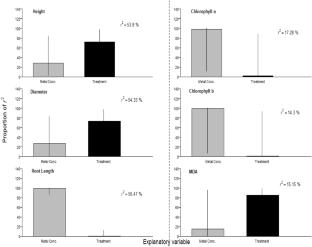
The application of chemical amendment to improve metal availability is a key strategy in phytoremediation and an important determinant for successful removal of heavy metals from soil, although empirical data on their effects on plants used in phytoremediation are scanty. In this study, field-based assisted phytoremediation with ethylene-diamine-tetra-acetic acid (EDTA), nitrogen-potassium-phosphorus fertilizer (NPK) and combination of EDTA and NPK modelled after the completely randomized block design was used to determine the effects of chemical amendments on some morphological and physiological growth parameters of vetiver grass (Chrysopogon zizanioides (L.) Roberty) as well as the relative effects of chemical amendment and free heavy metal ions contamination. Results showed that the soil amendments (EDTA, NPK, EDTA + NPK) enhanced plant height and diameter, and reduced the toxicity of free metal ions. On the other hand, heavy metals reduced plant chlorophyll-a and -b, and plant root, and correlated with lipid peroxidation. Notably, EDTA contributed the least to enhancing plant height, diameter, and root length although it interacted positively with NPK to enhance the above-mentioned parameters. In general, the results of this study confirm the effectiveness of chemical amendments (EDTA and NPK in this case) in reducing the toxicity of free heavy metal ions in plant during phytoremediation.
期刊介绍:
Acta Physiologiae Plantarum is an international journal established in 1978 that publishes peer-reviewed articles on all aspects of plant physiology. The coverage ranges across this research field at various levels of biological organization, from relevant aspects in molecular and cell biology to biochemistry.
The coverage is global in scope, offering articles of interest from experts around the world. The range of topics includes measuring effects of environmental pollution on crop species; analysis of genomic organization; effects of drought and climatic conditions on plants; studies of photosynthesis in ornamental plants, and more.



 京公网安备 11010802042870号
京ICP备2023020795号-1
京公网安备 11010802042870号
京ICP备2023020795号-1

 分享
分享
 求助内容:
求助内容: 应助结果提醒方式:
 扫码关注我们
