Laia Dotras, Amanda Barciela, Manuel Llana, Jordi Galbany, R. Adriana Hernandez-Aguilar
{"title":"Savanna chimpanzee (Pan troglodytes) crop feeding at Dindefelo, Senegal: challenges and implications for conservation","authors":"Laia Dotras, Amanda Barciela, Manuel Llana, Jordi Galbany, R. Adriana Hernandez-Aguilar","doi":"10.1007/s10329-024-01125-9","DOIUrl":null,"url":null,"abstract":"<p>Chimpanzees (<i>Pan troglodytes</i>) are categorized as Endangered by the International Union for Conservation of Nature, and habitat loss due to conversion of land for agriculture is one of the major threats to wild populations of this species. This challenging scenario can lead to negative human-chimpanzee interactions, including crop feeding. Chimpanzees consume crops across their geographical range, although little is known about this behavior in savanna habitats. Here we provide new evidence of crop feeding by savanna chimpanzees. We conducted our observations at Dindefelo, a community nature reserve in southeastern Senegal. The chimpanzees were observed to feed on mango (<i>Mangifera indica</i>) and also on baobab (<i>Adansonia digitata</i>), a wild species considered a crop by local people when found in and around villages. Although local people use the fruits of these species for food and income, they tolerated crop-feeding events until recently. In 2023, a case of harassment of a crop-feeding chimpanzee in a mango orchard was witnessed, and four days later a chimpanzee corpse was found at the same place. We conclude that habitat conversion into agricultural fields, uncontrolled bush fires and extraction of wild fruits are the important factors influencing crop-feeding events at Dindefelo. Our findings highlight the need to better understand human-chimpanzee interactions in the anthropogenic landscape of Dindefelo to help mitigate negative attitudes and behaviors towards chimpanzees.</p>","PeriodicalId":20468,"journal":{"name":"Primates","volume":"43 1","pages":""},"PeriodicalIF":1.5000,"publicationDate":"2024-04-30","publicationTypes":"Journal Article","fieldsOfStudy":null,"isOpenAccess":false,"openAccessPdf":"","citationCount":"0","resultStr":null,"platform":"Semanticscholar","paperid":null,"PeriodicalName":"Primates","FirstCategoryId":"99","ListUrlMain":"https://doi.org/10.1007/s10329-024-01125-9","RegionNum":4,"RegionCategory":"生物学","ArticlePicture":[],"TitleCN":null,"AbstractTextCN":null,"PMCID":null,"EPubDate":"","PubModel":"","JCR":"Q2","JCRName":"ZOOLOGY","Score":null,"Total":0}
引用次数: 0
Abstract
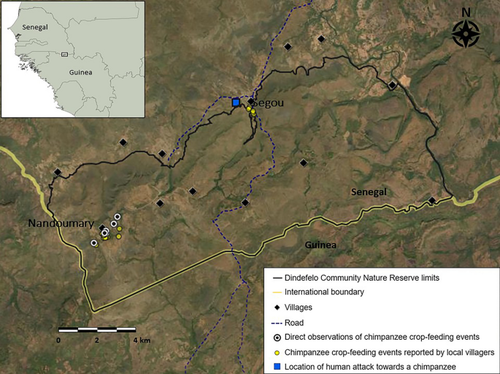
Chimpanzees (Pan troglodytes) are categorized as Endangered by the International Union for Conservation of Nature, and habitat loss due to conversion of land for agriculture is one of the major threats to wild populations of this species. This challenging scenario can lead to negative human-chimpanzee interactions, including crop feeding. Chimpanzees consume crops across their geographical range, although little is known about this behavior in savanna habitats. Here we provide new evidence of crop feeding by savanna chimpanzees. We conducted our observations at Dindefelo, a community nature reserve in southeastern Senegal. The chimpanzees were observed to feed on mango (Mangifera indica) and also on baobab (Adansonia digitata), a wild species considered a crop by local people when found in and around villages. Although local people use the fruits of these species for food and income, they tolerated crop-feeding events until recently. In 2023, a case of harassment of a crop-feeding chimpanzee in a mango orchard was witnessed, and four days later a chimpanzee corpse was found at the same place. We conclude that habitat conversion into agricultural fields, uncontrolled bush fires and extraction of wild fruits are the important factors influencing crop-feeding events at Dindefelo. Our findings highlight the need to better understand human-chimpanzee interactions in the anthropogenic landscape of Dindefelo to help mitigate negative attitudes and behaviors towards chimpanzees.
期刊介绍:
Primates is an international journal of primatology whose aim is to provide a forum for the elucidation of all aspects of primates. The oldest primatological journal, Primates publishes original papers that advance the scientific study of primates, and its scope embraces work in diverse fields covering biological bases of behavior, socio-ecology, learning and cognition, social processes, systematics, evolution, and medicine. Contributions relevant to conservation of natural populations and welfare of captive primates are welcome. Studies focusing on nonprimate species may be considered if their relevance to primatology is clear. Original Articles as well as Review Articles, News and Perspectives, and Book Reviews are included. All manuscripts received are initially screened for suitability by members of the Editorial Board, taking into account style and ethical issues, leading to a swift decision about whether to send the manuscript for external review.



 京公网安备 11010802042870号
京ICP备2023020795号-1
京公网安备 11010802042870号
京ICP备2023020795号-1

 分享
分享
 求助内容:
求助内容: 应助结果提醒方式:
 扫码关注我们
