Mohammad Nasb , Fengxing Li , Lamis Dayoub , Tong Wu , Minhui Wei , Ning Chen
{"title":"Bridging the gap: Integrating exercise mimicry into chronic disease management through suppressing chronic inflammation","authors":"Mohammad Nasb , Fengxing Li , Lamis Dayoub , Tong Wu , Minhui Wei , Ning Chen","doi":"10.1016/j.jare.2024.04.034","DOIUrl":null,"url":null,"abstract":"<div><h3>Background</h3><div>Chronic inflammation is a common hallmark of many chronic diseases. Although exercise holds paramount importance in preventing and managing chronic diseases, adherence to exercise programs can be challenging for some patients. Consequently, there is a pressing need to explore alternative strategies to emulate the anti-inflammatory effects of exercise for chronic diseases.</div></div><div><h3>Aim of Review</h3><div>This review explores the emerging role of green tea bioactive components as potential mitigators of chronic inflammation, offering insights into their capacity to mimic the beneficial effects of exercise. We propose that bioactive components in green tea are promising agents for suppressing chronic inflammation, suggesting their unique capability to replicate the health benefits of exercise.</div></div><div><h3>Key Scientific Concepts of Review</h3><div>This review focuses on several key concepts, including chronic inflammation and its role in chronic diseases, the anti-inflammatory effects of regular exercise, and bioactive components in green tea responsible for its health benefits. It elaborates on scientific evidence supporting the anti-inflammatory properties of green tea bioactive components, such as epigallocatechin gallate (EGCG), and theorizes how these bioactive components might replicate the effects of exercise at a molecular level. Through a comprehensive analysis of current research, this review proposes a novel perspective on the application of green tea as a potential intervention strategy to suppress chronic inflammation, thereby extending the benefits akin to those achieved through exercise.</div></div>","PeriodicalId":14952,"journal":{"name":"Journal of Advanced Research","volume":"70 ","pages":"Pages 307-322"},"PeriodicalIF":13.0000,"publicationDate":"2025-04-01","publicationTypes":"Journal Article","fieldsOfStudy":null,"isOpenAccess":false,"openAccessPdf":"","citationCount":"0","resultStr":null,"platform":"Semanticscholar","paperid":null,"PeriodicalName":"Journal of Advanced Research","FirstCategoryId":"103","ListUrlMain":"https://www.sciencedirect.com/science/article/pii/S2090123224001760","RegionNum":1,"RegionCategory":"综合性期刊","ArticlePicture":[],"TitleCN":null,"AbstractTextCN":null,"PMCID":null,"EPubDate":"2024/5/3 0:00:00","PubModel":"Epub","JCR":"Q1","JCRName":"MULTIDISCIPLINARY SCIENCES","Score":null,"Total":0}
引用次数: 0
Abstract
Background
Chronic inflammation is a common hallmark of many chronic diseases. Although exercise holds paramount importance in preventing and managing chronic diseases, adherence to exercise programs can be challenging for some patients. Consequently, there is a pressing need to explore alternative strategies to emulate the anti-inflammatory effects of exercise for chronic diseases.
Aim of Review
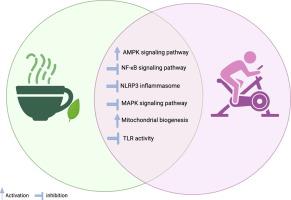
This review explores the emerging role of green tea bioactive components as potential mitigators of chronic inflammation, offering insights into their capacity to mimic the beneficial effects of exercise. We propose that bioactive components in green tea are promising agents for suppressing chronic inflammation, suggesting their unique capability to replicate the health benefits of exercise.
Key Scientific Concepts of Review
This review focuses on several key concepts, including chronic inflammation and its role in chronic diseases, the anti-inflammatory effects of regular exercise, and bioactive components in green tea responsible for its health benefits. It elaborates on scientific evidence supporting the anti-inflammatory properties of green tea bioactive components, such as epigallocatechin gallate (EGCG), and theorizes how these bioactive components might replicate the effects of exercise at a molecular level. Through a comprehensive analysis of current research, this review proposes a novel perspective on the application of green tea as a potential intervention strategy to suppress chronic inflammation, thereby extending the benefits akin to those achieved through exercise.
期刊介绍:
Journal of Advanced Research (J. Adv. Res.) is an applied/natural sciences, peer-reviewed journal that focuses on interdisciplinary research. The journal aims to contribute to applied research and knowledge worldwide through the publication of original and high-quality research articles in the fields of Medicine, Pharmaceutical Sciences, Dentistry, Physical Therapy, Veterinary Medicine, and Basic and Biological Sciences.
The following abstracting and indexing services cover the Journal of Advanced Research: PubMed/Medline, Essential Science Indicators, Web of Science, Scopus, PubMed Central, PubMed, Science Citation Index Expanded, Directory of Open Access Journals (DOAJ), and INSPEC.




 京公网安备 11010802042870号
京ICP备2023020795号-1
京公网安备 11010802042870号
京ICP备2023020795号-1

 分享
分享
 求助内容:
求助内容: 应助结果提醒方式:
 扫码关注我们
