Zhen Wang, Lars Vilhelmsen, Alexandr P. Rasnitsyn, Alexandra Viertler, Chungkun Shih, Shanshan Wen, Hongru Yang, Qiong Wu, Yanjie Zhang, Dong Ren, Taiping Gao
{"title":"Specialized ovipositor sensilla of Cretaceous wasps (Insecta: Hymenoptera) possibly reveal a unique way of host detection","authors":"Zhen Wang, Lars Vilhelmsen, Alexandr P. Rasnitsyn, Alexandra Viertler, Chungkun Shih, Shanshan Wen, Hongru Yang, Qiong Wu, Yanjie Zhang, Dong Ren, Taiping Gao","doi":"10.1111/cla.12579","DOIUrl":null,"url":null,"abstract":"<p>Insects have evolved complex sensory systems that are important for feeding, defence and reproduction. Parasitoid wasps often spend much time and effort in searching for concealed hosts with the help of specialized sensilla. However, the early evolution of such behaviour and sensilla is poorly known. We describe two fossil female wasps, †<i>Tichostephanus kachinensis</i> sp. nov. and †<i>Tichostephanus longus</i> sp. nov., from mid-Cretaceous Kachin amber. Phylogenetic analyses based on morphological data retrieved †<i>Tichostephanus</i> as deeply nested within Evanioidea and closely related to extant Gasteruptiidae and Evaniidae. Both of these Cretaceous wasps possess features, e.g. coronal tubercles and flexible ovipositor sheaths, that indicate that they might have laid eggs in wood where their larvae possibly parasitized insect larvae. They have a peculiar and unique ‘bottle brush’ of sensilla close to the apex of their ovipositor sheaths, which has not been observed in any extant parasitoid wasps. These sensilla comprise many regularly arranged plate-shaped setae, attached in relatively large sockets and with rows of longitudinal ridges. Such specialized sensilla perhaps served to enhance the ability to detect hosts inside wood.</p>","PeriodicalId":50688,"journal":{"name":"Cladistics","volume":"40 5","pages":"526-537"},"PeriodicalIF":8.9000,"publicationDate":"2024-05-07","publicationTypes":"Journal Article","fieldsOfStudy":null,"isOpenAccess":false,"openAccessPdf":"","citationCount":"0","resultStr":null,"platform":"Semanticscholar","paperid":null,"PeriodicalName":"Cladistics","FirstCategoryId":"99","ListUrlMain":"https://onlinelibrary.wiley.com/doi/10.1111/cla.12579","RegionNum":2,"RegionCategory":"生物学","ArticlePicture":[],"TitleCN":null,"AbstractTextCN":null,"PMCID":null,"EPubDate":"","PubModel":"","JCR":"Q1","JCRName":"EVOLUTIONARY BIOLOGY","Score":null,"Total":0}
引用次数: 0
Abstract
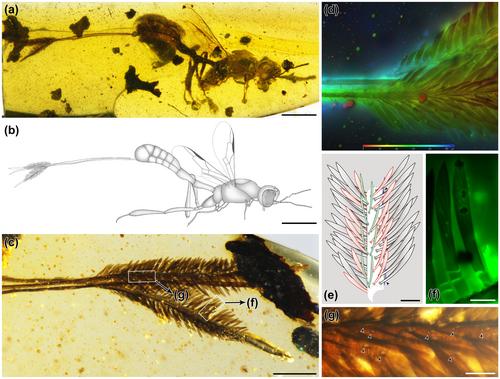
Insects have evolved complex sensory systems that are important for feeding, defence and reproduction. Parasitoid wasps often spend much time and effort in searching for concealed hosts with the help of specialized sensilla. However, the early evolution of such behaviour and sensilla is poorly known. We describe two fossil female wasps, †Tichostephanus kachinensis sp. nov. and †Tichostephanus longus sp. nov., from mid-Cretaceous Kachin amber. Phylogenetic analyses based on morphological data retrieved †Tichostephanus as deeply nested within Evanioidea and closely related to extant Gasteruptiidae and Evaniidae. Both of these Cretaceous wasps possess features, e.g. coronal tubercles and flexible ovipositor sheaths, that indicate that they might have laid eggs in wood where their larvae possibly parasitized insect larvae. They have a peculiar and unique ‘bottle brush’ of sensilla close to the apex of their ovipositor sheaths, which has not been observed in any extant parasitoid wasps. These sensilla comprise many regularly arranged plate-shaped setae, attached in relatively large sockets and with rows of longitudinal ridges. Such specialized sensilla perhaps served to enhance the ability to detect hosts inside wood.
期刊介绍:
Cladistics publishes high quality research papers on systematics, encouraging debate on all aspects of the field, from philosophy, theory and methodology to empirical studies and applications in biogeography, coevolution, conservation biology, ontogeny, genomics and paleontology.
Cladistics is read by scientists working in the research fields of evolution, systematics and integrative biology and enjoys a consistently high position in the ISI® rankings for evolutionary biology.




 京公网安备 11010802042870号
京ICP备2023020795号-1
京公网安备 11010802042870号
京ICP备2023020795号-1

 分享
分享
 求助内容:
求助内容: 应助结果提醒方式:
 扫码关注我们
