Qingsheng Li , Lingfei Yang , Kaixin Wang , Ziyi Chen , Huimin Liu , Xuan Yang , Yudi Xu , Yufei Chen , Zhe Gong , Yanjie Jia
{"title":"Oxidized mitochondrial DNA activates the cGAS-STING pathway in the neuronal intrinsic immune system after brain ischemia-reperfusion injury","authors":"Qingsheng Li , Lingfei Yang , Kaixin Wang , Ziyi Chen , Huimin Liu , Xuan Yang , Yudi Xu , Yufei Chen , Zhe Gong , Yanjie Jia","doi":"10.1016/j.neurot.2024.e00368","DOIUrl":null,"url":null,"abstract":"<div><p>In the context of stroke and revascularization therapy, brain ischemia-reperfusion injury is a significant challenge that leads to oxidative stress and inflammation. Central to the cell's intrinsic immunity is the cGAS-STING pathway, which is typically activated by unusual DNA structures. The involvement of oxidized mitochondrial DNA (ox-mtDNA)—an oxidative stress byproduct—in this type of neurological damage has not been fully explored. This study is among the first to examine the effect of ox-mtDNA on the innate immunity of neurons following ischemia-reperfusion injury. Using a rat model of transient middle cerebral artery occlusion and a cellular model of oxygen-glucose deprivation/reoxygenation, we have discovered that ox-mtDNA activates the cGAS-STING pathway in neurons. Importantly, pharmacologically limiting the release of ox-mtDNA into the cytoplasm reduces inflammation and improves neurological functions. Our findings suggest that targeting ox-mtDNA release may be a valuable strategy to attenuate brain ischemia-reperfusion injury following revascularization therapy for acute ischemic stroke.</p></div>","PeriodicalId":19159,"journal":{"name":"Neurotherapeutics","volume":"21 4","pages":"Article e00368"},"PeriodicalIF":6.9000,"publicationDate":"2024-07-01","publicationTypes":"Journal Article","fieldsOfStudy":null,"isOpenAccess":false,"openAccessPdf":"https://www.sciencedirect.com/science/article/pii/S1878747924000540/pdfft?md5=f9b38205ee66fa3fcdee74114df81530&pid=1-s2.0-S1878747924000540-main.pdf","citationCount":"0","resultStr":null,"platform":"Semanticscholar","paperid":null,"PeriodicalName":"Neurotherapeutics","FirstCategoryId":"3","ListUrlMain":"https://www.sciencedirect.com/science/article/pii/S1878747924000540","RegionNum":2,"RegionCategory":"医学","ArticlePicture":[],"TitleCN":null,"AbstractTextCN":null,"PMCID":null,"EPubDate":"","PubModel":"","JCR":"Q1","JCRName":"CLINICAL NEUROLOGY","Score":null,"Total":0}
引用次数: 0
Abstract
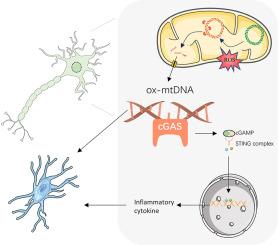
In the context of stroke and revascularization therapy, brain ischemia-reperfusion injury is a significant challenge that leads to oxidative stress and inflammation. Central to the cell's intrinsic immunity is the cGAS-STING pathway, which is typically activated by unusual DNA structures. The involvement of oxidized mitochondrial DNA (ox-mtDNA)—an oxidative stress byproduct—in this type of neurological damage has not been fully explored. This study is among the first to examine the effect of ox-mtDNA on the innate immunity of neurons following ischemia-reperfusion injury. Using a rat model of transient middle cerebral artery occlusion and a cellular model of oxygen-glucose deprivation/reoxygenation, we have discovered that ox-mtDNA activates the cGAS-STING pathway in neurons. Importantly, pharmacologically limiting the release of ox-mtDNA into the cytoplasm reduces inflammation and improves neurological functions. Our findings suggest that targeting ox-mtDNA release may be a valuable strategy to attenuate brain ischemia-reperfusion injury following revascularization therapy for acute ischemic stroke.
期刊介绍:
Neurotherapeutics® is the journal of the American Society for Experimental Neurotherapeutics (ASENT). Each issue provides critical reviews of an important topic relating to the treatment of neurological disorders written by international authorities.
The Journal also publishes original research articles in translational neuroscience including descriptions of cutting edge therapies that cross disciplinary lines and represent important contributions to neurotherapeutics for medical practitioners and other researchers in the field.
Neurotherapeutics ® delivers a multidisciplinary perspective on the frontiers of translational neuroscience, provides perspectives on current research and practice, and covers social and ethical as well as scientific issues.



 京公网安备 11010802042870号
京ICP备2023020795号-1
京公网安备 11010802042870号
京ICP备2023020795号-1

 分享
分享
 求助内容:
求助内容: 应助结果提醒方式:
 扫码关注我们
