Tomas Nakazato, Pablo Quezada, César Gutiérrez, Franco Romaní
{"title":"Chronic Neck Pain Prevalence Before and After COVID-19 Restrictions and Its Relationship With Digital Device Screen Viewing: A Population Study.","authors":"Tomas Nakazato, Pablo Quezada, César Gutiérrez, Franco Romaní","doi":"10.5535/arm.230030","DOIUrl":null,"url":null,"abstract":"<p><strong>Objective: </strong>To estimate the prevalence of chronic neck pain (CNP) among the adult population in Peru during the post-coronavirus disease 2019 (COVID-19) restriction period compared with that during the pre-pandemic period and evaluate its association with prolonged digital devices connected to the internet (DDCI) screen viewing.</p><p><strong>Methods: </strong>We conducted a cross-sectional study using a representative sample of adults living in Peru in November 2022. A structured survey was employed to identify CNP, and the exposure variable was set as the duration of DDCI screen viewing. The McNemar test was used to compare CNP prevalence pre- and post-COVID-19 restrictions, and ordinal logistic regression was used to evaluate its association with prolonged screen viewing.</p><p><strong>Results: </strong>A total of 1,202 individuals participated, with 52.8% females and 79.9% residing in urban areas. Following the restrictions, the prevalence of CNP occurring daily or almost daily and at least once a week was 14.8% and 27.8%, respectively (95% confidence Interval [95% CI], 12.6-17.3 and 24.9-30.9), representing a significant increase (p<0.001) compared with pre-pandemic estimates. Notably, among those viewing DDCI screens for ≥8 hours, the odds ratio for CNP frequency escalation compared with those who did not or rarely view screens was 1.61 (95% CI, 1.04-2.50; p=0.033).</p><p><strong>Conclusion: </strong>Approximately 4 of 10 adults in Peru experienced CNP following the lifting of COVID-19 social restrictions, more than double the pre-pandemic prevalence. Furthermore, prolonged viewing of DDCI screens increased the risk of having this condition.</p>","PeriodicalId":47738,"journal":{"name":"Annals of Rehabilitation Medicine-ARM","volume":"48 2","pages":"124-134"},"PeriodicalIF":2.9000,"publicationDate":"2024-04-01","publicationTypes":"Journal Article","fieldsOfStudy":null,"isOpenAccess":false,"openAccessPdf":"https://www.ncbi.nlm.nih.gov/pmc/articles/PMC11058364/pdf/","citationCount":"0","resultStr":null,"platform":"Semanticscholar","paperid":null,"PeriodicalName":"Annals of Rehabilitation Medicine-ARM","FirstCategoryId":"1085","ListUrlMain":"https://doi.org/10.5535/arm.230030","RegionNum":0,"RegionCategory":null,"ArticlePicture":[],"TitleCN":null,"AbstractTextCN":null,"PMCID":null,"EPubDate":"2024/4/22 0:00:00","PubModel":"Epub","JCR":"Q1","JCRName":"REHABILITATION","Score":null,"Total":0}
引用次数: 0
Abstract
Objective: To estimate the prevalence of chronic neck pain (CNP) among the adult population in Peru during the post-coronavirus disease 2019 (COVID-19) restriction period compared with that during the pre-pandemic period and evaluate its association with prolonged digital devices connected to the internet (DDCI) screen viewing.
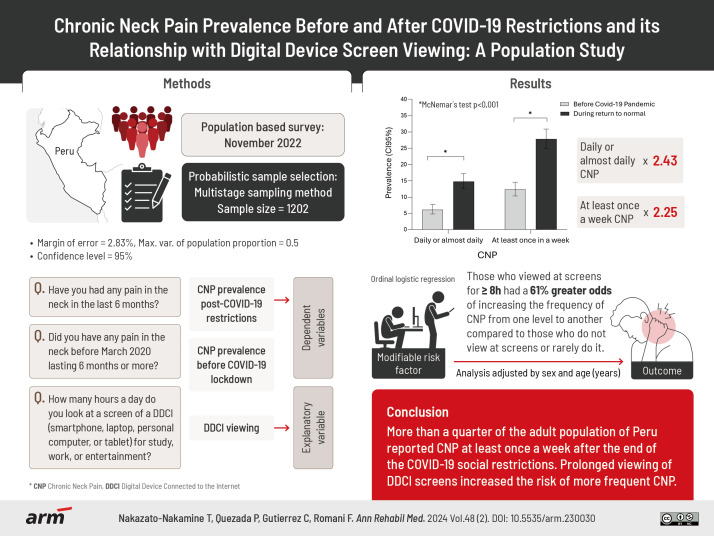
Methods: We conducted a cross-sectional study using a representative sample of adults living in Peru in November 2022. A structured survey was employed to identify CNP, and the exposure variable was set as the duration of DDCI screen viewing. The McNemar test was used to compare CNP prevalence pre- and post-COVID-19 restrictions, and ordinal logistic regression was used to evaluate its association with prolonged screen viewing.
Results: A total of 1,202 individuals participated, with 52.8% females and 79.9% residing in urban areas. Following the restrictions, the prevalence of CNP occurring daily or almost daily and at least once a week was 14.8% and 27.8%, respectively (95% confidence Interval [95% CI], 12.6-17.3 and 24.9-30.9), representing a significant increase (p<0.001) compared with pre-pandemic estimates. Notably, among those viewing DDCI screens for ≥8 hours, the odds ratio for CNP frequency escalation compared with those who did not or rarely view screens was 1.61 (95% CI, 1.04-2.50; p=0.033).
Conclusion: Approximately 4 of 10 adults in Peru experienced CNP following the lifting of COVID-19 social restrictions, more than double the pre-pandemic prevalence. Furthermore, prolonged viewing of DDCI screens increased the risk of having this condition.




 京公网安备 11010802042870号
京ICP备2023020795号-1
京公网安备 11010802042870号
京ICP备2023020795号-1

 分享
分享
 求助内容:
求助内容: 应助结果提醒方式:
 扫码关注我们
