Lindsey M Marian, Kathleen A Harris, Devon S Conway
{"title":"The patient-reported wearing-off phenomenon with monoclonal antibody treatments for multiple sclerosis.","authors":"Lindsey M Marian, Kathleen A Harris, Devon S Conway","doi":"10.1177/20552173241251707","DOIUrl":null,"url":null,"abstract":"<p><strong>Background: </strong>Many patients report a wearing-off phenomenon with monoclonal antibody treatment for multiple sclerosis in which perceived benefits wear off before the next dose is due.</p><p><strong>Objectives: </strong>To determine prevalence of the wearing-off effect, symptoms experienced, impact on treatment satisfaction, and associated patient characteristics.</p><p><strong>Methods: </strong>Patients receiving natalizumab, ocrelizumab, ofatumumab, or rituximab at a tertiary multiple sclerosis center were invited to take an online survey interrogating their monoclonal antibody experience. Additional history and patient characteristic data were collected. Logistic regression was used to determine if patient characteristics predicted the wearing-off effect and linear regression to evaluate the impact of the wearing-off effect on treatment satisfaction. The models were adjusted for age, disease duration, race, sex, body mass index, education, and depression as measured by the Patient Health Questionnaire-9.</p><p><strong>Results: </strong>We received 258 qualifying responses and 141 (54.7%) patients reported the wearing-off phenomenon. The most common symptom was fatigue (47.7%). Higher Patient Health Questionnaire-9 scores were significantly associated with the wearing-off phenomenon (OR = 1.02, <i>p</i> = 0.005). The wearing-off effect (β = -0.52, <i>p</i> = 0.04) and higher Patient Health Questionnaire-9 (β = -0.09, <i>p</i> < 0.01) scores were associated with significantly reduced treatment satisfaction.</p><p><strong>Conclusion: </strong>The wearing-off phenomenon is common, associated with depression, and reduces treatment satisfaction. Research addressing mitigation strategies is needed.</p>","PeriodicalId":18961,"journal":{"name":"Multiple Sclerosis Journal - Experimental, Translational and Clinical","volume":"10 2","pages":"20552173241251707"},"PeriodicalIF":2.3000,"publicationDate":"2024-05-06","publicationTypes":"Journal Article","fieldsOfStudy":null,"isOpenAccess":false,"openAccessPdf":"https://www.ncbi.nlm.nih.gov/pmc/articles/PMC11075606/pdf/","citationCount":"0","resultStr":null,"platform":"Semanticscholar","paperid":null,"PeriodicalName":"Multiple Sclerosis Journal - Experimental, Translational and Clinical","FirstCategoryId":"1085","ListUrlMain":"https://doi.org/10.1177/20552173241251707","RegionNum":0,"RegionCategory":null,"ArticlePicture":[],"TitleCN":null,"AbstractTextCN":null,"PMCID":null,"EPubDate":"2024/4/1 0:00:00","PubModel":"eCollection","JCR":"Q2","JCRName":"CLINICAL NEUROLOGY","Score":null,"Total":0}
引用次数: 0
Abstract
Background: Many patients report a wearing-off phenomenon with monoclonal antibody treatment for multiple sclerosis in which perceived benefits wear off before the next dose is due.
Objectives: To determine prevalence of the wearing-off effect, symptoms experienced, impact on treatment satisfaction, and associated patient characteristics.
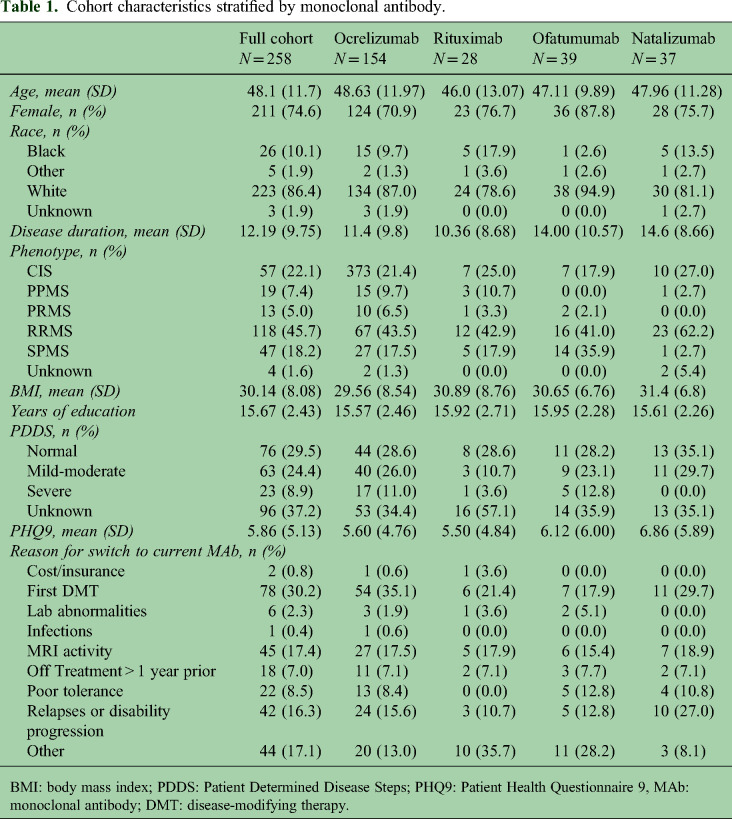
Methods: Patients receiving natalizumab, ocrelizumab, ofatumumab, or rituximab at a tertiary multiple sclerosis center were invited to take an online survey interrogating their monoclonal antibody experience. Additional history and patient characteristic data were collected. Logistic regression was used to determine if patient characteristics predicted the wearing-off effect and linear regression to evaluate the impact of the wearing-off effect on treatment satisfaction. The models were adjusted for age, disease duration, race, sex, body mass index, education, and depression as measured by the Patient Health Questionnaire-9.
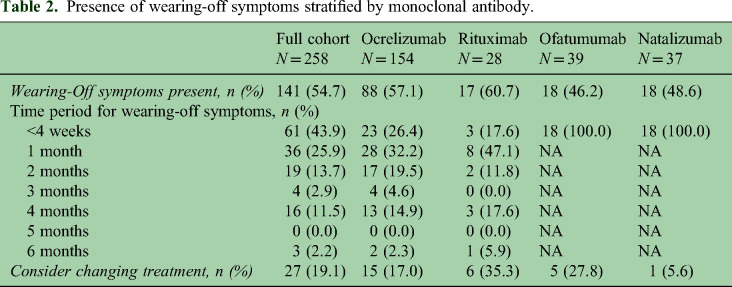
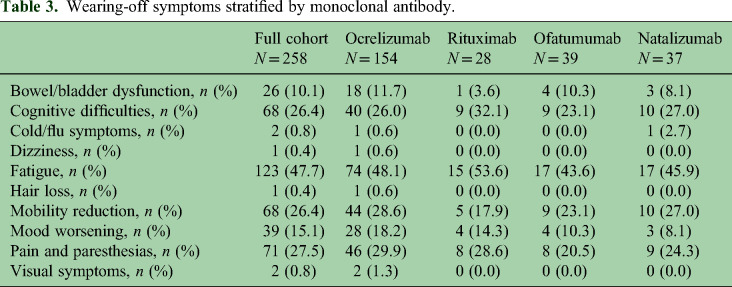
Results: We received 258 qualifying responses and 141 (54.7%) patients reported the wearing-off phenomenon. The most common symptom was fatigue (47.7%). Higher Patient Health Questionnaire-9 scores were significantly associated with the wearing-off phenomenon (OR = 1.02, p = 0.005). The wearing-off effect (β = -0.52, p = 0.04) and higher Patient Health Questionnaire-9 (β = -0.09, p < 0.01) scores were associated with significantly reduced treatment satisfaction.
Conclusion: The wearing-off phenomenon is common, associated with depression, and reduces treatment satisfaction. Research addressing mitigation strategies is needed.




 京公网安备 11010802042870号
京ICP备2023020795号-1
京公网安备 11010802042870号
京ICP备2023020795号-1

 分享
分享
 求助内容:
求助内容: 应助结果提醒方式:
 扫码关注我们
