{"title":"Measurement of Knee Extensor Torque During Repetitive Peripheral Magnetic Stimulation: Comparison of the Forces Induced by Different Stimulators.","authors":"Masanori Kamiue, Akio Tsubahara, Tomotaka Ito, Yasuhiro Koike","doi":"10.5535/arm.230025","DOIUrl":null,"url":null,"abstract":"<p><strong>Objective: </strong>To investigate the factors that induce strong contractions during repetitive peripheral magnetic stimulation (rPMS) and compare the muscle torque induced by two stimulators (Stim A and Stim B) with different coil properties.</p><p><strong>Methods: </strong>rPMS was applied to the right vastus lateralis of 30 healthy young adults. Stim A contained a 10.1 cm2 rectangular iron core coil, while Stim B contained a 191 cm2 round coil. The knee extensor torque (KET) induced by rPMS at 30 Hz was measured isometrically and divided by the maximum voluntary contraction (MVC) to obtain a relative value of MVC (%MVC). KET at 100% intensity of Stim A (A100%, 1.08 T) was compared to those at 100% or 70% intensity of Stim B (B100%, 1.47 T vs. B70%, 1.07 T). Additionally, we conducted a comprehensive literature search for studies that measured the KET during rPMS.</p><p><strong>Results: </strong>Both the mean values of %MVC using B100% and B70% were significantly greater than that using A100%. Furthermore, the KET induced by Stim B was found to be larger than that described in previous reports, unless booster units were used to directly stimulate the main trunk of the femoral nerve.</p><p><strong>Conclusion: </strong>Stim B induced a stronger muscle contraction force than Stim A did. This may be because the larger the coil area, the wider the area that can be stimulated. Additionally, a circular coil allows for deeper stimulation.</p>","PeriodicalId":47738,"journal":{"name":"Annals of Rehabilitation Medicine-ARM","volume":" ","pages":"203-210"},"PeriodicalIF":2.9000,"publicationDate":"2024-06-01","publicationTypes":"Journal Article","fieldsOfStudy":null,"isOpenAccess":false,"openAccessPdf":"https://www.ncbi.nlm.nih.gov/pmc/articles/PMC11217762/pdf/","citationCount":"0","resultStr":null,"platform":"Semanticscholar","paperid":null,"PeriodicalName":"Annals of Rehabilitation Medicine-ARM","FirstCategoryId":"1085","ListUrlMain":"https://doi.org/10.5535/arm.230025","RegionNum":0,"RegionCategory":null,"ArticlePicture":[],"TitleCN":null,"AbstractTextCN":null,"PMCID":null,"EPubDate":"2024/5/8 0:00:00","PubModel":"Epub","JCR":"Q1","JCRName":"REHABILITATION","Score":null,"Total":0}
引用次数: 0
Abstract
Objective: To investigate the factors that induce strong contractions during repetitive peripheral magnetic stimulation (rPMS) and compare the muscle torque induced by two stimulators (Stim A and Stim B) with different coil properties.
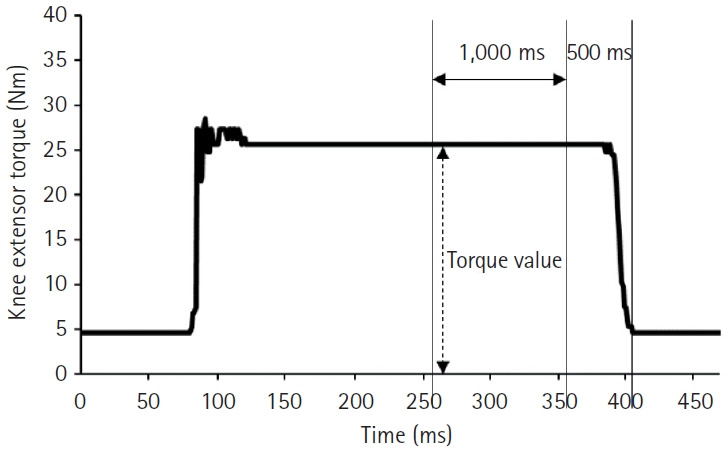
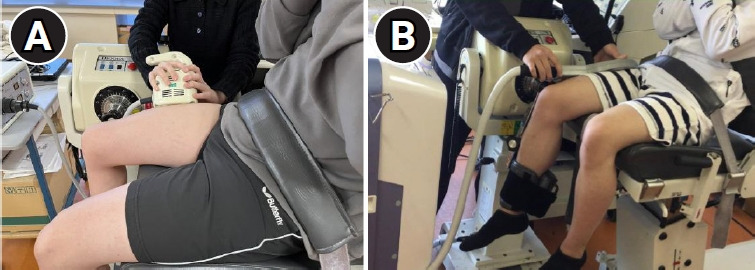
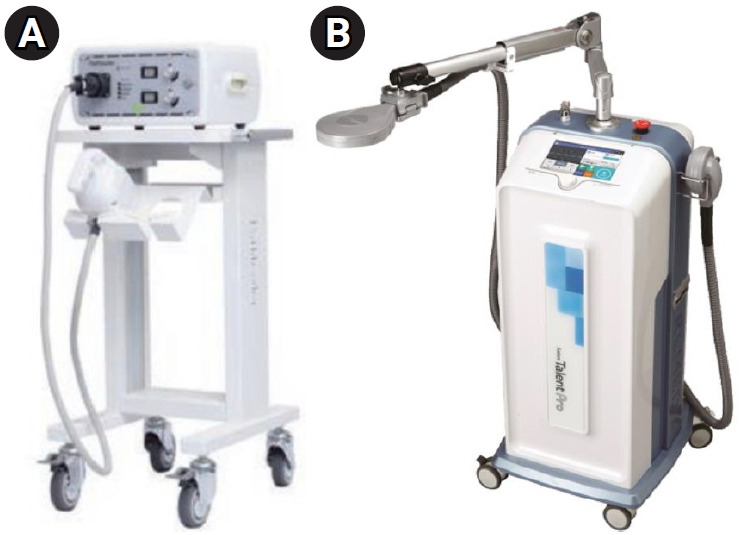
Methods: rPMS was applied to the right vastus lateralis of 30 healthy young adults. Stim A contained a 10.1 cm2 rectangular iron core coil, while Stim B contained a 191 cm2 round coil. The knee extensor torque (KET) induced by rPMS at 30 Hz was measured isometrically and divided by the maximum voluntary contraction (MVC) to obtain a relative value of MVC (%MVC). KET at 100% intensity of Stim A (A100%, 1.08 T) was compared to those at 100% or 70% intensity of Stim B (B100%, 1.47 T vs. B70%, 1.07 T). Additionally, we conducted a comprehensive literature search for studies that measured the KET during rPMS.
Results: Both the mean values of %MVC using B100% and B70% were significantly greater than that using A100%. Furthermore, the KET induced by Stim B was found to be larger than that described in previous reports, unless booster units were used to directly stimulate the main trunk of the femoral nerve.
Conclusion: Stim B induced a stronger muscle contraction force than Stim A did. This may be because the larger the coil area, the wider the area that can be stimulated. Additionally, a circular coil allows for deeper stimulation.
目的研究在重复性外周磁刺激(rPMS)过程中诱发强烈收缩的因素,并比较具有不同线圈特性的两种刺激器(刺激 A 和刺激 B)诱发的肌肉扭矩。Stim A 包含一个 10.1 平方厘米的矩形铁芯线圈,而 Stim B 包含一个 191 平方厘米的圆形线圈。以 30 Hz 的频率测量 rPMS 引起的膝关节伸肌扭矩(KET),并将其除以最大自主收缩力(MVC),得出 MVC 的相对值(%MVC)。将 100%强度刺激 A(A100%,1.08 T)下的 KET 与 100%或 70%强度刺激 B(B100%,1.47 T vs. B70%,1.07 T)下的 KET 进行比较。此外,我们还对测量 rPMS 期间 KET 的研究进行了全面的文献检索:结果:使用 B100% 和 B70% 时,%MVC 的平均值均明显高于使用 A100% 时。此外,除非使用增压器直接刺激股神经主干,否则发现刺激 B 诱导的 KET 比之前的报告中描述的要大:结论:刺激 B 比刺激 A 诱导的肌肉收缩力更强。这可能是因为线圈面积越大,可刺激的区域就越宽。此外,圆形线圈还能进行更深层次的刺激。




 京公网安备 11010802042870号
京ICP备2023020795号-1
京公网安备 11010802042870号
京ICP备2023020795号-1

 分享
分享
 求助内容:
求助内容: 应助结果提醒方式:
 扫码关注我们
