Adrián-Enrique Ortiz-Rojas , Ismaela Magliotto-Quevedo , Leonardo Guerra , Carlos Gaete-Morales , Paula Guerra , Camila Mery-Araya
{"title":"Comparison of the environmental impacts of heating systems in Chile by life cycle assessment","authors":"Adrián-Enrique Ortiz-Rojas , Ismaela Magliotto-Quevedo , Leonardo Guerra , Carlos Gaete-Morales , Paula Guerra , Camila Mery-Araya","doi":"10.1016/j.cesys.2024.100192","DOIUrl":null,"url":null,"abstract":"<div><p>The present study conducts a Life Cycle Assessment (LCA) to evaluate the environmental impacts of heating technologies commonly used in Chile based on six environmental indicators: Climate Change (CC), Human Toxicity (HT), Formation of Particulate Matter (PM), Formation of Photochemical Oxidants (PO), Ozone Destruction (OD), and Water Depletion (WD). Due to the extensive length of the territory studied, it is demonstrated that the environmental impacts depend on the geographical location where the heating equipment is used. Stoves that use wet firewood presented the highest environmental impact in CC, PM, HT, and PO. Using dry firewood could reduce pollution by 14%–81%, compared to wet firewood. Replacing wood heating with natural gas, LPG, and kerosene stoves reduces the CC and HT indicators. On the other hand, switching to electric heating, such as split inverter heat pumps, could transfer these impacts to areas where electricity is generated using coal. When the pellet is a byproduct of the forestry industry and transportation distances are not very high, the pellet stove stands out for its lower CC. In Magallanes, electric heating appears environmentally attractive due to using natural gas for electricity generation.</p></div>","PeriodicalId":34616,"journal":{"name":"Cleaner Environmental Systems","volume":"13 ","pages":"Article 100192"},"PeriodicalIF":4.9000,"publicationDate":"2024-04-29","publicationTypes":"Journal Article","fieldsOfStudy":null,"isOpenAccess":false,"openAccessPdf":"https://www.sciencedirect.com/science/article/pii/S2666789424000308/pdfft?md5=bd094b47f61269b5fb3dffe1cb2634f3&pid=1-s2.0-S2666789424000308-main.pdf","citationCount":"0","resultStr":null,"platform":"Semanticscholar","paperid":null,"PeriodicalName":"Cleaner Environmental Systems","FirstCategoryId":"1085","ListUrlMain":"https://www.sciencedirect.com/science/article/pii/S2666789424000308","RegionNum":0,"RegionCategory":null,"ArticlePicture":[],"TitleCN":null,"AbstractTextCN":null,"PMCID":null,"EPubDate":"","PubModel":"","JCR":"Q2","JCRName":"ENGINEERING, ENVIRONMENTAL","Score":null,"Total":0}
引用次数: 0
Abstract
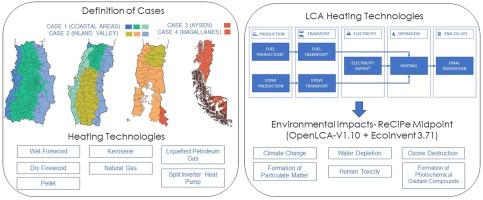
The present study conducts a Life Cycle Assessment (LCA) to evaluate the environmental impacts of heating technologies commonly used in Chile based on six environmental indicators: Climate Change (CC), Human Toxicity (HT), Formation of Particulate Matter (PM), Formation of Photochemical Oxidants (PO), Ozone Destruction (OD), and Water Depletion (WD). Due to the extensive length of the territory studied, it is demonstrated that the environmental impacts depend on the geographical location where the heating equipment is used. Stoves that use wet firewood presented the highest environmental impact in CC, PM, HT, and PO. Using dry firewood could reduce pollution by 14%–81%, compared to wet firewood. Replacing wood heating with natural gas, LPG, and kerosene stoves reduces the CC and HT indicators. On the other hand, switching to electric heating, such as split inverter heat pumps, could transfer these impacts to areas where electricity is generated using coal. When the pellet is a byproduct of the forestry industry and transportation distances are not very high, the pellet stove stands out for its lower CC. In Magallanes, electric heating appears environmentally attractive due to using natural gas for electricity generation.



 京公网安备 11010802042870号
京ICP备2023020795号-1
京公网安备 11010802042870号
京ICP备2023020795号-1

 分享
分享
 求助内容:
求助内容: 应助结果提醒方式:
 扫码关注我们
