{"title":"Simulation of the SARS-CoV-2 Virus Containing Aerosol Particles Spread Around a Hospital","authors":"N. A. Lapteva, A. S. Safatov, A. P. Agafonov","doi":"10.1134/S1024856023060118","DOIUrl":null,"url":null,"abstract":"<p>The new coronavirus pneumonia has rapidly spread around the world. The World Health Organization emphasized that the SARS-CoV-2 coronavirus spreads mainly between people who are in close contact with each other, as well as in the case of touching contaminated surfaces followed by touching the eyes, nose, or mouth without first cleaning the hands. Possible permanent sources of the spread of the virus can be gathering of patients in hospitals in the case of noncompliance with the requirements for organizing the functioning of a hospital. Meteorological conditions can be a key factor influencing the spread of the virus in the case of an accidental release of virus-containing aerosol from such a hospital. Simulations are carried out with modern methods for solving a system of differential equations of the atmospheric boundary layer, which are adapted to describe the distribution of harmful atmospheric impurities over a real complex terrain considering urban buildings of various heights, forests, reservoirs, changing meteorological conditions, and many other factors.</p>","PeriodicalId":46751,"journal":{"name":"Atmospheric and Oceanic Optics","volume":"36 6","pages":"779 - 784"},"PeriodicalIF":0.9000,"publicationDate":"2024-01-17","publicationTypes":"Journal Article","fieldsOfStudy":null,"isOpenAccess":false,"openAccessPdf":"","citationCount":"0","resultStr":null,"platform":"Semanticscholar","paperid":null,"PeriodicalName":"Atmospheric and Oceanic Optics","FirstCategoryId":"1085","ListUrlMain":"https://link.springer.com/article/10.1134/S1024856023060118","RegionNum":0,"RegionCategory":null,"ArticlePicture":[],"TitleCN":null,"AbstractTextCN":null,"PMCID":null,"EPubDate":"","PubModel":"","JCR":"Q4","JCRName":"OPTICS","Score":null,"Total":0}
引用次数: 0
Abstract
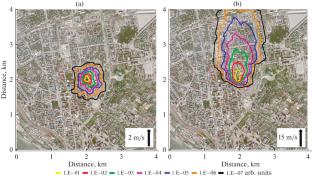
The new coronavirus pneumonia has rapidly spread around the world. The World Health Organization emphasized that the SARS-CoV-2 coronavirus spreads mainly between people who are in close contact with each other, as well as in the case of touching contaminated surfaces followed by touching the eyes, nose, or mouth without first cleaning the hands. Possible permanent sources of the spread of the virus can be gathering of patients in hospitals in the case of noncompliance with the requirements for organizing the functioning of a hospital. Meteorological conditions can be a key factor influencing the spread of the virus in the case of an accidental release of virus-containing aerosol from such a hospital. Simulations are carried out with modern methods for solving a system of differential equations of the atmospheric boundary layer, which are adapted to describe the distribution of harmful atmospheric impurities over a real complex terrain considering urban buildings of various heights, forests, reservoirs, changing meteorological conditions, and many other factors.
期刊介绍:
Atmospheric and Oceanic Optics is an international peer reviewed journal that presents experimental and theoretical articles relevant to a wide range of problems of atmospheric and oceanic optics, ecology, and climate. The journal coverage includes: scattering and transfer of optical waves, spectroscopy of atmospheric gases, turbulent and nonlinear optical phenomena, adaptive optics, remote (ground-based, airborne, and spaceborne) sensing of the atmosphere and the surface, methods for solving of inverse problems, new equipment for optical investigations, development of computer programs and databases for optical studies. Thematic issues are devoted to the studies of atmospheric ozone, adaptive, nonlinear, and coherent optics, regional climate and environmental monitoring, and other subjects.



 京公网安备 11010802042870号
京ICP备2023020795号-1
京公网安备 11010802042870号
京ICP备2023020795号-1

 分享
分享
 求助内容:
求助内容: 应助结果提醒方式:
 扫码关注我们
