Association of healthy lifestyle factors with the risk of hypertension, dyslipidemia, and their comorbidity in Korea: results from the Korea National Health and Nutrition Examination Survey 2019-2021.
{"title":"Association of healthy lifestyle factors with the risk of hypertension, dyslipidemia, and their comorbidity in Korea: results from the Korea National Health and Nutrition Examination Survey 2019-2021.","authors":"Ji-Sook Kong, Mi Kyung Kim","doi":"10.4178/epih.e2024049","DOIUrl":null,"url":null,"abstract":"<p><strong>Objectives: </strong>We investigated the association of individual healthy lifestyle factors (HLFs) and their combined healthy lifestyle score (HLS) with hypertension and/or dyslipidemia.</p><p><strong>Methods: </strong>We analyzed data from 10,693 adults aged ≥19 from the 2019 to 2021 Korea National Health and Nutrition Examination Survey. HLS was evaluated based on smoking status, alcohol consumption, body mass index (BMI), diet, and physical activity. Using logistic regression models, we estimated odds ratios (ORs) with 95% confidence intervals (CIs) to evaluate the associations of HLFs and HLS with hypertension, dyslipidemia, and their comorbidity.</p><p><strong>Results: </strong>The prevalence of hypertension alone, dyslipidemia alone, and their comorbidity was 8.7%, 24.6%, and 15.0%, respectively. Multivariable models showed an inverse association of hypertension (OR, 0.37; 95% CI, 0.30 to 0.46) and dyslipidemia (OR, 0.36; 95% CI, 0.32 to 0.41) with healthy BMI. Hypertension was inversely associated with healthy alcohol consumption (OR, 0.46; 95% CI, 0.35 to 0.61) and diet (OR, 0.79; 95% CI, 0.63 to 0.99), whereas dyslipidemia was inversely associated with non-smoking (OR, 0.51; 95% CI, 0.43 to 0.60). Physical activity was inversely associated with their comorbidity (OR, 0.69; 95% CI, 0.56 to 0.85). Adherence to HLS was associated with significantly lower odds of hypertension (81%), dyslipidemia (66%), and their conditions (89%) (all ptrend<0.001). Stratified analyses consistently showed inverse associations between HLS and hypertension and/or dyslipidemia independently of demographic factors (pinteractions>0.05).</p><p><strong>Conclusions: </strong>HLFs were associated with lower risk for hypertension and/or dyslipidemia. Obesity may contribute significantly to the risk of these conditions, while relevant HLFs for individual chronic diseases may vary significantly.</p>","PeriodicalId":48543,"journal":{"name":"Epidemiology and Health","volume":" ","pages":"e2024049"},"PeriodicalIF":2.2000,"publicationDate":"2024-01-01","publicationTypes":"Journal Article","fieldsOfStudy":null,"isOpenAccess":false,"openAccessPdf":"https://www.ncbi.nlm.nih.gov/pmc/articles/PMC11417455/pdf/","citationCount":"0","resultStr":null,"platform":"Semanticscholar","paperid":null,"PeriodicalName":"Epidemiology and Health","FirstCategoryId":"3","ListUrlMain":"https://doi.org/10.4178/epih.e2024049","RegionNum":4,"RegionCategory":"医学","ArticlePicture":[],"TitleCN":null,"AbstractTextCN":null,"PMCID":null,"EPubDate":"2024/5/1 0:00:00","PubModel":"Epub","JCR":"Q2","JCRName":"PUBLIC, ENVIRONMENTAL & OCCUPATIONAL HEALTH","Score":null,"Total":0}
引用次数: 0
Abstract
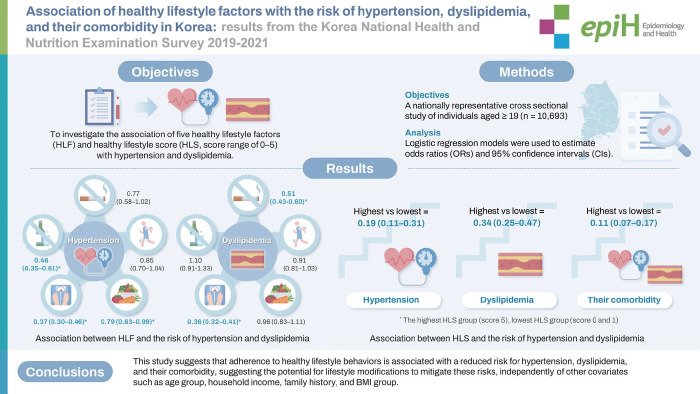
Objectives: We investigated the association of individual healthy lifestyle factors (HLFs) and their combined healthy lifestyle score (HLS) with hypertension and/or dyslipidemia.
Methods: We analyzed data from 10,693 adults aged ≥19 from the 2019 to 2021 Korea National Health and Nutrition Examination Survey. HLS was evaluated based on smoking status, alcohol consumption, body mass index (BMI), diet, and physical activity. Using logistic regression models, we estimated odds ratios (ORs) with 95% confidence intervals (CIs) to evaluate the associations of HLFs and HLS with hypertension, dyslipidemia, and their comorbidity.
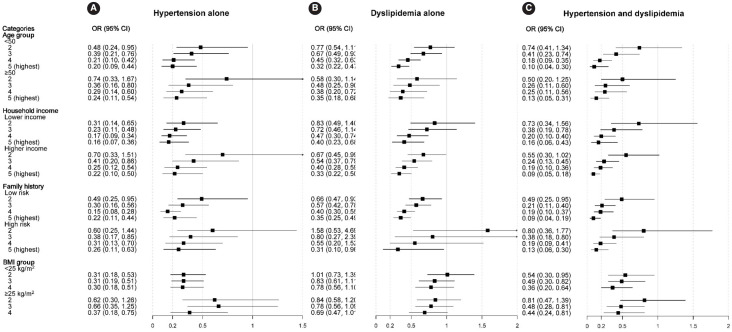
Results: The prevalence of hypertension alone, dyslipidemia alone, and their comorbidity was 8.7%, 24.6%, and 15.0%, respectively. Multivariable models showed an inverse association of hypertension (OR, 0.37; 95% CI, 0.30 to 0.46) and dyslipidemia (OR, 0.36; 95% CI, 0.32 to 0.41) with healthy BMI. Hypertension was inversely associated with healthy alcohol consumption (OR, 0.46; 95% CI, 0.35 to 0.61) and diet (OR, 0.79; 95% CI, 0.63 to 0.99), whereas dyslipidemia was inversely associated with non-smoking (OR, 0.51; 95% CI, 0.43 to 0.60). Physical activity was inversely associated with their comorbidity (OR, 0.69; 95% CI, 0.56 to 0.85). Adherence to HLS was associated with significantly lower odds of hypertension (81%), dyslipidemia (66%), and their conditions (89%) (all ptrend<0.001). Stratified analyses consistently showed inverse associations between HLS and hypertension and/or dyslipidemia independently of demographic factors (pinteractions>0.05).
Conclusions: HLFs were associated with lower risk for hypertension and/or dyslipidemia. Obesity may contribute significantly to the risk of these conditions, while relevant HLFs for individual chronic diseases may vary significantly.
期刊介绍:
Epidemiology and Health (epiH) is an electronic journal publishing papers in all areas of epidemiology and public health. It is indexed on PubMed Central and the scope is wide-ranging: including descriptive, analytical and molecular epidemiology; primary preventive measures; screening approaches and secondary prevention; clinical epidemiology; and all aspects of communicable and non-communicable diseases prevention. The epiH publishes original research, and also welcomes review articles and meta-analyses, cohort profiles and data profiles, epidemic and case investigations, descriptions and applications of new methods, and discussions of research theory or public health policy. We give special consideration to papers from developing countries.



 京公网安备 11010802042870号
京ICP备2023020795号-1
京公网安备 11010802042870号
京ICP备2023020795号-1

 分享
分享
 求助内容:
求助内容: 应助结果提醒方式:
 扫码关注我们
