Axel M. Orban, Johanna Eichberg, Michael Marner, Sandra Breuer, Maria A. Patras, Ute Mettal, Till F. Schäberle, Martin Rühl
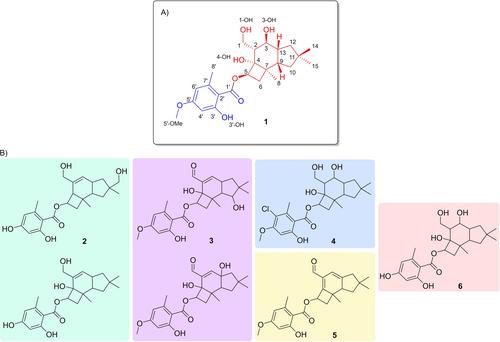
{"title":"5’-Methoxyarmillane, a Bioactive Sesquiterpenoid Aryl Ester from the Fungus Armillaria ostoyae","authors":"Axel M. Orban, Johanna Eichberg, Michael Marner, Sandra Breuer, Maria A. Patras, Ute Mettal, Till F. Schäberle, Martin Rühl","doi":"10.1002/cbic.202400168","DOIUrl":null,"url":null,"abstract":"<p>Higher fungi of the genus <i>Armillaria</i> belonging to the phylum Basidiomycota produce bioactive sesquiterpenoid aryl esters called melleolides. A bioactivity-guided discovery process led to the identification of the new melleolide 5’-methoxyarmillane (<b>1</b>) in organic extracts from the mycelium of <i>Armillaria ostoyae</i>. Remarkably, supplementation of rapeseed oil to the culture medium potato dextrose broth increased the production of <b>1</b> by a factor of six during the course of the 35 days fermentation. Compound <b>1</b> was isolated and its structure elucidated by UHPLC-QTOF-HR-MS/MS and NMR spectroscopy. It showed toxicity against Madin-Darby canine kidney II (MDCK II, IC<sub>50</sub> 19.2 μg/mL, 44.1 μM) and human lung cancer Calu-3 cells (IC<sub>50</sub> 15.2 μg/mL, 34.9 μM) as well as moderate bioactivity against <i>Mycobacterium tuberculosis</i> (MIC 8 mg/mL, 18.4 μM) and <i>Mycobacterium smegmatis</i> (MIC 16 mg/mL, 36.8 μM), but not against <i>Staphylococcus aureus</i>, <i>Escherichia coli</i>, <i>Candida albicans</i>, and <i>Septoria tritici</i>. No inhibitory effects of <b>1</b> against the influenza viruses H3N2, H1N1pdm, B/Malaysia, and B/Massachusetts were observed.</p>","PeriodicalId":140,"journal":{"name":"ChemBioChem","volume":"25 21","pages":""},"PeriodicalIF":2.8000,"publicationDate":"2024-05-13","publicationTypes":"Journal Article","fieldsOfStudy":null,"isOpenAccess":false,"openAccessPdf":"https://onlinelibrary.wiley.com/doi/epdf/10.1002/cbic.202400168","citationCount":"0","resultStr":null,"platform":"Semanticscholar","paperid":null,"PeriodicalName":"ChemBioChem","FirstCategoryId":"99","ListUrlMain":"https://chemistry-europe.onlinelibrary.wiley.com/doi/10.1002/cbic.202400168","RegionNum":4,"RegionCategory":"生物学","ArticlePicture":[],"TitleCN":null,"AbstractTextCN":null,"PMCID":null,"EPubDate":"","PubModel":"","JCR":"Q3","JCRName":"BIOCHEMISTRY & MOLECULAR BIOLOGY","Score":null,"Total":0}
引用次数: 0
Abstract
Higher fungi of the genus Armillaria belonging to the phylum Basidiomycota produce bioactive sesquiterpenoid aryl esters called melleolides. A bioactivity-guided discovery process led to the identification of the new melleolide 5’-methoxyarmillane (1) in organic extracts from the mycelium of Armillaria ostoyae. Remarkably, supplementation of rapeseed oil to the culture medium potato dextrose broth increased the production of 1 by a factor of six during the course of the 35 days fermentation. Compound 1 was isolated and its structure elucidated by UHPLC-QTOF-HR-MS/MS and NMR spectroscopy. It showed toxicity against Madin-Darby canine kidney II (MDCK II, IC50 19.2 μg/mL, 44.1 μM) and human lung cancer Calu-3 cells (IC50 15.2 μg/mL, 34.9 μM) as well as moderate bioactivity against Mycobacterium tuberculosis (MIC 8 mg/mL, 18.4 μM) and Mycobacterium smegmatis (MIC 16 mg/mL, 36.8 μM), but not against Staphylococcus aureus, Escherichia coli, Candida albicans, and Septoria tritici. No inhibitory effects of 1 against the influenza viruses H3N2, H1N1pdm, B/Malaysia, and B/Massachusetts were observed.
期刊介绍:
ChemBioChem (Impact Factor 2018: 2.641) publishes important breakthroughs across all areas at the interface of chemistry and biology, including the fields of chemical biology, bioorganic chemistry, bioinorganic chemistry, synthetic biology, biocatalysis, bionanotechnology, and biomaterials. It is published on behalf of Chemistry Europe, an association of 16 European chemical societies, and supported by the Asian Chemical Editorial Society (ACES).





 京公网安备 11010802042870号
京ICP备2023020795号-1
京公网安备 11010802042870号
京ICP备2023020795号-1

 分享
分享
 求助内容:
求助内容: 应助结果提醒方式:
 扫码关注我们
